
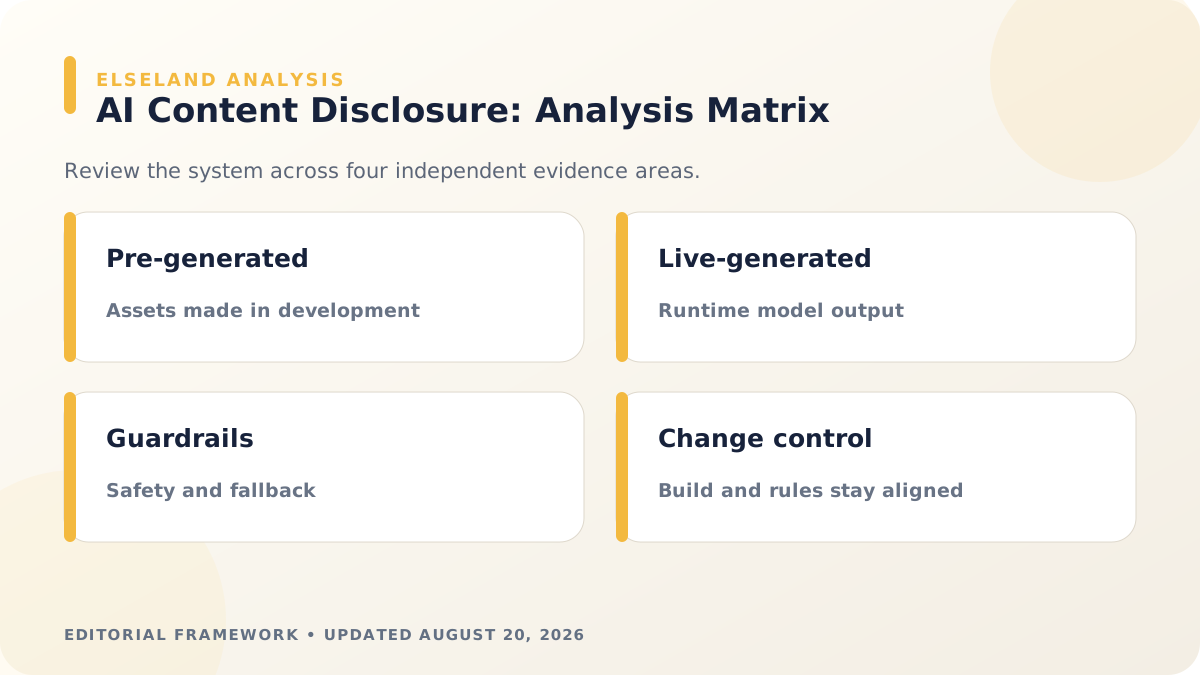
Steam's current content survey asks developers to describe AI use and distinguishes pre-generated content from live-generated content. That distinction changes the evidence a team needs: an AI-assisted texture workflow and an in-game dialogue generator do not create the same release risk.
Start the disclosure process before QA. The AI game QA checklist connects provenance and safety records to gameplay, accessibility, performance, discovery, and rollback checks.
Quick read
Key takeaways
- Separate pre-generated content from live-generated content in the production inventory.
- For every AI-assisted asset or system, record model, date, inputs, rights, human edits, and where it appears.
- Live-generated systems need documented guardrails, failure behavior, logging, and player-facing reporting where required.
- Keep store-page claims, the submitted survey, and the reviewed shipping build consistent.
1. Build an AI Use Inventory
List every tool or model used for code, text, image, audio, video, 3D assets, animation, level drafts, moderation, and live interaction. Record where the output appears and whether it ships directly, is substantially edited, or only informed human work.
For each entry, store provider and model, generation date, product surface or API, prompt or workflow, source references, licenses, output, human edits, approver, and linked build or asset identifier.
2. Review Pre-Generated Content
Steam describes pre-generated content as material created with AI tools during development. Confirm that the content is not illegal or infringing, matches the description submitted to the platform, and has passed the same player-facing QA as manually produced content.
Do not use the label AI-assisted to avoid inventory detail. Review recognizable brands, characters, artists, performers, personal data, and training or reference assets according to applicable rights and policies.
3. Document Live-Generated Systems and Guardrails
For content generated while the game is running, describe what the system creates, what players can input, what model or service is involved, which blocked categories apply, how moderation works, and what safe fallback appears on timeout or refusal.
Test adversarial prompts, repeated attempts, multilingual input, indirect prompt injection where relevant, network failure, model unavailability, and logging. Assign a human owner for incident review and guardrail changes.
4. Align Survey, Store Page, and Shipping Build
The submitted description should match the actual reviewed build. If a live feature is disabled, added, or materially changed, re-check the disclosure and store claims before release.
Maintain a release snapshot that links the AI inventory, QA evidence, approved disclosure text, known limitations, and build identifier. This supports review and later updates.
5. Use a Release-Ready Evidence Pack
After approval, verify the same release path a player sees: public page, game category, app entry, metadata, and the playable build. Elseland's game library is an example of that discovery layer.
- AI use inventory with pre-generated/live-generated classification
- Source, rights, prompt, output, and human-edit records
- Guardrail and adversarial test results for live systems
- Player reporting, incident response, monitoring, and fallback procedures
- Approved survey text and store-page claims
- Final build ID, human approver, and rollback plan
Worked Example: Classify a Mixed AI-Assisted Game
Imagine a game with AI-assisted concept art refined by artists, generated background textures, developer code suggestions, and an in-game dialogue system that responds to player text. Inventory each workflow separately. The first three are pre-generated development uses; the runtime dialogue is a live-generated system with different guardrail, logging, fallback, and player-reporting evidence.
Connect every inventory row to the exact asset or feature, provider and model, date, source inputs and rights, human edits, reviewer, disclosure wording, and build. If a feature is removed or disabled before release, update both the inventory and submitted description so the evidence matches the shipping product.
| AI use | Classification | Evidence |
|---|---|---|
| Concept thumbnails | Pre-generated, not shipped directly | Workflow notes and artist review |
| Background textures | Pre-generated, shipped after edits | Sources, prompt, edits, asset IDs |
| Code suggestions | Pre-generated development use | Repository review and testing |
| Runtime dialogue | Live-generated | Guardrails, logs, fallback, reporting |
| Store description | Release representation | Approved survey text and build mapping |
Maintain a Disclosure Control Loop
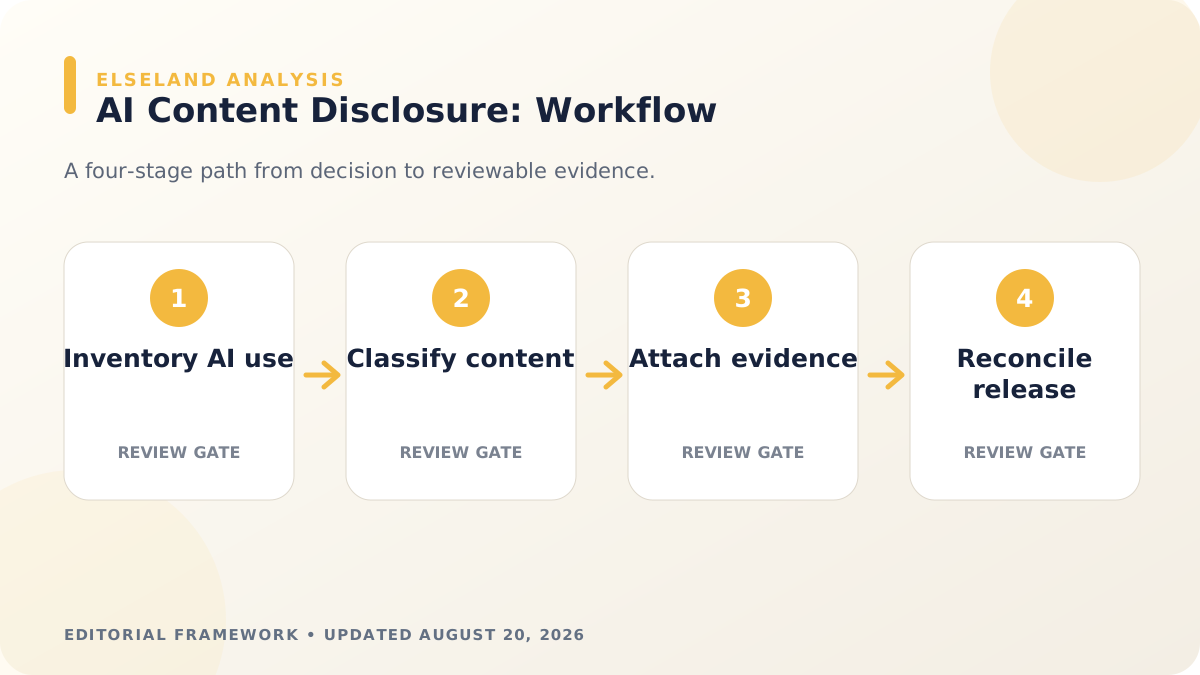
Discovery identifies AI use; classification separates pre-generated and live-generated behavior; evidence captures rights, process, and safeguards; review compares evidence with current platform rules; submission records approved wording; change control reopens the loop whenever the build or rule changes.
Assign one release owner who can see art, engineering, legal or policy review, store operations, and incident planning. Disclosure fails when each discipline assumes another team has the complete inventory.
- Discover every model, service, plugin, and generated asset or system.
- Classify shipped, substantially edited, reference-only, and live-generated uses.
- Attach provenance, rights review, safety tests, fallback, and approver evidence.
- Reconcile survey wording, store claims, player disclosures, and exact build.
- Reopen review after feature, model, prompt, provider, or platform-rule changes.
Resolve Common Steam Disclosure Gaps
The most common gaps are untracked experiments that reached production, assets without source records, live features described as pre-generated, guardrails documented in theory but not tested, and store wording that no longer matches the build.
Steam's content survey is the primary source for its current categories and expectations. As of August 20, 2026, teams should verify that page again before submission because platform language can change. C2PA provenance can complement internal records but does not replace review or disclosure.
| Symptom | Likely cause | Next check |
|---|---|---|
| Tool used but no output shipped | Unclear whether it belongs in inventory | Record workflow and explain disposition |
| Asset heavily edited | Team assumes AI use disappeared | Keep origin and human-edit record |
| Live feature has moderation only | No timeout or refusal recovery | Add and test safe fallback |
| Survey and build disagree | Feature changed after approval | Reconcile before submission |
| No incident owner | Guardrail failures cannot be handled | Assign monitoring, response, disable path |
Steam Submission Evidence Checklist
Treat the following as an operational drafting checklist, not legal advice. Storefront rules, provider terms, regional laws, and the shipped implementation all matter; use qualified counsel when legal interpretation is required.
Keep the evidence pack after launch. Updates can add models, prompts, assets, languages, or generation paths that change the disclosure and risk profile even when the feature name stays the same.
- Complete AI inventory covers art, code, audio, text, video, 3D, animation, moderation, and runtime generation.
- Every shipped pre-generated asset has origin, rights, human-edit, review, and build records.
- Every live system has input boundaries, guardrails, adversarial tests, logging, reporting, fallback, and an owner.
- Current survey wording, store page, player messaging, and release build agree.
- Provider, model, prompt, moderation, and feature changes trigger re-review.
- Monitoring, incident response, feature disable, rollback, and evidence retention are documented.
What the Primary Sources Establish About AI Game Content Disclosure
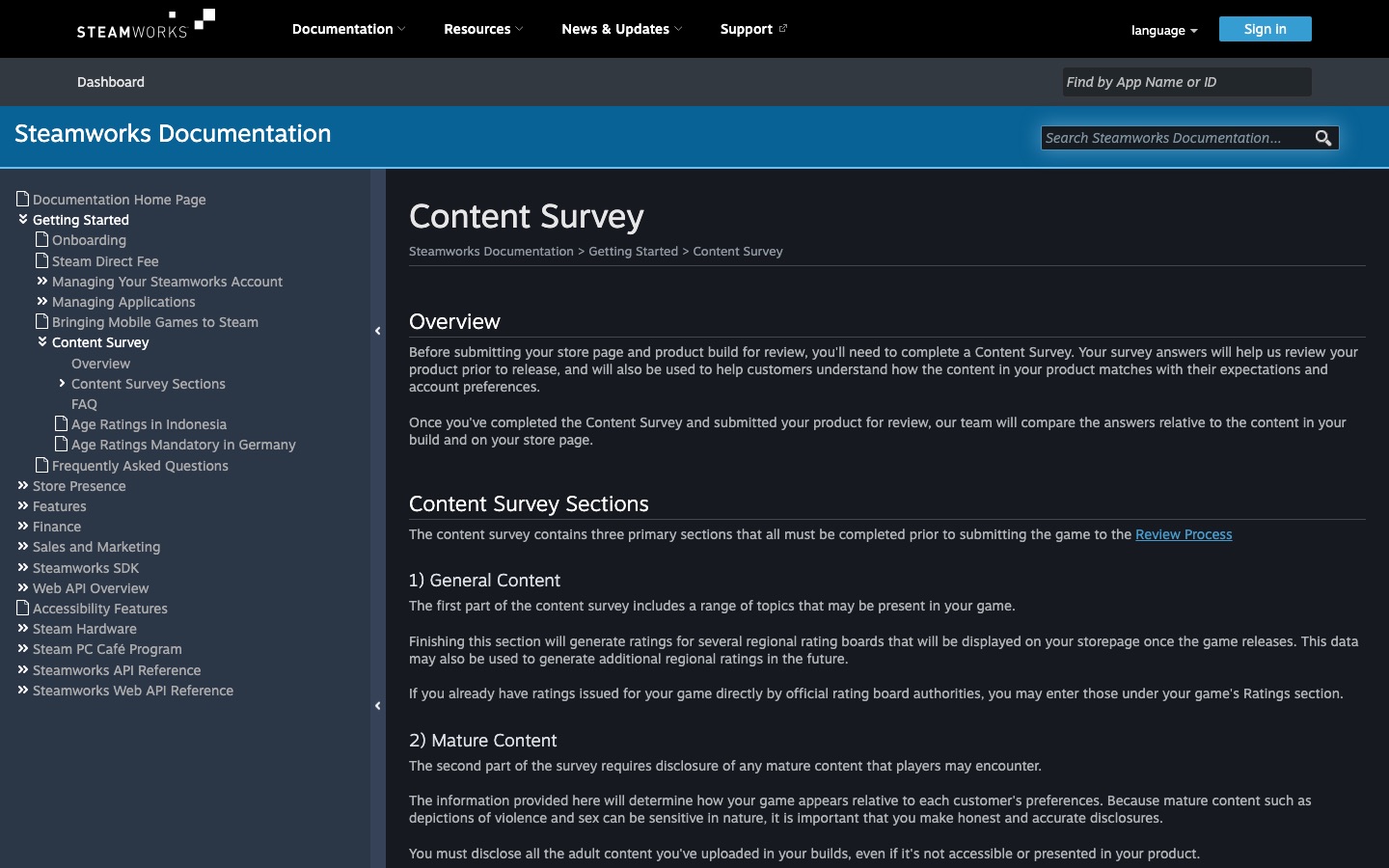
Our evidence baseline starts with the Steamworks content survey, accessed August 20, 2026. We use it to establish documented behavior, terminology, or constraints—not to claim that the source endorses Elseland's workflow or conclusions. The practical artifact under review is a release-linked inventory of AI use, source and rights records, human edits, guardrail tests, approved wording, and build identity.
That distinction is central to E-E-A-T. A first-party page can establish what a format, tool, platform, model, or game team publicly documents. It cannot prove that a particular asset is fast, accessible, legally cleared, fun, or production-ready. Those conclusions require separate observation, measurement, specialist review, or player evidence tied to the actual project.
For this topic, the decision is whether the Steam disclosure accurately describes the reviewed shipping product. The following observations turn the official reference into a reviewable production record rather than a decorative citation:
| Evidence layer | What it can support | What it cannot support alone |
|---|---|---|
| Official source | Documented feature, rule, format, or published design context | Project-specific quality or universal performance |
| Project measurement | Observed behavior in a named build, scene, device, or sample | Unmeasured platforms or future versions |
| Human review | Usability, visual, editorial, and production judgment | Legal certainty or population-level player behavior |
| Release record | Who approved what, when, with which evidence | Permanent compliance after inputs or rules change |
- 1. classify pre-generated development content separately from live-generated runtime output. Store the result with the asset or build identifier so another reviewer can reproduce the conclusion.
- 2. connect every use to provider, model, inputs, assets, edits, and location. Store the result with the asset or build identifier so another reviewer can reproduce the conclusion.
- 3. document live-system input controls, blocked content, logging, fallback, and reporting. Store the result with the asset or build identifier so another reviewer can reproduce the conclusion.
- 4. reconcile the survey, store language, public notices, and final build. Store the result with the asset or build identifier so another reviewer can reproduce the conclusion.
A Field Review Protocol for AI Game Content Disclosure
Use this protocol after the first plausible output exists and before scaling the workflow. Keep one untouched baseline, one candidate revision, and one deliberately stressed case. The stressed case should expose the topic's likely failure mode—crowded scenes, extreme poses, small-screen play, unusual inputs, or a release-rule change—rather than merely repeat the easiest success case.
Run the review in the real delivery context whenever possible. Capture the tool or model version, source files, settings, target device or engine, date, and reviewer. If the work depends on a changing external service, record the response or exported artifact instead of assuming the same output can be recreated later.
A useful review ends with a decision and a next action. “Looks good” is not a gate. State whether the candidate passes, passes with a bounded exception, needs revision, or should be rejected; identify the evidence behind that status and the owner of the next check.
| Review status | Meaning | Required next action |
|---|---|---|
| Pass | All defined visual, technical, and release gates are supported by evidence | Freeze the reviewed artifact and link it to the build |
| Conditional pass | A known limitation is bounded and does not invalidate the intended use | Document the exception, owner, and trigger for re-review |
| Revise | The direction is viable but one or more gates remain unsupported | Change one controlled variable and repeat the affected checks |
| Reject | The candidate conflicts with the intended use, evidence, rights, safety, or budget | Preserve the record and choose a different approach |
- inventory code, text, image, audio, video, 3D, animation, and live systems. Record the expected result before the check, then attach the observed result and any exception after it.
- record provenance and rights questions without assuming human edits erase origin. Record the expected result before the check, then attach the observed result and any exception after it.
- test guardrails adversarially across languages and indirect input. Record the expected result before the check, then attach the observed result and any exception after it.
- assign owners for monitoring, incidents, policy changes, and shutdown. Record the expected result before the check, then attach the observed result and any exception after it.
- review the exact submission wording with the exact release candidate. Record the expected result before the check, then attach the observed result and any exception after it.
- reopen review when model, provider, prompt, feature, or platform rules change. Record the expected result before the check, then attach the observed result and any exception after it.
Expert Interpretation and Limits of This AI Game Creation Guide
The strongest conclusion this guide can support is a conditional production recommendation: use the workflow when its documented assumptions match the project, and keep the evidence needed to revisit the decision. We do not infer universal model quality, player preference, legal clearance, or performance from an official screenshot, a provider example, or a single successful asset.
Experience matters here because ai game content disclosure crosses creative judgment and implementation detail. The practical review should include the people who will edit the source, integrate the result, test it in play, maintain it after release, and answer rights or policy questions. A narrow expert handoff often misses problems that appear only when those responsibilities meet.
Before publishing or shipping, repeat time-sensitive checks against the current source and exact build. Preserve dated evidence, disclose the evaluation method, and distinguish measured results from editorial inference. That record is more valuable than a confident conclusion that future reviewers cannot reproduce.
| Claim type | Editorial treatment |
|---|---|
| Documented fact | Link to Steamworks content survey and include the access date |
| Observed project result | Name the build, environment, sample, and method |
| Expert judgment | State the criteria, reviewer role, and tradeoff |
| Inference or forecast | Label it explicitly and describe what evidence could change it |
- This operational checklist is not legal advice.
- Steam's current survey language can change and must be rechecked before submission.
- Technical provenance standards can complement but not replace platform disclosure.
- A complete inventory does not by itself establish copyright, privacy, or regulatory compliance.
Frequently asked questions
Does Steam require developers to disclose AI-generated content?
Steam's current content survey asks developers to describe AI use and separates pre-generated from live-generated content. Verify the latest Steamworks page before submission.
What is pre-generated AI content?
Steam uses the category for content created with AI tools during development, such as art, code, audio, or other material that is included in the game.
What is live-generated AI content?
It is content created by AI while the game is running. Steam asks for information about the guardrails used to prevent illegal content.
Is this checklist legal advice?
No. It is an operational drafting checklist based on current platform documentation. Consult qualified counsel for legal questions and re-check rules before release.
Should AI-assisted code be included in a release inventory?
Yes, record the workflow so the team can review ownership, licenses, security, and the resulting shipped code. The exact platform disclosure treatment should be checked against current rules and the actual use rather than assumed from this checklist.
Does substantial human editing remove the need to track AI origin?
No. Human editing may change the risk and final authorship contribution, but provenance remains useful for rights review, disclosure, reproducibility, and future updates. Record both the generated source and the human transformation.
What evidence should a live-generation guardrail include?
Document policy scope, input and output controls, adversarial tests, false-positive review, timeouts, refusals, safe fallback, logging, player reporting, monitoring, incident ownership, and the feature-disable path.
When should a Steam AI disclosure be updated?
Re-check it when the shipping build, generated content category, provider, model, prompt behavior, moderation, player input, store wording, or Steam's rules change. Tie review to release change control rather than relying on calendar reminders alone.
Sources and further reading
- Steamworks content survey
Primary current source for Steam's pre-generated and live-generated AI content survey requirements.
- Steamworks rules and guidelines
Official developer onboarding context for preparing and releasing products on Steam.
- C2PA specifications
Technical provenance standard that can complement, but not replace, an internal asset and approval record.
Next step