

C2PA for AI game assets is useful only when it improves a result the player can see, understand, and control. C2PA specification 2.4, published in April 2026, added format and assertion updates including a JSON representation for evaluation and validation reporting. The standard can support provenance across media workflows, while practical game pipelines must also handle metadata loss and non-C2PA formats.
This guide is designed for game artists, technical artists, producers, legal and policy reviewers, and teams shipping AI-assisted assets. It connects the current topic to the practical AI-generated game content disclosure checklist, giving readers a way to compare a public launch or known game-design pattern with a broader production workflow.
Elseland connects this editorial analysis with playable browser examples. The article uses first-party documentation for time-sensitive facts and names well-known games only as public design cases. Where no controlled Elseland test exists, the text says so. Recommendations are conditional on the target build, audience, performance budget, safety requirements, and current platform rules.
Quick read
Key takeaways
- C2PA records provenance assertions; it does not prove copyright ownership, quality, safety, or storefront compliance by itself.
- Keep a human-readable asset manifest even when embedded credentials are available.
- Track ingredients and edits across concept art, textures, audio, video, and promotional exports.
- Verify credentials after optimization and packaging because metadata can be removed or separated from the shipped file.
Define What C2PA Can and Cannot Prove
Start with the player-visible decision, not the novelty of the technology. A Content Credential can bind signed assertions about an asset's origin, ingredients, and actions to a verifiable manifest, helping readers inspect a recorded history. This framing keeps the section useful after launch-week excitement fades, because the reader can evaluate the same decision against a later model, engine version, browser, or platform rule.
The C2PA 2.4 specification provides the primary evidence for this part of the guide. It establishes the documented feature or public design context; it does not prove universal quality, player preference, production readiness, or an endorsement of Elseland. Read the C2PA 2.4 specification alongside the dated notes in this article before relying on the claim in a shipping decision.
A practical implementation begins with a written contract for inputs, outputs, failure states, and approval. Write separate fields for provenance, rights basis, creative approval, technical approval, safety review, and platform disclosure so no one treats one credential as universal clearance. The related AI-generated game content disclosure checklist offers a second Elseland perspective on the workflow, so teams can move from the current topic into a concrete production or play context without treating this page as an isolated answer.
The main failure mode is easy to understate: Teams may describe a valid credential as proof that an asset is authentic, owned, unbiased, safe, or legally usable when the standard records claims rather than adjudicating them. Record the expected result before the test, capture what actually happened, and decide whether the gap is acceptable, fixable, or large enough to reject the approach. A polished output without that record is a demo; a reviewed output with a reproducible decision can become production evidence.
- Define the expected credential validity result before generating or integrating anything.
- Save the exact input, version, settings, output, and build where the decision was reviewed.
- Test one normal case, one boundary case, and one deliberate failure case.
- Assign a named owner for revision, approval, and re-checking after a tool or platform update.
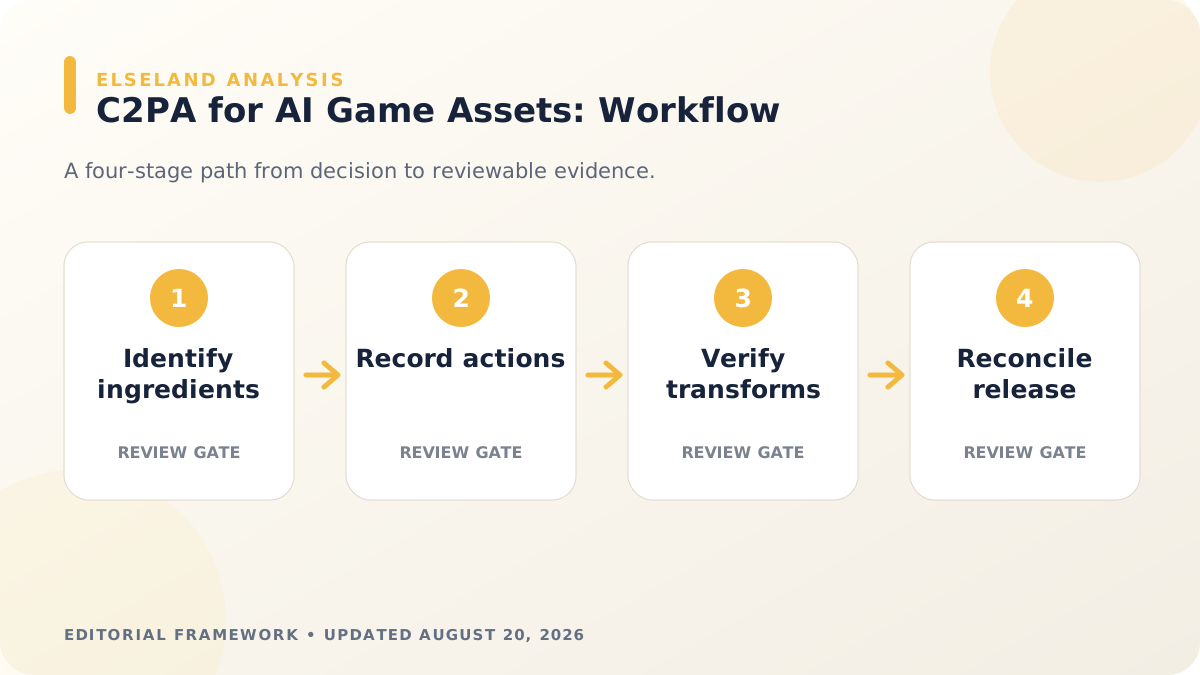
Record Ingredients Across the Game-Asset Chain
The useful question is not whether the feature looks impressive in a demonstration, but whether a team can control it in production. A final texture, sprite, audio clip, trailer, or concept sheet may contain generated material, licensed references, human paintover, procedural output, and later transformations. This framing keeps the section useful after launch-week excitement fades, because the reader can evaluate the same decision against a later model, engine version, browser, or platform rule.
The C2PA implementation guidance provides the primary evidence for this part of the guide. It establishes the documented feature or public design context; it does not prove universal quality, player preference, production readiness, or an endorsement of Elseland. Read the C2PA implementation guidance alongside the dated notes in this article before relying on the claim in a shipping decision.
Build one narrow vertical slice before expanding the workflow across a full game or content library. Assign stable asset identifiers and record every material ingredient, source, provider, model, date, prompt or input, contributor, edit, and intended use. To keep the recommendation grounded in playable interactions, the AI game platform collection lets readers compare how current examples communicate goals, state changes, feedback, and recovery instead of judging the idea from a static demo alone.
The main failure mode is easy to understate: A final export can hide the composite nature of the work, causing later teams to reuse one element outside the scope of its rights or disclosure record. Record the expected result before the test, capture what actually happened, and decide whether the gap is acceptable, fixable, or large enough to reject the approach. A polished output without that record is a demo; a reviewed output with a reproducible decision can become production evidence.
- Define the expected pipeline continuity result before generating or integrating anything.
- Save the exact input, version, settings, output, and build where the decision was reviewed.
- Test one normal case, one boundary case, and one deliberate failure case.
- Assign a named owner for revision, approval, and re-checking after a tool or platform update.
Describe AI Generation and Human Edits Precisely
Treat the public example as evidence of a capability boundary, then translate that boundary into a game-design requirement. Provenance is more useful when action labels distinguish creation, opening, editing, compositing, format conversion, and export instead of collapsing the history into 'AI-generated.' This framing keeps the section useful after launch-week excitement fades, because the reader can evaluate the same decision against a later model, engine version, browser, or platform rule.
The OpenAI content provenance update provides the primary evidence for this part of the guide. It establishes the documented feature or public design context; it does not prove universal quality, player preference, production readiness, or an endorsement of Elseland. Read the OpenAI content provenance update alongside the dated notes in this article before relying on the claim in a shipping decision.
Make the review gate observable: another developer should be able to reproduce the result from the saved build and source record. Capture the generated baseline, accepted candidate, substantive human changes, tool versions, and approval rationale so an editor can understand the creative contribution and decision path. The related Elseland game library offers a second Elseland perspective on the workflow, so teams can move from the current topic into a concrete production or play context without treating this page as an isolated answer.
The main failure mode is easy to understate: A binary AI label can obscure extensive human work or, in the opposite direction, hide a generated core behind a minor manual adjustment. Record the expected result before the test, capture what actually happened, and decide whether the gap is acceptable, fixable, or large enough to reject the approach. A polished output without that record is a demo; a reviewed output with a reproducible decision can become production evidence.
- Define the expected editorial meaning result before generating or integrating anything.
- Save the exact input, version, settings, output, and build where the decision was reviewed.
- Test one normal case, one boundary case, and one deliberate failure case.
- Assign a named owner for revision, approval, and re-checking after a tool or platform update.
Make Provenance Survive the Game Pipeline
Start with the player-visible decision, not the novelty of the technology. Images may become atlases, audio may be transcoded, models may be packed into GLB or proprietary bundles, and build systems may strip unfamiliar metadata. This framing keeps the section useful after launch-week excitement fades, because the reader can evaluate the same decision against a later model, engine version, browser, or platform rule.
The source record for this section is included in the article's evidence list. Use it to establish documented behavior or public design context, then keep project-specific performance, player preference, rights, and release conclusions tied to the actual artifact and build under review.
A practical implementation begins with a written contract for inputs, outputs, failure states, and approval. Test credentials after each transformation, preserve the original signed asset, and link the runtime artifact to an external manifest when embedded data cannot survive. The related AI game asset creation workflow offers a second Elseland perspective on the workflow, so teams can move from the current topic into a concrete production or play context without treating this page as an isolated answer.
The main failure mode is easy to understate: A team can have excellent provenance at creation time and no verifiable connection between that record and the compressed file shipped to players. Record the expected result before the test, capture what actually happened, and decide whether the gap is acceptable, fixable, or large enough to reject the approach. A polished output without that record is a demo; a reviewed output with a reproducible decision can become production evidence.
- Define the expected release reconciliation result before generating or integrating anything.
- Save the exact input, version, settings, output, and build where the decision was reviewed.
- Test one normal case, one boundary case, and one deliberate failure case.
- Assign a named owner for revision, approval, and re-checking after a tool or platform update.
Verify Credentials During Asset Review
The useful question is not whether the feature looks impressive in a demonstration, but whether a team can control it in production. A verification step should confirm signature validity, trusted signer context, asset binding, ingredient availability, action history, and whether the manifest matches the current file. This framing keeps the section useful after launch-week excitement fades, because the reader can evaluate the same decision against a later model, engine version, browser, or platform rule.
The source record for this section is included in the article's evidence list. Use it to establish documented behavior or public design context, then keep project-specific performance, player preference, rights, and release conclusions tied to the actual artifact and build under review.
Build one narrow vertical slice before expanding the workflow across a full game or content library. Add verification status, tool, date, reviewer, exception, and screenshot or report to the same release record used for visual and technical approval. For a shorter comparison loop, the minigame platform provides compact sessions where pacing, input clarity, accessibility, restart behavior, and player feedback can be inspected directly.
The main failure mode is easy to understate: A visible Content Credentials icon without verification can become decorative trust language that neither reviewers nor players can independently inspect. Record the expected result before the test, capture what actually happened, and decide whether the gap is acceptable, fixable, or large enough to reject the approach. A polished output without that record is a demo; a reviewed output with a reproducible decision can become production evidence.
- Define the expected credential validity result before generating or integrating anything.
- Save the exact input, version, settings, output, and build where the decision was reviewed.
- Test one normal case, one boundary case, and one deliberate failure case.
- Assign a named owner for revision, approval, and re-checking after a tool or platform update.
Connect C2PA to Disclosure and Release Records
Treat the public example as evidence of a capability boundary, then translate that boundary into a game-design requirement. Storefront disclosure, internal provenance, player-facing transparency, and legal review answer related but different questions and may use different classifications. This framing keeps the section useful after launch-week excitement fades, because the reader can evaluate the same decision against a later model, engine version, browser, or platform rule.
The source record for this section is included in the article's evidence list. Use it to establish documented behavior or public design context, then keep project-specific performance, player preference, rights, and release conclusions tied to the actual artifact and build under review.
Make the review gate observable: another developer should be able to reproduce the result from the saved build and source record. Reconcile the asset manifest with the current Steam or platform questionnaire, marketing claims, credits, takedown process, and the exact content included in the release build. The related Elseland game library offers a second Elseland perspective on the workflow, so teams can move from the current topic into a concrete production or play context without treating this page as an isolated answer.
The main failure mode is easy to understate: A team can maintain accurate asset credentials while submitting an outdated disclosure that no longer matches live-generated features or later replacement assets. Record the expected result before the test, capture what actually happened, and decide whether the gap is acceptable, fixable, or large enough to reject the approach. A polished output without that record is a demo; a reviewed output with a reproducible decision can become production evidence.
- Define the expected pipeline continuity result before generating or integrating anything.
- Save the exact input, version, settings, output, and build where the decision was reviewed.
- Test one normal case, one boundary case, and one deliberate failure case.
- Assign a named owner for revision, approval, and re-checking after a tool or platform update.
A Production Decision Framework for C2PA for AI Game Assets
A useful first draft should help a team make a bounded decision. For C2PA for AI game assets, that means separating what the technology or design pattern can produce from what the project can reliably integrate, what the player can understand, and what the release process can defend. Mixing those questions creates false confidence: a visually strong result can still fail performance, safety, accessibility, or maintenance review.
Score each dimension against the same artifact or build. Do not compare a provider's polished showcase with an unrelated local prototype and call the result a benchmark. If direct testing is unavailable, label the analysis as documentation-based, retain uncertainty, and define the smallest experiment needed to replace inference with observation.
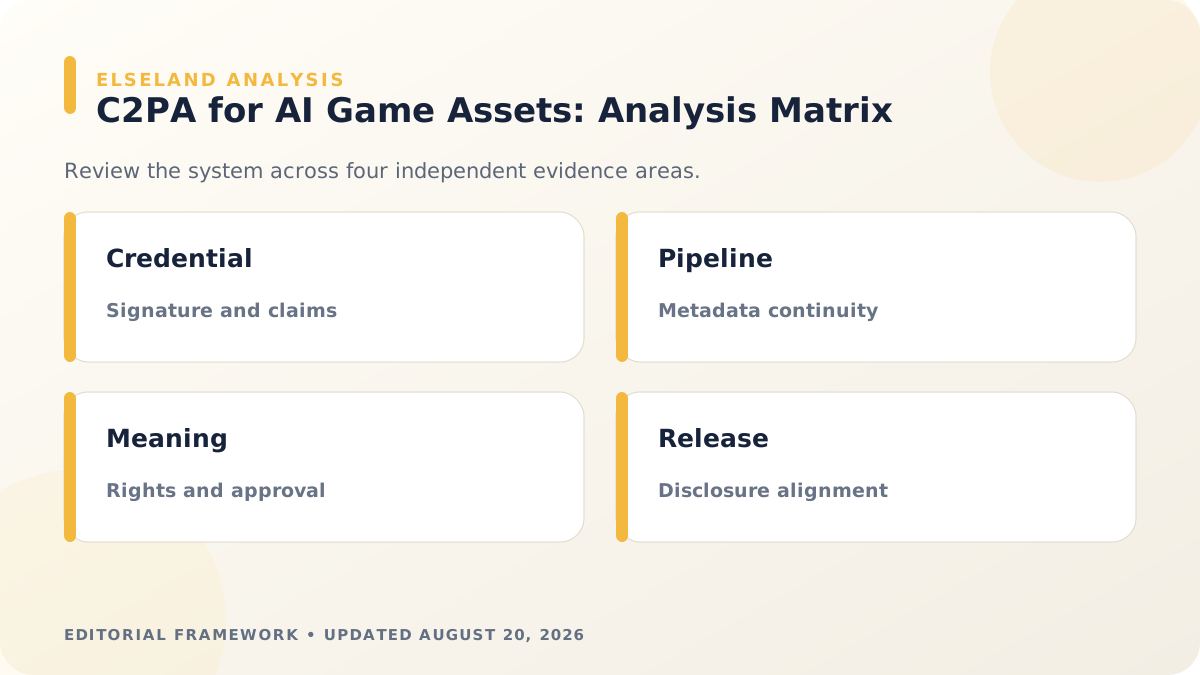
The table below is deliberately tool-neutral. It can be reused after a model, engine, API, or platform changes. A pass requires evidence in all four rows; strength in one row should not compensate for a release-blocking failure in another.
| Review dimension | Question | Evidence to retain | Fail condition |
|---|---|---|---|
| Credential validity | Can it produce the required player-visible result? | Inputs, outputs, version, and selection criteria | The result depends on an undocumented lucky sample |
| Pipeline continuity | Can the result enter the real pipeline without hidden rework? | Source files, transforms, code changes, and build logs | The workflow breaks the runtime, format, or ownership contract |
| Editorial meaning | Can a player understand, control, and recover from it? | Fresh-player notes, accessibility checks, and failure captures | The feature obscures rules, removes agency, or fails without explanation |
| Release reconciliation | Can the team ship and maintain it responsibly? | Rights, disclosures, approvals, monitoring, and rollback plan | The team cannot explain provenance, policy fit, or operational ownership |
Field Validation Checklist for C2PA for AI game assets
Run this checklist after the first plausible result and before scaling. Keep an untouched baseline beside the candidate revision. The baseline reveals whether a change actually improved the intended dimension or merely moved the problem somewhere less visible.
Use the real delivery environment whenever possible. Browser, mobile, engine editor, storefront, and local inference conditions expose different constraints. Record the device, browser or engine version, network state, content version, and reviewer so a later editor can reproduce the observation instead of relying on memory.
End the review with one of four statuses: pass, conditional pass, revise, or reject. Conditional pass requires a bounded exception, an owner, and a trigger for review. “Looks good” is not a release status because it says nothing about the evidence, intended use, or known limit.
- Confirm the article's documented capability against the current official source and access date.
- Test the smallest complete player loop, not only an isolated asset or conversation response.
- Capture latency, performance, clarity, safety, and recovery behavior where they affect the experience.
- Ask a reviewer who did not build the feature to explain the rules and identify the next action.
- Verify anchor-text links, source attributions, disclosures, and rights records before publishing.
- Preserve the accepted artifact and the reason it passed; repeat the affected checks after any material update.
Evidence, Limits, and the Editorial Position on C2PA for AI Game Assets
This guide is a documentation-based editorial analysis, not a claim that Elseland conducted a controlled benchmark of every named product or game. Official sources establish public features, rules, release timing, and design context. They do not establish universal performance, legal clearance, commercial success, or the experience every player will have.
Named games are used as public case studies. The article does not imply access to private design data, an affiliation with the developer, or knowledge of internal metrics. When the analysis moves from a documented fact to an interpretation, the wording should remain conditional and identify the design principle being inferred.
Before publication, an editor should re-open time-sensitive sources, verify that screenshots still match the English version of the referenced page, and update absolute dates where needed. The strongest conclusion is therefore practical and bounded: use the approach when its assumptions match the project, test it in the real context, and keep enough evidence to revisit the decision.
| Statement type | Required treatment |
|---|---|
| Officially documented fact | Use an anchor-text citation and an absolute date for unstable details |
| Observed project result | Name the build, environment, sample, and method |
| Editorial interpretation | State the criteria and the tradeoff; avoid presenting inference as fact |
| Forecast or roadmap | Separate confirmed, reported, and speculative elements |
Frequently asked questions
What is the quickest way to evaluate C2PA for AI game assets?
Choose one player-visible outcome, build the smallest complete loop that contains it, and define pass criteria before testing. Use the same input and review dimensions for the baseline and candidate so the comparison reflects the change rather than a different task.
Who is this C2PA for AI Game Assets guide for?
It is written for game artists, technical artists, producers, legal and policy reviewers, and teams shipping AI-assisted assets. Specialists can use the decision tables as a handoff tool, while smaller teams can use the field checklist to avoid scaling an attractive but unverified result.
Does an official product demo prove the workflow is production-ready?
No. A demo can establish that a provider is presenting a capability, but production readiness also depends on repeatability, integration cost, player clarity, performance, safety, rights, and maintenance in the target project.
How should teams document AI-assisted game work?
Store the prompt or input, provider and version, settings, generated output, human edits, reviewer, decision date, and final asset or build identifier. Add rights, disclosure, safety, and rollback records wherever they affect release approval.
How many test cases are enough for an initial draft?
Start with at least one normal case, one boundary case, and one deliberate failure case. That is not a universal benchmark, but it is enough to reveal whether the workflow has a defined recovery path before the team invests in a larger evaluation.
When should a team reject the approach instead of revising it?
Reject it when the core player outcome conflicts with the project's performance, control, safety, rights, or maintenance requirements and no bounded change can close the gap. Preserve the failed evidence so the same unsuitable approach is not repeated later.
Can the same framework be used after the platform or model changes?
Yes. The four review dimensions are intentionally independent of one vendor. Re-run the time-sensitive source checks and affected tests, then compare the new result with the preserved baseline rather than assuming a newer version is automatically better.
What should readers do after finishing this guide?
Use the field checklist on one real artifact or playable loop, then continue with the linked Elseland guide that best matches the next production decision. If the goal is simply to play, explore the game library and compare the analysis with an experience you can test directly.
Sources and further reading
- C2PA 2.4 specification
April 2026 technical specification and version history.
- C2PA implementation guidance
Current implementation and action-vocabulary guidance.
- OpenAI content provenance update
Vendor example of Content Credentials, watermarking, and verification work.
Next step