
The GPT-6 Astra AGI question does not have a responsible one-word answer. The published material supports taking Astra seriously as a broadly capable AI system. It does not, by itself, establish that every reasonable definition of artificial general intelligence has been met. A benchmark result, a product demonstration and a claim about general intelligence are different kinds of evidence.
The useful approach is to ask what would count as proof, then compare that standard with the evidence actually available. This is an analysis of public documentation and research, not a hands-on evaluation of Astra or a declaration that the AGI debate has been settled.
The definition changes the GPT-6 Astra AGI verdict
Before evaluating the claim, choose a definition. Does AGI mean strong performance across many intellectual tasks, rapid learning in unfamiliar situations, or reliable completion of economically valuable work? Those standards overlap, but a system could satisfy one more convincingly than another. Moving between them during an argument makes almost any conclusion possible.
The research paper Levels of AGI offers a useful framework that separates the breadth of capabilities from their level of performance and considers autonomy in deployment. It is a proposed research framework, not a universal certification. Its practical lesson is to describe the dimensions you mean instead of treating intelligence as a single on/off property.
For this article, the question is whether the available evidence establishes broad, dependable competence beyond selected demonstrations. That is deliberately different from asking whether Astra is impressive, commercially useful or better than its predecessor. All three could be true without resolving the larger question.
What the published Astra evidence establishes
OpenAI’s Astra announcement describes improvements across coding, computer use and professional work, alongside strong benchmark results. These are substantive capability claims worth examining. They should still be attributed to the publisher and read with their evaluation conditions, rather than converted into a guarantee for an individual project.
A benchmark answers a bounded question: how did a particular system perform on this task set, with these tools, resources and scoring rules? A demonstration shows an achievable outcome under its setup. Neither automatically tells you how often an unfamiliar user will obtain the same outcome, how much intervention was needed or how the system behaves when requirements conflict.
The important next evidence is reproducibility: independent evaluators, clearly described setups, unfamiliar tasks and reporting of failures as well as successes. A persuasive claim should survive changes in wording and environment instead of depending on one carefully arranged example.
Capability, autonomy and reliability are different
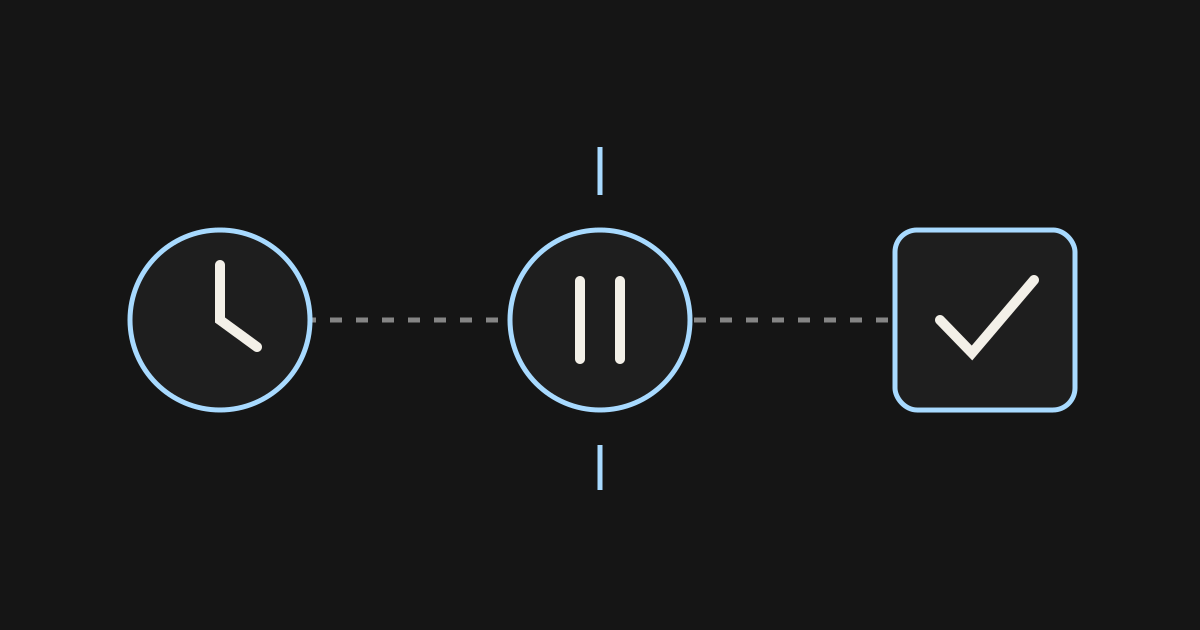
A capable model may know how to solve a problem but lack the tools to act. A highly autonomous application may execute many steps yet make a consequential mistake. A reliable workflow may be narrow because it deliberately constrains the task and asks a person to approve uncertain decisions. These are not contradictions; they describe different properties.
Consider an assistant preparing a community event page. Drafting the copy demonstrates one ability. Updating a calendar involves another system. Sending invitations adds an external consequence. Recovering from a wrong date tests error handling. Granting more permissions does not itself make the model more intelligent, and asking for approval is not evidence of failure.
This also explains why consciousness is a separate question. Competent outputs and task completion are observations about behavior. They do not establish subjective experience. An article about practical capabilities should not quietly turn into a claim about what a model feels.
A reusable checklist for AGI claims
When a headline says a model has reached AGI, translate the headline into questions you can answer. Record both the successful result and the conditions that made it possible. A missing answer is an evidence gap, not proof that the capability is either absent or unlimited.
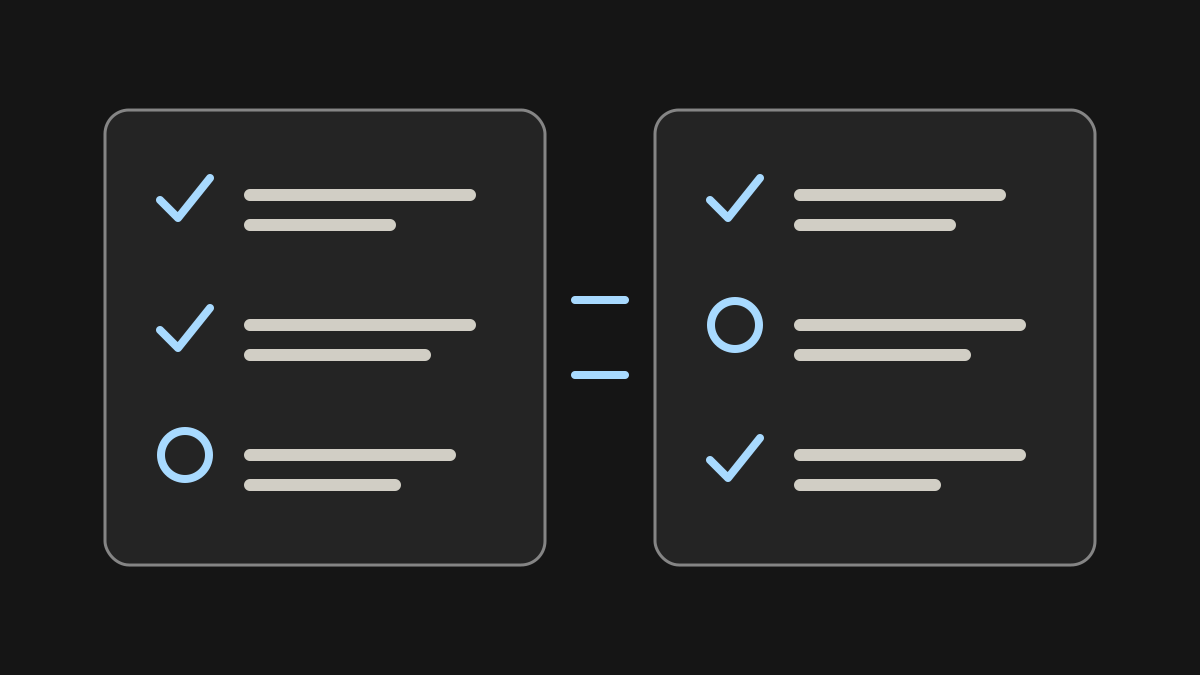
Use the checklist below when reading a release, benchmark report or demonstration. It is an editorial evaluation tool, not a new scientific test or a score we have assigned to Astra.
- Definition: What precise meaning of AGI is being used?
- Breadth: Which different tasks were evaluated, and which were excluded?
- Novelty: How were unfamiliar situations separated from familiar examples?
- Resources: What tools, time, retries and human assistance were allowed?
- Reliability: Are failures, repeated attempts and recovery behavior reported?
- Transfer: Does the result hold when the environment or instructions change?
- Accountability: Can a person inspect the work and stop consequential actions?
A game example makes the distinction concrete
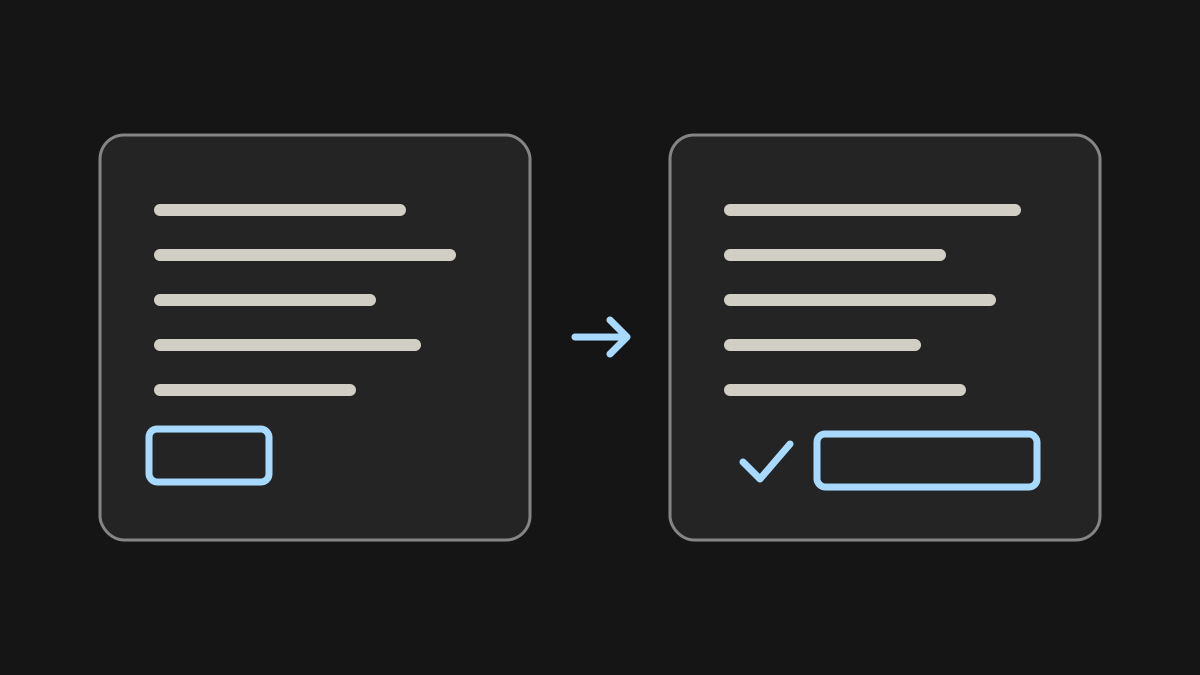
Imagine asking an AI to make a small puzzle game. Producing a playable screen is one milestone. Preserving the rules after a revision, preventing impossible states and explaining a failed test are different milestones. A convincing screenshot cannot show whether restart works or whether a player can get stuck after an unusual move.
You can explore playable games to collect examples of controls, feedback and restart behavior, then turn those observations into acceptance criteria for a separate prototype. That exercise evaluates a useful outcome. It does not establish AGI, and it does not mean the games you inspect were created with Astra.
This is where the debate becomes useful for creators: ask whether the system can produce and maintain a result you can verify. Keep subjective judgments, such as whether a game is enjoyable, separate from functional checks such as whether a button responds.
Use the capability without overstating the label
The careful conclusion is not that Astra is unimportant. It is that a strong model release and a settled AGI verdict are different claims. You can recognize progress while asking for broader, repeatable evidence before accepting the larger label.
For your next project, define a small deliverable, set boundaries and inspect the result. Measure useful completion, correction effort and failure recovery. Those observations can guide a real decision even while researchers and companies disagree about terminology.
If future evidence changes the picture, the conclusion should change with it. The standard should remain stable: make the definition explicit, attribute claims and do not let impressive examples substitute for the evidence the question requires.
Sources and further reading
- Levels of AGI
The definition changes the GPT-6 Astra AGI verdict
- Astra announcement
What the published Astra evidence establishes
Next step