AI game development agents are increasingly capable at reading repositories, editing multiple files, running commands, and repairing test failures. That is real progress, but a game has two sources of truth: the project on disk and the experience that runs. A patch can be correct at the first layer while the character spawns behind the camera, an animation event never fires, a save file stops loading, or a mobile build misses its frame budget.
The useful distinction is therefore not between one brand and another. It is between an agent that stops at repository evidence and a workflow that can close the loop inside a game. If you need a product-level comparison, our Claude Code versus Codex guide covers that narrower decision; this article focuses on the architecture and evaluation standard any tool should meet.
Quick read
Key takeaways
- Game-native does not require a separate foundation model; it requires an execution layer that can inspect engine state, run the game, collect evidence, and revise safely.
- Repository tests prove only part of the result. A game change can compile and still fail in input, timing, scene wiring, animation, readability, or performance.
- The most reliable workflow uses a validation ladder: static checks, engine import, automated runtime tests, representative play sessions, performance sampling, and a human experience gate.
- General coding agents remain useful for bounded code, tooling, tests, and refactors. Game-aware access becomes important when a task crosses scenes, assets, runtime behavior, or player experience.
- Evaluate agents by the evidence they leave behind: a focused diff, repeatable commands, runtime captures, measured budgets, known limitations, and an easy rollback path.
AI game development agents need a different definition of done
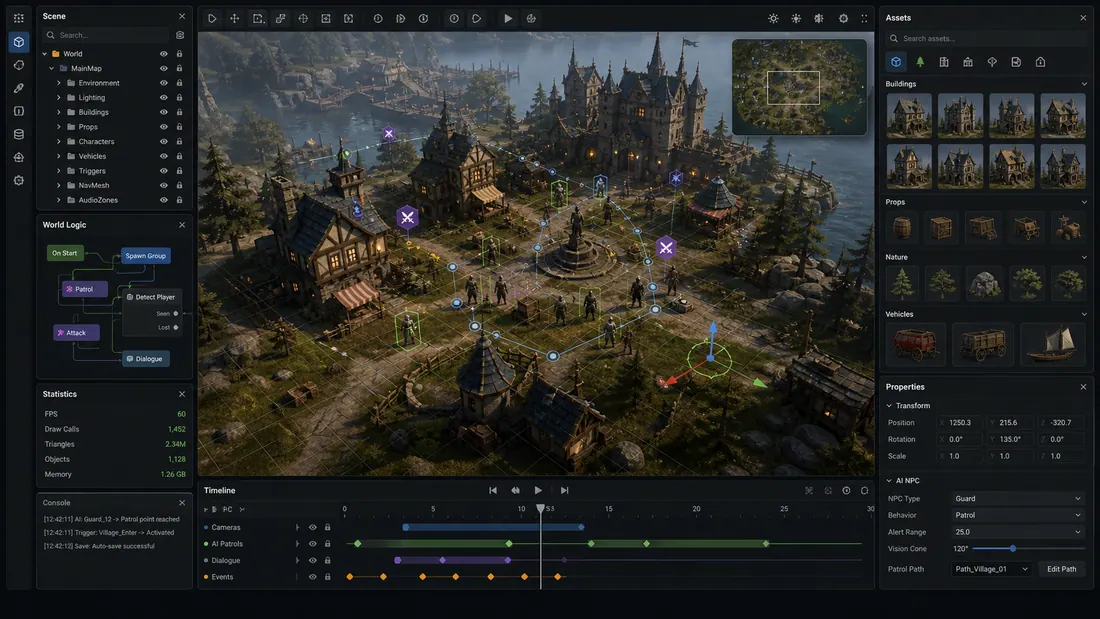
A general coding agent works primarily through repository artifacts: issues, files, symbols, commands, tests, logs, and diffs. A game-native agent extends that loop into the editor and runtime. It can reason about the scene or world hierarchy, asset references, input mappings, engine lifecycle, visual output, performance traces, and the state a player actually encounters.
Game-native is best understood as a capability profile, not a marketing label. The same underlying model may behave like a general coding agent in a terminal and like a game-development agent when connected to editor APIs, a playable build, instrumentation, and a project-specific acceptance contract.
| Dimension | General coding agent | Game-native workflow |
|---|---|---|
| Primary object | Repository and issue | Playable system and supporting repository |
| Context | Code, configuration, tests, logs | Code plus scenes, assets, runtime state, telemetry, and design intent |
| Execution | Shell commands and test runner | Build, editor, player, input, capture, profiler, and target device |
| Definition of done | Patch passes specified checks | Build works, scenario plays correctly, budgets hold, and evidence is reviewable |
| Typical failure | Incorrect code or regression | Correct code with broken wiring, feel, visuals, persistence, or performance |
Why repository-level success is incomplete for games
SWE-bench formalized an important software-engineering task: give a model a real codebase and issue, then ask it to edit the repository so the relevant tests pass. That measures multi-file reasoning and executable correctness. It does not claim to measure whether a game mechanic feels responsive, whether a scene communicates its objective, or whether a packaged build behaves on target hardware.
Game state also lives outside ordinary source files. Godot, for example, defines SceneTree as both a hierarchy of nodes and the engine's main-loop implementation. Unity and Unreal have comparable relationships among objects, scenes or levels, editor metadata, and runtime systems. Changing a script without observing that wider graph is like changing a database query without checking the schema or the data.
The gap is most visible in time-dependent behavior. Physics updates, animation transitions, asynchronous loading, networking, camera smoothing, and input focus unfold across frames. A unit test can confirm a cooldown calculation while missing that the UI updates one frame late or that the action remains bound to an inaccessible control on mobile.
The six-layer context stack for game-aware work
A reliable agent does not need to ingest the entire project at once. It needs the right context at the right stage, with explicit boundaries. Think of game-native context as six connected layers that can be queried and validated independently.
The same layers should remain visible even when an interface hides implementation details. Playing current experiences on Elseland AI helps teams identify which intent, interaction, and presentation decisions must survive from a brief into a running experience.
- Intent layer: the player goal, verbs, failure conditions, target platform, and non-goals.
- Repository layer: source, configuration, dependencies, tests, generated files, and ownership rules.
- World layer: scenes, entities, prefabs, levels, navigation, collision, cameras, and object references.
- Asset layer: models, textures, audio, animation, import settings, licenses, and memory cost.
- Runtime layer: lifecycle events, input, logs, frame timing, memory, network state, saves, and device differences.
- Evidence layer: commands, screenshots, recordings, traces, test reports, diffs, and reviewer decisions.
Close the loop: build, launch, play, observe, revise
The essential upgrade is closed-loop validation. The agent begins with a measurable scenario, inspects the current implementation, makes the smallest justified change, builds it, launches the relevant state, performs the required actions, observes the outcome, and revises only when the evidence identifies a gap.
Unreal Engine's Automation Test Framework illustrates why engine-aware tests are broader than unit tests. Its official documentation distinguishes unit, feature, smoke, content-stress, screenshot-comparison, input-simulation, and level-testing capabilities. A game-development agent should orchestrate the appropriate checks rather than treating one green test suite as universal proof.
This is a partially observable problem: no single artifact reveals the whole game state. The agent must combine signals from code, runtime logs, captured frames, object state, and performance data. When evidence conflicts, it should report the conflict and narrow the test instead of guessing.
| Loop step | Agent action | Evidence left for review |
|---|---|---|
| Specify | Translate the request into observable behavior and limits | Acceptance checklist and non-goals |
| Inspect | Trace code, scene, asset, and lifecycle dependencies | Dependency map and risk notes |
| Change | Apply a bounded, reversible implementation | Focused diff with rationale |
| Execute | Build and launch the exact target state | Command log and build result |
| Observe | Replay inputs and collect state, visuals, and timings | Test report, captures, and metrics |
| Decide | Compare evidence with the acceptance contract | Pass, revise, or escalate with reason |
Use a validation ladder instead of one oversized test
Validation becomes faster and easier to diagnose when cheap checks run before expensive ones. A syntax error should fail before a five-minute play session; a broken asset reference should fail before a device performance run. Each rung answers a different question, and passing a lower rung never substitutes for the ones above it.
| Rung | Question | Example gate |
|---|---|---|
| 1. Static | Is the repository internally consistent? | Types, lint, schema, references, and forbidden-file checks pass |
| 2. Build/import | Can the engine consume the result? | Clean import and target build without new errors |
| 3. Deterministic runtime | Does the defined state transition work? | Input produces the expected state, event, and reset behavior |
| 4. Visual and interaction | Can a player perceive and control it? | Correct framing, feedback, focus, safe area, and readable UI |
| 5. Performance | Does it stay within the project budget? | Representative frame time, memory, loading, and network thresholds |
| 6. Human experience | Is the result understandable and worth keeping? | Designer or reviewer approves feel, clarity, and intent |
Route each task to the narrowest capable workflow
Not every game task needs full editor control. Using the heaviest loop for a documentation fix wastes time, while using a repository-only loop for a camera or collision change hides important failure modes. Route by the evidence required to approve the task.
| Task | General agent can lead when… | Game-aware access is required when… |
|---|---|---|
| Code refactor | Behavior is covered by stable tests | Serialization, lifecycle, or scene ownership may change |
| Build tooling | Inputs and outputs are deterministic | Packaging depends on editor state or platform services |
| Gameplay feature | Agent prepares isolated logic and tests | Input, animation, camera, audio, UI, and feel must be verified together |
| Asset pipeline | Agent writes validators and conversion scripts | Import settings, materials, rigs, collision, or visual quality must be inspected |
| Performance fix | Agent narrows likely hot paths | Profiler captures and target-device comparisons determine success |
| Balance or onboarding | Agent analyzes structured telemetry | Human play sessions must judge clarity, pacing, and frustration |
Worked example: adding a dash mechanic
Suppose the brief says: add a directional dash with a 1.2-second cooldown, preserve jump behavior, show a visible cooldown, and keep the character inside collision boundaries. A repository-only agent might add the state, input handler, and unit tests. That is useful, but it does not yet prove the feature.
A game-aware loop first identifies the player controller, input map, animation state machine, collision layer, camera behavior, HUD owner, save or settings implications, and the scene used for movement tests. It implements the smallest slice, enters a known test level, triggers dashes from rest, during movement, near walls, in the air, after pause, and after restart, then captures the state and visible response.
The failures are often cross-system: the character tunnels through thin collision at low frame rates; the animation locks input after interruption; the camera overshoots; the cooldown icon uses scaled time and freezes in a menu; a controller binding is missing; or the sound fires twice because two event paths overlap. None of these necessarily appears in the function that computes dash velocity.
- Deterministic proof: cooldown, state transitions, collision response, and reset behavior meet the contract.
- Visual proof: direction, trail, animation, camera response, and cooldown feedback remain readable.
- Performance proof: the effect does not create sustained allocations or exceed its frame budget in a representative scene.
- Human proof: the dash feels intentional, is discoverable, and does not undermine the level's challenge.
Score the agent on proof, not output volume
A long transcript or large diff is not evidence of quality. Use a repeatable scorecard on the same project commit, task brief, permissions, hardware, and time limit. Score each dimension from one to five, multiply by the agreed weight, and retain the raw artifacts so another reviewer can reproduce the result.
Add automatic failure conditions before scoring. Examples include a broken build, lost save data, an unlicensed asset entering the repository, a secret written to the client, inaccessible essential controls, or an agent claiming a playtest it did not actually perform.
| Dimension | Suggested weight | What a high score requires |
|---|---|---|
| Functional correctness | 25% | Acceptance scenarios pass without regressions |
| Playable integration | 20% | Scene, input, UI, audio, and lifecycle work together |
| Verification quality | 20% | Evidence is relevant, reproducible, and honestly scoped |
| Performance and robustness | 15% | Budgets hold across representative states and targets |
| Change quality | 10% | Diff is focused, conventional, documented, and maintainable |
| Safety and recovery | 10% | Assets are preserved, risky actions are gated, and rollback is clear |
A hybrid workflow is usually stronger than a single autonomous agent
The practical architecture is a set of bounded roles. A general coding agent can map the repository, implement isolated logic, write test fixtures, and review diffs. Engine automation can load scenes, inspect object state, run functional tests, and export builds. Capture tools and profilers produce runtime evidence. A human sets taste, risk tolerance, and the final acceptance decision.
Keep those roles connected through a written artifact contract: task brief, files or systems in scope, commands, expected observations, evidence locations, and stop conditions. Our end-to-end AI game development workflow shows how the same contract can carry a project from brief and greybox through assets, QA, and release.
Parallel agents help when ownership is separate: one may inspect save compatibility while another prepares tests, or one may validate an asset while another documents its import contract. Do not let several agents freely edit the same scene, prefab, central state manager, or generated project metadata. Reconciliation is an explicit step, not an assumption.
Performance and player judgment remain explicit gates
Unity's profiling guidance makes an important distinction: Play Mode is useful for quick iteration, but target-platform profiling provides more accurate timings, and editor measurements should not replace validation on supported devices. An agent should report where a measurement came from instead of presenting editor data as final hardware proof.
Performance is also scenario-dependent. Average frame rate can hide traversal spikes, shader compilation, asset streaming, garbage collection, or a memory leak after repeated scene changes. Define a representative capture window and preserve the profile alongside the change.
Human review is not a fallback for weak automation. It is the correct evaluator for goals that are subjective or social: whether feedback is satisfying, difficulty is legible, humor lands, motion causes discomfort, or a generated character fits the intended audience. The agent should prepare the smallest playable question a reviewer can answer confidently.
A decision checklist for adopting a game-development agent
Start with one vertical slice that represents your real project. Do not evaluate only on a toy script or a polished demo selected by the vendor. Give every candidate the same starting commit, scenario, constraints, and validation ladder, then compare both the result and the cost of supervision.
Use playable references to sharpen acceptance criteria before automation begins. Browse Elseland's AI games collection and write down what the player can do, what feedback confirms each action, what state persists, and what would count as a broken experience. That turns taste into a testable brief without pretending every quality can be reduced to a unit test.
- Can the agent inspect the engine, scene, and asset context needed for this task?
- Can it launch the exact runtime state and perform or request the relevant interactions?
- Can it distinguish simulated evidence, editor evidence, and target-device evidence?
- Does it preserve source assets, generated metadata, secrets, licenses, and save compatibility?
- Does it stop for human judgment when success depends on feel, clarity, accessibility, or risk?
- Can another developer reproduce the checks and revert the change without reconstructing the conversation?
Frequently asked questions
What is a game-native AI development agent?
It is an AI agent workflow that can reason about and validate the running game, not only its source repository. Typical capabilities include scene or world inspection, asset awareness, engine execution, controlled input, runtime state capture, visual checks, profiling, and a human approval handoff.
Does a game-native agent require a special AI model?
Not necessarily. The differentiator is often the harness around the model: editor and runtime tools, project context, instrumentation, acceptance rules, and recovery controls. The same model can have very different results with or without those capabilities.
Can a general coding agent still build a game?
Yes. General coding agents can implement substantial gameplay code, tools, tests, build scripts, and documentation. Their result still needs engine import, playable validation, performance checks, and human review whenever the task affects runtime or player experience.
Are automated tests enough for AI-written game features?
No single test layer is enough. Combine static checks, engine or import validation, deterministic runtime tests, visual and interaction checks, representative performance sampling, and human review for experiential goals.
What game context should an AI agent receive?
Provide the player goal, non-goals, systems in scope, architecture notes, relevant scenes and assets, target platforms, build and test commands, performance limits, known risks, and observable acceptance scenarios. Add context progressively instead of dumping the entire project without priorities.
How should I compare AI game development agents?
Run the same real vertical slice from the same commit with the same permissions, hardware, time limit, and acceptance contract. Score functional correctness, playable integration, verification quality, performance, change quality, safety, and the amount of human intervention required.
Which engines can use game-development agents?
Any engine can benefit when it exposes repeatable build, test, editor, runtime, or capture interfaces. The exact loop differs across Unity, Unreal, Godot, browser engines, and custom technology, so verify the integrations your project actually supports.
What decisions should remain human?
Humans should retain approval for product intent, fun and feel, accessibility, audience suitability, rights and provenance, security, economy risk, destructive migrations, and release readiness. Agents can collect evidence and narrow choices, but they should not invent approval.
Sources and further reading
- SWE-bench: Can Language Models Resolve Real-World GitHub Issues?
Primary research defining repository-level issue resolution as a software-engineering evaluation task.
- Godot Engine: SceneTree documentation
Official description of the scene hierarchy and its role in the engine main loop.
- Unreal Engine: Automation Test Framework
Official engine guidance covering unit, feature, smoke, content-stress, screenshot, input, and level testing.
- Unity Manual: Profiling your application
Official guidance on Play Mode iteration, target-platform profiling, and the limits of editor measurements.
Next step