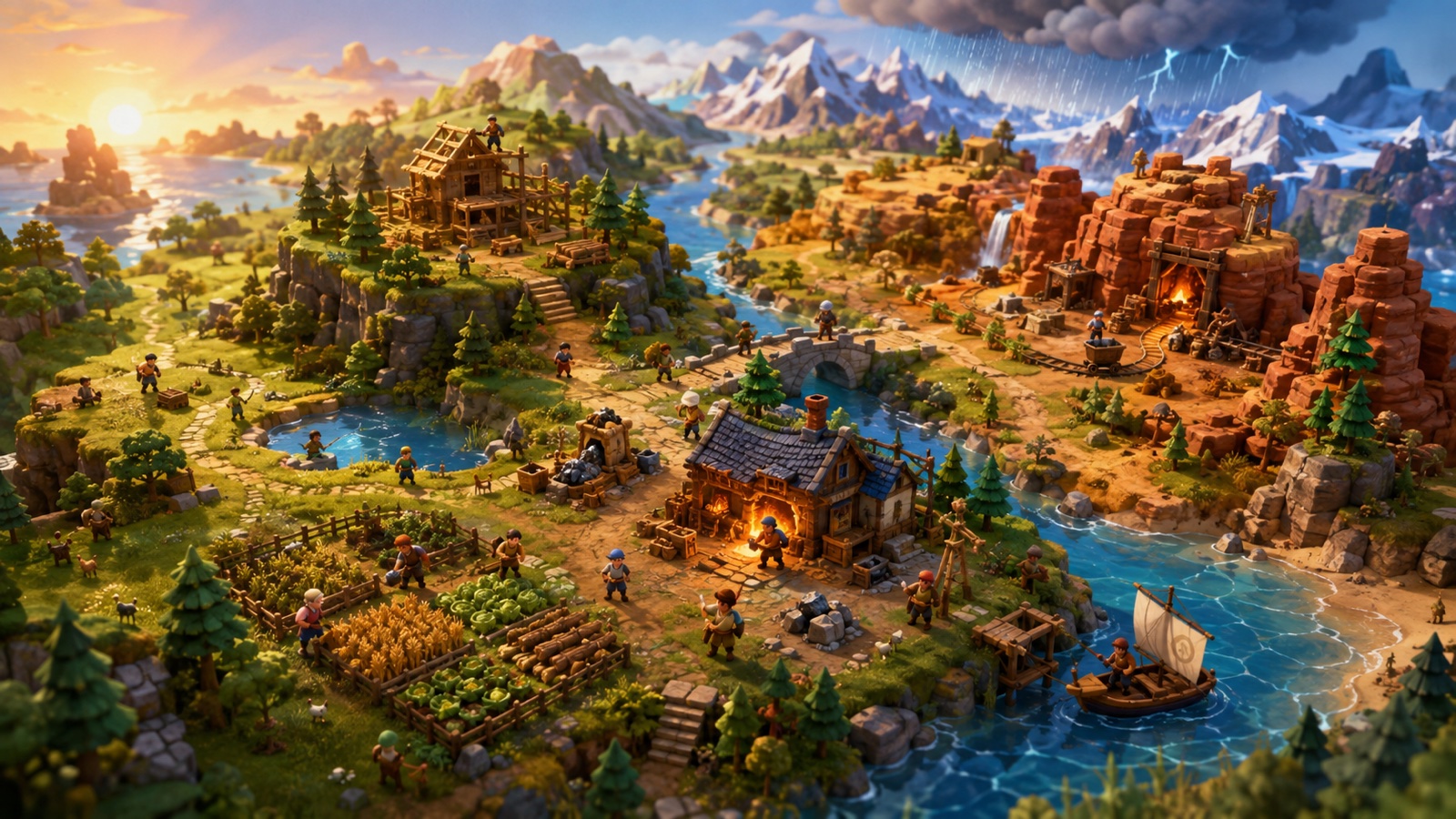
The attraction of a sandbox is agency: the player chooses a goal, combines systems, changes the world, and sees that change persist. AI can accelerate the content around that loop, but it cannot compensate for verbs that feel weak, rules that are unreadable, or state that disappears after a reload.
Start by studying deliberately small playable simulation games on Elseland. A compact loop makes goals, feedback, state changes, and recovery easier to observe before procedural scale and generated content make failures harder to diagnose.
Quick read
Key takeaways
- Design the sandbox around four to six player verbs and explicit world state before generating content.
- Use procedural generation for bounded, repeatable variation; use generative AI only where semantic variety adds value.
- Keep authoritative simulation rules deterministic even when AI proposes dialogue, quests, layouts, or behaviors.
- Build persistence, rollback, and observability early because sandbox bugs compound across systems.
- Ship a tiny closed loop, then expand only after players can form a plan, act, see consequences, and recover from failure.
What makes a game a sandbox?
A sandbox gives players reusable verbs, objects with state, and rules that interact. Place, remove, gather, grow, trade, connect, command, and defend are verbs. Soil moisture, ownership, inventory, health, time, relationships, and power are state. A weather rule that changes growth and movement turns separate features into a system.
Emergence happens when understandable rules create outcomes the designer did not script scene by scene. Randomness alone is not emergence. Infinite terrain alone is not a sandbox. The design succeeds when a player can predict enough to form a plan, then discover consequences through play.
| Layer | Design question | Minimum artifact |
|---|---|---|
| Player verbs | What can the player do repeatedly? | Four to six verbs with input and feedback |
| World state | What can change and persist? | Typed state model with ownership and save rules |
| Simulation rules | How do systems affect one another? | Readable rules with limits and priorities |
| Content generation | What may vary between sessions? | Seeded generator with constraints |
| Agents | Who observes, decides, and acts? | Allowed actions, memory scope, and fallback behavior |
| Safety and rights | What output is unacceptable? | Filters, provenance, reporting, and review gates |
| Persistence | Can the world be trusted? | Versioned saves, migration, backup, and rollback |
Choose where AI belongs—and where it does not
Procedural systems and generative models solve different problems. A seeded terrain generator can reproduce a world from rules and parameters. A generative model can propose semantically varied dialogue, descriptions, quests, code, or assets, but identical inputs may not yield identical outputs and failures can be difficult to enumerate.
Keep inventory transactions, physics, damage, crafting recipes, permissions, currency, and save writes inside deterministic game code. Let AI propose content through a validated schema. The engine should reject invalid actions, clamp numbers, check ownership, and provide a safe fallback when the model is unavailable.
| Use case | Recommended system | Reason |
|---|---|---|
| Terrain placement | Seeded procedural generator | Reproducible and easy to profile |
| Crafting outcome | Authored rule table | Economy and saves need determinism |
| NPC intent | AI proposal plus allowed-action schema | Variation without surrendering authority |
| Quest flavor | AI draft plus constraint and review layer | Semantic variety can add value |
| Collision and navigation | Engine systems | Must be measurable and reliable |
| Concept variants | Generative AI | Fast exploration before production commitment |
Build procedural generation as a controllable foundation
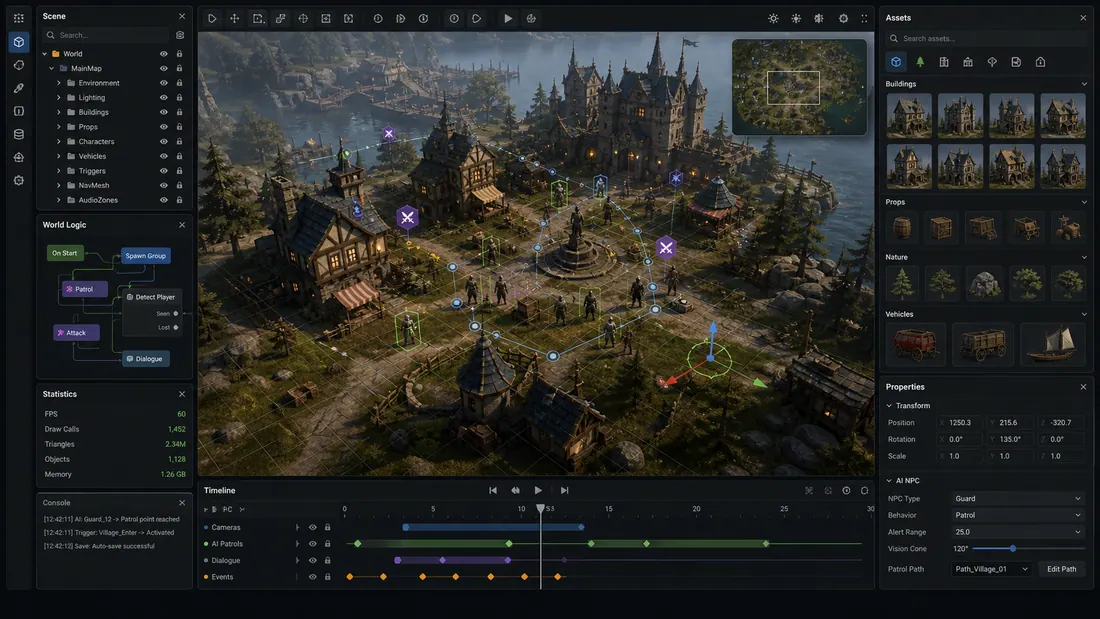
Epic describes Unreal Engine's Procedural Content Generation framework as a toolset for creating content from asset utilities and buildings through biomes and entire worlds, while keeping procedural and traditional workflows connected. That combination matters: designers need authored exceptions, landmarks, and protected spaces inside a generated layout.
Give every generated world a seed and record the generator version. Separate layout from decoration so navigation can be tested without visual noise. Add constraints for reachability, spacing, resource access, and protected spawn zones. Store the parameters that created the world, not only the final mesh arrangement.
- Same seed and generator version reproduce the same critical layout.
- The start area always provides a legal path to the first resource and objective.
- Landmarks remain visible enough for orientation after decoration.
- Resource placement respects minimum and maximum distances.
- Generated content stays inside memory, draw-call, and navigation budgets.
- Designers can lock, replace, or hand-author important regions.
Design a one-loop vertical slice
Use a garden settlement as a test case. The player gathers wood and seed, places a plot, plants a crop, waits through one weather change, harvests, and trades the result for a tool that unlocks a second planting option. That loop is enough to exercise input, placement, inventory, time, growth, economy, feedback, saves, and recovery.
Write the loop as state transitions. A plot moves from available to placed, prepared, planted, growing, harvestable, and depleted. Each transition names its trigger, required inputs, output, duration, visual feedback, audio feedback, and save behavior. AI may draft variants, but the engine owns legal transitions.
| Step | Player proof | System proof |
|---|---|---|
| Gather | Understands source and capacity | Inventory cannot duplicate or go negative |
| Place | Sees valid location and orientation | Collision and ownership rules hold |
| Grow | Can read progress and modifiers | Time and weather produce valid transitions |
| Harvest | Receives clear reward feedback | Yield respects state and economy bounds |
| Trade | Can compare cost and benefit | Transaction is atomic and saved |
| Reload | Recognizes the changed world | All authoritative state restores correctly |
A seven-stage AI-assisted sandbox workflow
Stage one defines the fantasy, audience, device, camera, and four to six verbs. Stage two writes the authoritative state model. Stage three implements one deterministic loop in a greybox. Stage four adds seeded procedural variation. Stage five introduces one bounded AI feature. Stage six hardens saves, safety, and performance. Stage seven expands content only after repeated playtests.
At each stage, ask for one inspectable deliverable. An AI coding agent can produce a state diagram, a test fixture, a validator, or a small patch. An image or 3D model can propose a visual direction. Keep generated outputs out of the production branch until their acceptance checks pass.
- Brief: one fantasy, one core loop, one target player, one device budget.
- State contract: types, ownership, transitions, persistence, and migration.
- Greybox: complete loop with placeholder art and a restart command.
- Procedural layer: seeds, constraints, observability, and authored overrides.
- AI layer: narrow input, schema output, policy checks, timeout, and fallback.
- Hardening: save/load, performance, accessibility, abuse, and rights review.
- Expansion: new content uses the same contracts instead of bypassing them.
What PCG research says about the hard parts
The PCGML survey by Adam Summerville and colleagues describes machine-learning approaches to generating game content and identifies opportunities beyond level generation, including co-creation, repair, critique, and content analysis. It also identifies persistent problems such as limited training data, representation choices, parameter tuning, and using generation as part of gameplay.
That research suggests a practical design principle: the generator should be a collaborator with explicit controls and evaluation, not a black box asked to deliver a finished world. Use AI to suggest, repair, or critique content where a human or validator can still judge the result.
Runtime AI needs stricter controls than development-time AI
Development-time generation produces content before release, so a team can inspect and reject it. Runtime generation creates content while players are using the product, which adds latency, availability, moderation, privacy, cost, and adversarial-input risks.
Steamworks' content survey distinguishes pre-generated AI content from live-generated AI content and asks developers of live systems to describe guardrails that prevent illegal content. Even outside Steam, that distinction is a useful release checklist: document what is generated, when it is generated, what data it receives, how output is filtered, and how a player reports a failure.
Playtest the system, not only the content
Run automated simulations before human sessions. Accelerate time, create thousands of transactions, remove resources, interrupt agent calls, reload old saves, and force unusual placements. The objective is to expose impossible states and runaway loops before players spend hours building a world.
Then observe human players without explaining the rules. Can they form a goal, find the relevant verb, predict a consequence, understand what changed, and recover from a mistake? A system is not readable merely because its designer can explain it.
| Test area | Test case | Pass condition |
|---|---|---|
| Determinism | Replay the same seed and action log | Authoritative outcomes match |
| Economy | Simulate long sessions and extreme inventories | No negative, infinite, or dominant loop |
| Navigation | Generate many layouts and agent routes | Objectives remain reachable |
| Persistence | Save during every state transition | Reload is valid or safely rolled back |
| AI failure | Timeout, malformed output, unsafe output | Fallback preserves the session |
| Performance | Stress maximum entities and generated content | Target frame and memory budgets hold |
| Comprehension | First-time player attempts the loop | Actions and consequences are understood |
Release a small world with deep consequences
Browse the wider Elseland games library to compare how different genres make goals and feedback legible. Use those observations to cut any generated feature that does not strengthen the player's plan, action, or consequence loop.
When the slice is stable, put it in front of players and observe whether they can form a plan without explanation. Elseland AI offers current playable examples that are more useful as references than an untested promise of unlimited creation.
Frequently asked questions
Can AI create a complete sandbox game?
AI can accelerate code, content, assets, dialogue, tests, and documentation, but a reliable sandbox still needs an authored state model, deterministic rules, saves, performance budgets, safety controls, and human playtesting. Begin with one complete loop rather than asking for an entire world at once.
What should I build first in a sandbox game?
Build the smallest loop that lets a player form a plan, act, observe a persistent consequence, and repeat. Four to six strong verbs in a small space are enough to reveal whether the system is understandable and interesting.
What is the difference between procedural generation and generative AI?
Procedural generation usually applies explicit rules and parameters, often with a reproducible seed. Generative AI learns patterns from data and can produce richer semantic variation, but its outputs require stronger validation and may be less predictable.
Should NPCs be allowed to change game state directly?
An AI system can propose an action, but authoritative game code should validate permissions, range, cost, timing, and legal state transitions. Invalid or unavailable responses should fall back to deterministic behavior without corrupting the session.
How do I save an AI-generated sandbox world?
Save authoritative state, generator seed, generator version, player changes, and references to approved content. Version the schema, test migrations, keep backups, and provide rollback when a generated or agent-driven transition fails.
How do I test emergent gameplay?
Combine automated simulation with observed human sessions. Stress economies, navigation, persistence, and edge cases at scale, then verify that new players can understand the rules well enough to plan and recover from mistakes.
Is runtime-generated AI content harder to release?
Yes. Runtime systems add availability, latency, cost, privacy, moderation, abuse, and platform-disclosure requirements. Use strict schemas, filters, rate limits, reporting, audit logs, and a safe fallback, and confirm the rules of each distribution platform.
How large should the first sandbox map be?
Large enough to complete and repeat the core loop, but small enough that the team can inspect every important state. A dense one-screen or one-room slice often teaches more than a generated open world with weak interactions.
Sources and further reading
- Epic Games: Procedural Content Generation Framework
Official engine documentation for procedural content tools and their integration with traditional workflows.
- Summerville et al.: Procedural Content Generation via Machine Learning
Peer-reviewed survey preprint covering PCGML applications, opportunities, and open problems.
- Steamworks: Content Survey
Current platform guidance distinguishing pre-generated and live-generated AI content and related disclosures.
Next step