

Many AI-generated 3D objects look finished but behave like a sealed sculpture. A car may not have wheels that rotate independently; a chest may not have a lid with a usable pivot. Structure-aware generation aims to make the parts themselves part of the output.
That direction connects directly to structural modeling: hierarchy, pivots, topology, materials, and animation contracts determine whether a visually strong object becomes a usable game asset.
Quick read
Key takeaways
- CubePart focuses on open-vocabulary part-level control rather than one fused output.
- Semantic parts could make generated assets easier to edit, animate, materialize, and script.
- Part labels do not automatically guarantee game-ready topology, UVs, rigs, collision, or performance.
- Creators should evaluate structure quality and downstream editability, not only render quality.
What Roblox Announced
Roblox describes CubePart as an open-vocabulary, part-controllable 3D generation model. The research direction builds on Roblox Cube and targets more structured control over generated objects.
Open vocabulary suggests that part concepts are not restricted to one small fixed taxonomy, while part control is intended to give creators more influence over object composition. Exact product availability and supported workflows should be checked against Roblox's current documentation.
Why Semantic Parts Matter for Games
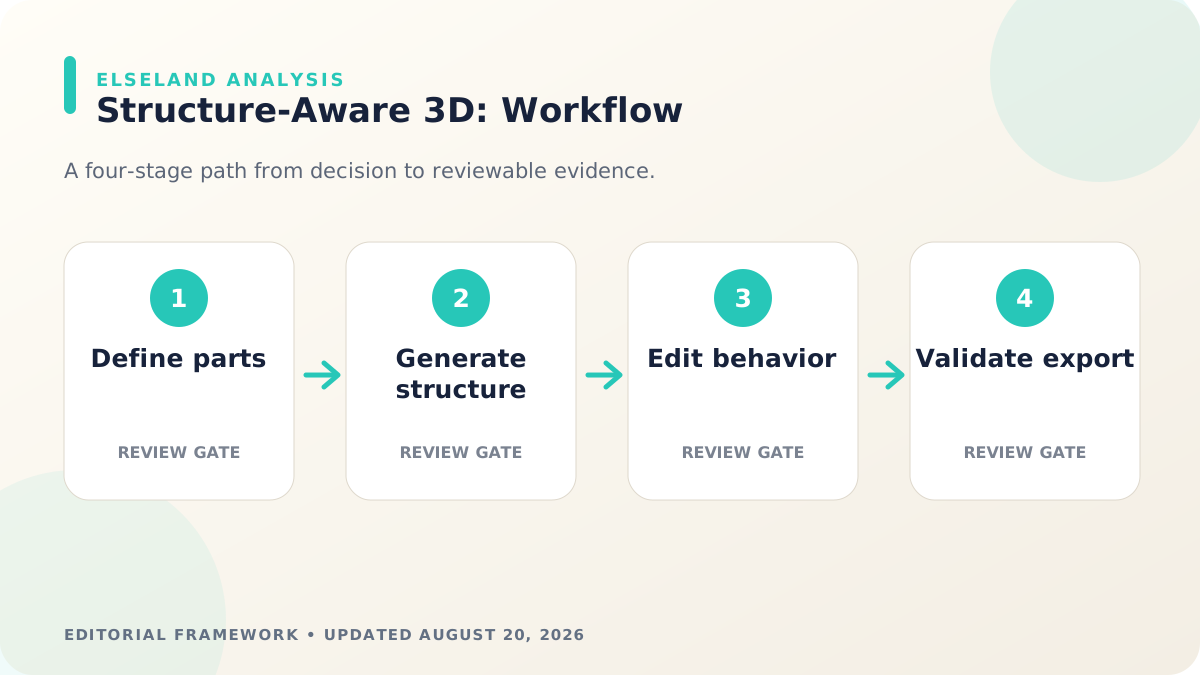
Game objects are behavior containers. Doors open, wheels rotate, armor breaks, colors change, and collision differs by component. Semantic separation can reduce the work of finding and rebuilding those parts after generation.
It can also improve authoring interfaces: a creator could select, regenerate, scale, hide, or re-material one named region instead of editing a fused mesh.
What Part Awareness Does Not Solve
A structured output may still need topology cleanup, UV review, material consolidation, scale, pivots, collision, rigging, LODs, and target-platform optimization. Labels can be wrong or boundaries can cut through forms that should deform together.
Evaluate the exported artifact rather than the showcase render. Can the intended part be selected? Is the hierarchy stable? Do seams, normals, and materials survive edits and export?
A Practical Evaluation Checklist
- Generate objects with obvious and ambiguous part boundaries.
- Inspect semantic names, hierarchy, mesh separation, pivots, and material slots.
- Try recoloring, replacing, animating, and scripting one part.
- Export to the target format and validate topology, UVs, scale, and performance.
- Record where human reconstruction is still required.
The Broader Production Implication
Our inference is that structure-aware models are more likely than render-only models to fit real asset pipelines, because they expose handles for revision and gameplay. The value will depend on whether those structures remain controllable across tools.
Use Elseland's simulation game library to frame a destination test, then apply the concept-to-3D and browser optimization workflows to the actual exported asset.
Design a Part-Control Evaluation Set
Use objects with different structural ambiguity: a chair with legs and back, a vehicle with wheels and doors, a creature with horns and armor, and a fantasy device with no standard taxonomy. For each object, define the expected parts before generation so evaluation does not move after seeing the output.
Test selection, naming, separation, pivot placement, material assignment, replacement, deletion, scaling, and export. Then perform one gameplay edit: rotate wheels, open a door, break armor, or recolor one semantic region. A visually accurate part label is useful only when the downstream artifact remains editable.
| Test | Pass evidence | Hidden failure |
|---|---|---|
| Semantic naming | Expected parts are identifiable | Labels exist but boundaries are wrong |
| Independent edit | One part changes without damage | Shared topology or texture contamination |
| Behavior | Pivot and hierarchy support motion | Part rotates around unusable origin |
| Export | Structure survives target format | Hierarchy collapses or materials merge |
| Runtime | Asset meets scene budget | Part count inflates primitives and draws |
Score Structure Across Four Layers
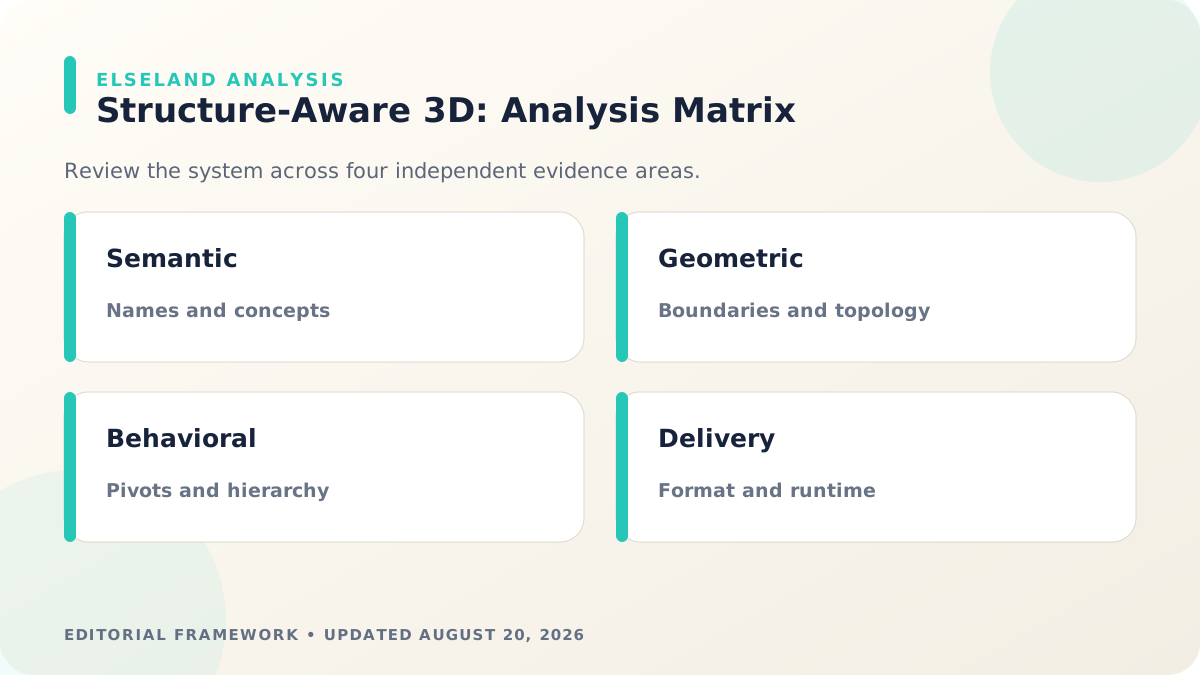
Semantic structure asks whether parts have meaningful identity. Geometric structure asks whether boundaries and topology are usable. Behavioral structure asks whether hierarchy and pivots support interaction. Delivery structure asks whether the target format and engine preserve the result efficiently.
A model can pass one layer and fail the next. Correctly labeled wheels may be fused into the body; separate wheels may have bad pivots; a perfect hierarchy may export as many expensive material primitives.
- Semantic: names and part concepts match creator intent
- Geometric: boundaries, topology, normals, UVs, and watertightness are useful
- Behavioral: hierarchy, pivot, collision, animation, replacement, and damage work
- Delivery: export preserves structure within mesh, material, texture, and instance budgets
Interpret CubePart Claims Conservatively
Roblox describes CubePart as open-vocabulary and part-controllable, but those terms should not be expanded into claims about every object, perfect segmentation, automatic rigging, or general engine export without evidence. Check current access and technical details directly.
Use Roblox's announcement and public Cube repository as primary context, then label workflow implications as editorial inference. Research progress can be important even when creator-facing integration remains incomplete or limited.
| Symptom | Likely cause | Next check |
|---|---|---|
| Part name is right, shape is wrong | Semantic guess exceeds geometry | Repair boundary or regenerate constrained region |
| Edit damages neighbors | Shared mesh, UV, or material | Separate production structure |
| Animation is awkward | No behavioral pivot or hierarchy | Reauthor transform structure |
| Export loses parts | Format or importer mapping | Test target delivery early |
| Runtime cost grows | Every part creates primitive/material overhead | Merge by shared behavior where safe |
Structure-Aware 3D Benchmark Checklist
Publish the expected part schema, prompts or references, model version, output settings, cleanup time, and target export. Otherwise a showcase cannot be compared or reproduced.
Include hard cases and failed outputs. A structure-aware model's production value depends on how reliably creators can correct errors, not only on the best successful object.
- Expected semantic parts are defined before generation.
- Part names, boundaries, topology, UVs, materials, and hierarchy are inspected.
- Selection, local regeneration, replacement, and deletion are attempted.
- Pivots, collision, animation, and one gameplay behavior are tested.
- The target export preserves structure and passes runtime profiling.
- Failures, cleanup time, access limitations, and model version are reported.
What the Primary Sources Establish About Roblox CubePart
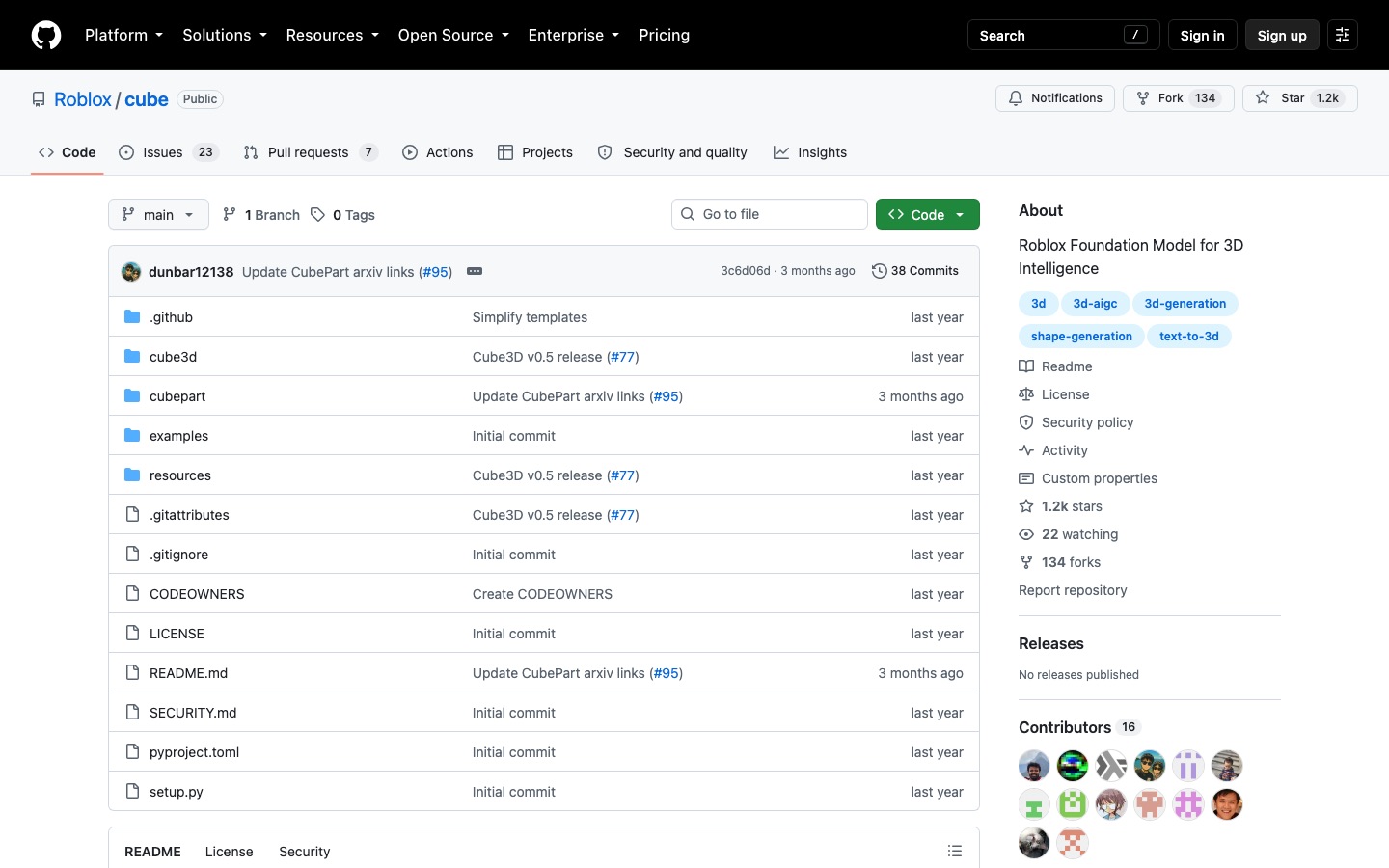
Our evidence baseline starts with the Roblox Cube repository, accessed August 20, 2026. We use it to establish documented behavior, terminology, or constraints—not to claim that the source endorses Elseland's workflow or conclusions. The practical artifact under review is a generated asset inspected for semantic parts, geometric boundaries, pivots, hierarchy, editability, and runtime export.
That distinction is central to E-E-A-T. A first-party page can establish what a format, tool, platform, model, or game team publicly documents. It cannot prove that a particular asset is fast, accessible, legally cleared, fun, or production-ready. Those conclusions require separate observation, measurement, specialist review, or player evidence tied to the actual project.
For this topic, the decision is whether structure-aware generation produces useful control rather than only a plausible surface. The following observations turn the official reference into a reviewable production record rather than a decorative citation:
| Evidence layer | What it can support | What it cannot support alone |
|---|---|---|
| Official source | Documented feature, rule, format, or published design context | Project-specific quality or universal performance |
| Project measurement | Observed behavior in a named build, scene, device, or sample | Unmeasured platforms or future versions |
| Human review | Usability, visual, editorial, and production judgment | Legal certainty or population-level player behavior |
| Release record | Who approved what, when, with which evidence | Permanent compliance after inputs or rules change |
- 1. distinguish named semantic parts from clean geometric separation. Store the result with the asset or build identifier so another reviewer can reproduce the conclusion.
- 2. test whether parts can be selected, transformed, replaced, and animated. Store the result with the asset or build identifier so another reviewer can reproduce the conclusion.
- 3. inspect boundaries, overlap, thickness, normals, and topology. Store the result with the asset or build identifier so another reviewer can reproduce the conclusion.
- 4. verify that hierarchy and pivots survive the intended export path. Store the result with the asset or build identifier so another reviewer can reproduce the conclusion.
A Field Review Protocol for Roblox CubePart
Use this protocol after the first plausible output exists and before scaling the workflow. Keep one untouched baseline, one candidate revision, and one deliberately stressed case. The stressed case should expose the topic's likely failure mode—crowded scenes, extreme poses, small-screen play, unusual inputs, or a release-rule change—rather than merely repeat the easiest success case.
Run the review in the real delivery context whenever possible. Capture the tool or model version, source files, settings, target device or engine, date, and reviewer. If the work depends on a changing external service, record the response or exported artifact instead of assuming the same output can be recreated later.
A useful review ends with a decision and a next action. “Looks good” is not a gate. State whether the candidate passes, passes with a bounded exception, needs revision, or should be rejected; identify the evidence behind that status and the owner of the next check.
| Review status | Meaning | Required next action |
|---|---|---|
| Pass | All defined visual, technical, and release gates are supported by evidence | Freeze the reviewed artifact and link it to the build |
| Conditional pass | A known limitation is bounded and does not invalidate the intended use | Document the exception, owner, and trigger for re-review |
| Revise | The direction is viable but one or more gates remain unsupported | Change one controlled variable and repeat the affected checks |
| Reject | The candidate conflicts with the intended use, evidence, rights, safety, or budget | Preserve the record and choose a different approach |
- record the public model, repository revision, input, and generation settings. Record the expected result before the check, then attach the observed result and any exception after it.
- compare requested part vocabulary with returned structure. Record the expected result before the check, then attach the observed result and any exception after it.
- perform a concrete edit such as replacing or articulating one part. Record the expected result before the check, then attach the observed result and any exception after it.
- inspect seams and topology after the edit. Record the expected result before the check, then attach the observed result and any exception after it.
- export to the target format and validate hierarchy. Record the expected result before the check, then attach the observed result and any exception after it.
- label research demonstrations separately from generally available product features. Record the expected result before the check, then attach the observed result and any exception after it.
Expert Interpretation and Limits of This Game Assets & 3D Guide
The strongest conclusion this guide can support is a conditional production recommendation: use the workflow when its documented assumptions match the project, and keep the evidence needed to revisit the decision. We do not infer universal model quality, player preference, legal clearance, or performance from an official screenshot, a provider example, or a single successful asset.
Experience matters here because roblox cubepart crosses creative judgment and implementation detail. The practical review should include the people who will edit the source, integrate the result, test it in play, maintain it after release, and answer rights or policy questions. A narrow expert handoff often misses problems that appear only when those responsibilities meet.
Before publishing or shipping, repeat time-sensitive checks against the current source and exact build. Preserve dated evidence, disclose the evaluation method, and distinguish measured results from editorial inference. That record is more valuable than a confident conclusion that future reviewers cannot reproduce.
| Claim type | Editorial treatment |
|---|---|
| Documented fact | Link to Roblox Cube repository and include the access date |
| Observed project result | Name the build, environment, sample, and method |
| Expert judgment | State the criteria, reviewer role, and tradeoff |
| Inference or forecast | Label it explicitly and describe what evidence could change it |
- Open research code and an announcement do not establish production availability.
- Semantic labels do not guarantee watertight or deformation-ready geometry.
- A successful example may not generalize to unusual categories or part vocabularies.
- Runtime budgets, licenses, and downstream tool compatibility still need separate review.
Frequently asked questions
What is Roblox CubePart?
Roblox describes CubePart as an open-vocabulary, part-controllable 3D generation model intended to generate objects with more explicit semantic structure.
Is CubePart the same as Roblox Cube?
CubePart is presented as a research direction building on Roblox's Cube foundation-model work, with additional emphasis on controllable object parts.
Does structure-aware generation create game-ready assets?
Not automatically. Teams still need to inspect topology, UVs, materials, scale, pivots, collision, animation, export compatibility, and runtime cost.
Why are semantic parts useful?
They can provide editable handles for materials, animation, replacement, damage, interaction, collision, and procedural variation.
What does open-vocabulary part generation mean?
It suggests the system can work with part descriptions beyond one small fixed label list. The practical range, reliability, and creator controls still need to be evaluated from current technical materials and outputs.
Are more generated parts always better?
No. Parts should correspond to meaningful editing, behavior, material, collision, or production needs. Excess fragments can complicate hierarchy, materials, export, and runtime cost.
How is part generation different from segmentation?
Segmentation identifies regions of an existing object, while part-controllable generation aims to create or modify an object with part structure as part of the process. Real systems may combine both ideas, so use vendor-specific definitions.
What is the strongest test of structure-aware generation?
Make a controlled downstream edit and use the asset in the target runtime. Selection, motion, replacement, export, and profiling reveal whether the structure is more than a visual label.
Sources and further reading
- Roblox: CubePart announcement
First-party announcement of the part-controllable 3D generation research.
- Roblox: Cube foundation model
Official context for Roblox Cube and the broader creation roadmap.
- Roblox Cube repository
Public source repository and technical project context.
Next step