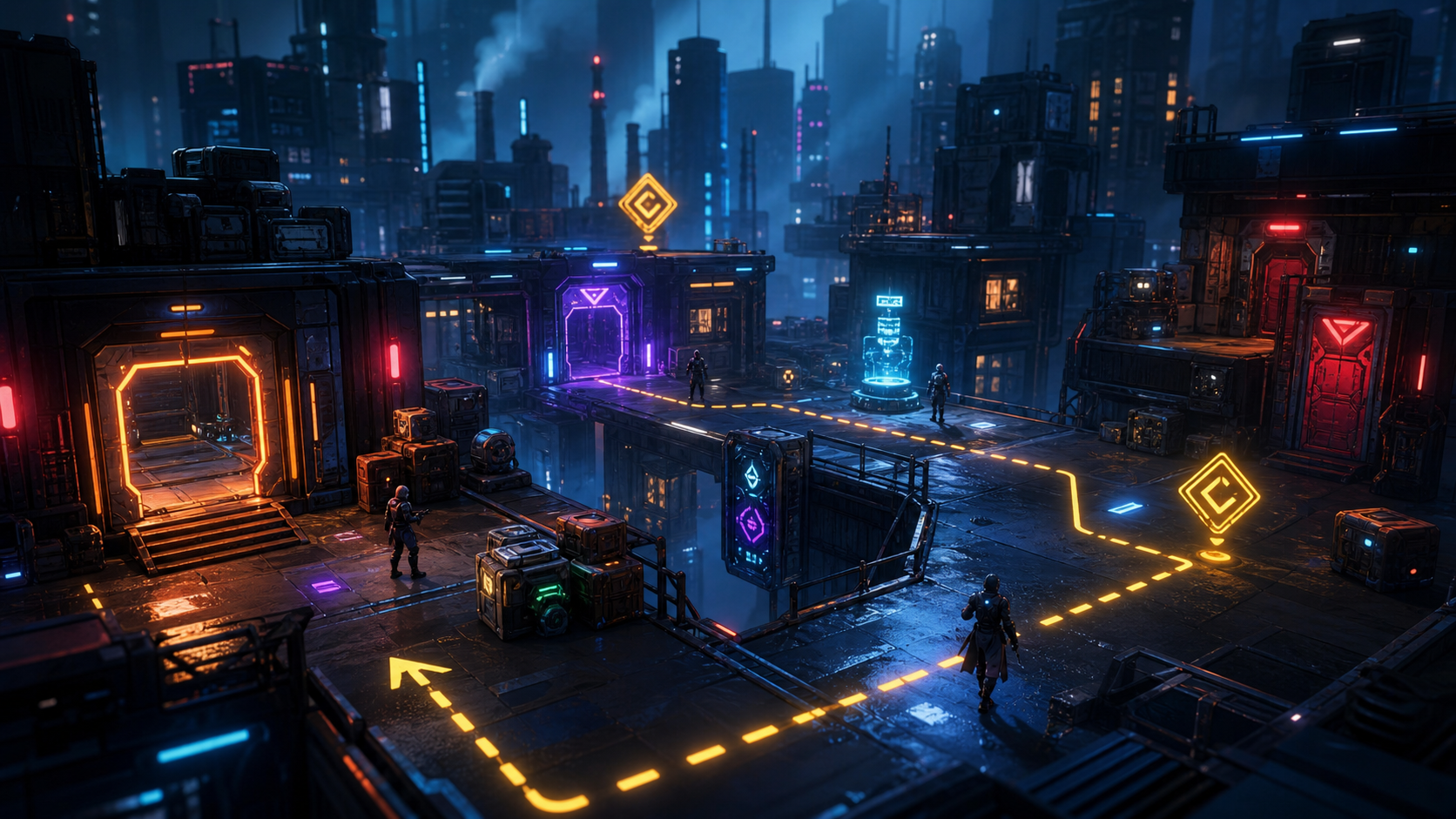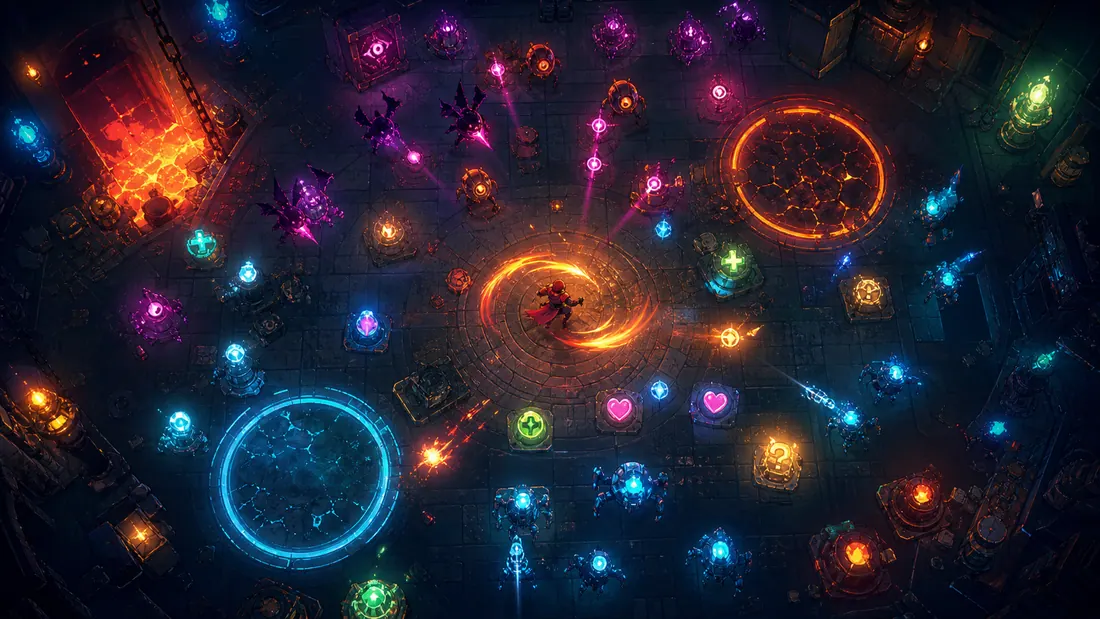
Interactive 3D world models are changing what a generated scene can do. Instead of producing a fixed image or video, they attempt to predict the next state of a world after a user or agent acts. Google DeepMind's Genie 3 demonstrates real-time navigation in generated environments, while World Labs' Marble turns text, images, video, or coarse 3D input into persistent 3D spaces. Those are meaningful advances, but neither claim makes a production game engine obsolete.
A grounded way to judge the shift is to begin with a playable loop on Elseland AI and ask which parts require simulated state, authored rules, deterministic controls, and shippable assets.
Quick read
Key takeaways
- A world model predicts how a scene changes after an action; a video generator only needs to produce a plausible clip.
- Current systems demonstrate real-time exploration or persistent 3D capture, but they do not replace game engines, authored rules, networking, or release QA.
- The most useful near-term roles are previsualization, spatial ideation, agent training, reference creation, and rapid playability tests.
- Evaluate state persistence, action coverage, editability, export, latency, and repeatability—not visual novelty alone.
What makes an interactive 3D world model different
A useful definition has three parts: the system represents a world, accepts an action or intervention, and predicts a consequential next state. A model that only turns a prompt into a camera move may be visually convincing without offering stable state or meaningful control.
The term also covers different technical outputs. Genie 3 generates an explorable visual stream frame by frame. Marble creates persistent 3D worlds that can be revisited and exported. A game engine executes explicit rules, collision, scripts, assets, UI, saving, and networking. These systems can complement one another, but their deliverables are not interchangeable.
| System | Primary output | Control model | Production gap |
|---|---|---|---|
| Video generator | Linear clip | Prompt, references, edit controls | No persistent playable state |
| Interactive world model | Predicted visual world | Actions and promptable events | Limited duration, actions, determinism, and export |
| 3D world generator | Persistent spatial scene | Text, image, video, or 3D inputs | Topology, semantics, optimization, and logic still need review |
| Game engine | Executable interactive product | Authored code, data, tools, and runtime | Requires deliberate content and engineering |
What has changed in interactive world generation
The first change is latency. DeepMind reports that Genie 3 operates at 20–24 frames per second at 720p, enabling continuous control rather than offline clip generation. The second is longer spatial memory: its official material says environments remain largely consistent for several minutes and can recall some interaction changes for about a minute.
The third change is input and output flexibility. World Labs describes Marble as accepting text, images, video, or coarse 3D layouts and producing persistent worlds that can be explored or downloaded. This moves the workflow closer to spatial ideation and downstream 3D work than a single rendered video.
These are vendor-reported capabilities, not evidence that every prompt produces a release-ready level. Access, export format, geometry quality, rights, and reliability must be checked for the exact product tier and date.
| Capability | Why it matters | Required test |
|---|---|---|
| Real-time response | Actions can influence the next view | Input-to-response latency and dropped frames |
| Spatial memory | A revisited place should remain recognizable | Loop route, alter an object, return later |
| Promptable events | Creators can introduce weather or objects | Check locality, persistence, and unintended changes |
| Persistent 3D output | A world can enter another tool | Inspect geometry, scale, materials, collisions, and license |
The limits that separate a demo from a game
DeepMind explicitly lists limited action space, difficulty simulating multiple independent agents, imperfect real-world accuracy, text-rendering problems, and only a few minutes of continuous interaction. Those constraints matter because games often depend on long sessions, exact rules, readable interfaces, repeatable encounters, and multiple actors.
A visually stable world can still fail as a level. Doors may not have semantic states, paths may be unreachable, geometry may be expensive, and a repeated input may produce a different outcome. A shippable game also needs saves, accessibility, localization, moderation, analytics, networking, and platform compliance.
- State: can inventory, damage, doors, and quests persist correctly?
- Control: does the same input have a predictable range of outcomes?
- Structure: can geometry be selected, edited, optimized, and collision-tested?
- Delivery: can the result be versioned, licensed, built, and reproduced?
- Safety: can users create harmful, infringing, or deceptive environments?
A practical world-model workflow for creators
Use world models early, where ambiguity is cheap. Start with a one-sentence player fantasy and a reference board, then generate or explore candidate spaces. Capture useful compositions, routes, landmarks, and lighting ideas. Convert selected material into an authored greybox and implement the actual rules in an engine.
Before committing to production, compare the concept against live game categories on Elseland: the useful question is whether the world supports a clear player action and consequence, not whether one frame looks cinematic.
Keep a provenance sheet for every reference and exported asset. Record the producing system, model or product version, prompt, input rights, date, transformations, reviewer, and intended use.
| Stage | World-model contribution | Human or engine gate |
|---|---|---|
| Intent | Explore worlds and visual directions | Define audience, loop, exclusions, and rights |
| Previsualization | Test routes, framing, scale, and mood | Select evidence, not just attractive frames |
| Greybox | Provide spatial reference | Author collision, metrics, rules, and states |
| Vertical slice | Supply reviewed references or assets | Optimize, integrate, localize, and playtest |
| Release | Optional scenario generation for QA | Deterministic builds, safety review, and approval |
How to evaluate world models for game development
Use the same task across systems: create a compact space with two landmarks, a locked route, a movable object, a weather change, and a return path. Fix the inputs, test duration, hardware, and allowed retries. Record failures as well as the best run.
Score control fidelity, spatial consistency, state persistence, interaction coverage, editability, export quality, latency, cost, and time to an accepted result. If a system is research-only or access-limited, label it as evidence of direction rather than a tool readers can use today.
| Axis | Question | Evidence |
|---|---|---|
| Consistency | Does the route remain coherent when revisited? | Recorded loop and landmark comparison |
| Persistence | Do interventions remain in state? | Before/after/return sequence |
| Editability | Can a creator correct one element without rebuilding all? | Versioned edit and exported artifact |
| Performance | Can it meet the target response and runtime budget? | Measured latency, frame rate, memory, and build size |
| Fit | Does it reduce time to a tested playable result? | Accepted output divided by total effort and cost |
Where interactive 3D world models fit now
Today, the strongest fit is exploration: spatial concepts, previsualization, rapid environment variation, synthetic training scenarios, and reference generation. Persistent 3D systems can also shorten the path from a visual idea to an editable starting point when their exports meet the team's requirements.
They are weakest when a project needs exact rules, long-horizon state, competitive determinism, dense multi-agent behavior, optimized geometry, or guaranteed reproducibility. Treat the world model as a new instrument around the engine—not a substitute for the production system that makes the experience reliable.
Frequently asked questions
Is a world model the same as a game engine?
No. A world model predicts environments or their next states, while an engine executes authored rules, assets, physics, UI, saves, networking, and builds. A workflow may use both.
Can Genie 3 make a complete game?
Its official demos show real-time interactive generated environments, not a complete shipping pipeline. DeepMind also lists limited actions, short interaction duration, and multi-agent limitations.
What does persistent 3D mean?
It means a spatial world can be revisited and, depending on the product, explored or exported rather than existing only as a linear clip. Persistence does not automatically guarantee clean topology or game-ready semantics.
Are video world models useful for level design?
They can help with mood, route ideas, composition, and previsualization. Designers still need to translate useful evidence into measured geometry, collision, rules, and tests.
What should teams benchmark first?
Test a short route with landmarks, an intervention, and a return path. This reveals control, spatial memory, state persistence, latency, and repeatability.
Can generated worlds be exported to an engine?
Some products describe downloadable 3D output, while others provide an interactive visual stream. Verify formats, geometry, materials, scale, licenses, and current access before planning an integration.
What are the biggest production risks?
Long-horizon inconsistency, limited actions, uneditable output, unpredictable costs, unclear rights, and failure to reproduce a selected result are central risks.
Will world models replace authored levels?
Current evidence does not support that broad claim. They can expand ideation and testing, while authored systems remain essential for precise, persistent, optimized, and reviewable gameplay.
Sources and further reading
- Google DeepMind: Genie 3
Official capabilities, technical framing, examples, and limitations.
- World Labs: Marble
Official description of multimodal inputs, persistent 3D worlds, exploration, and export.
- Google DeepMind: Genie 3 announcement
Official research announcement and recorded interaction examples.
Next step