The phrase generative game engine can make a demo sound like a direct replacement for existing development stacks. That framing hides the production questions: Can the team define exact rules, inspect state, reproduce a bug, persist a world, integrate services, meet performance targets, and ship to the intended platform?
Elseland's model comparison article focuses on choosing among AI systems for development. This guide instead explains the category boundary between a learned world model and an executable game engine.
Quick read
Key takeaways
- World models generate or predict experience; engines execute explicit authored systems.
- Controllability, persistent state, debugging, deterministic rules, and export remain major production distinctions.
- Genie 3 and Muse are research or limited-access systems, not drop-in replacements for Unity, Unreal, Godot, or browser runtimes.
- The near-term opportunity is hybrid ideation, prototyping, training, and content workflows.
What a World Model and a Game Engine Represent
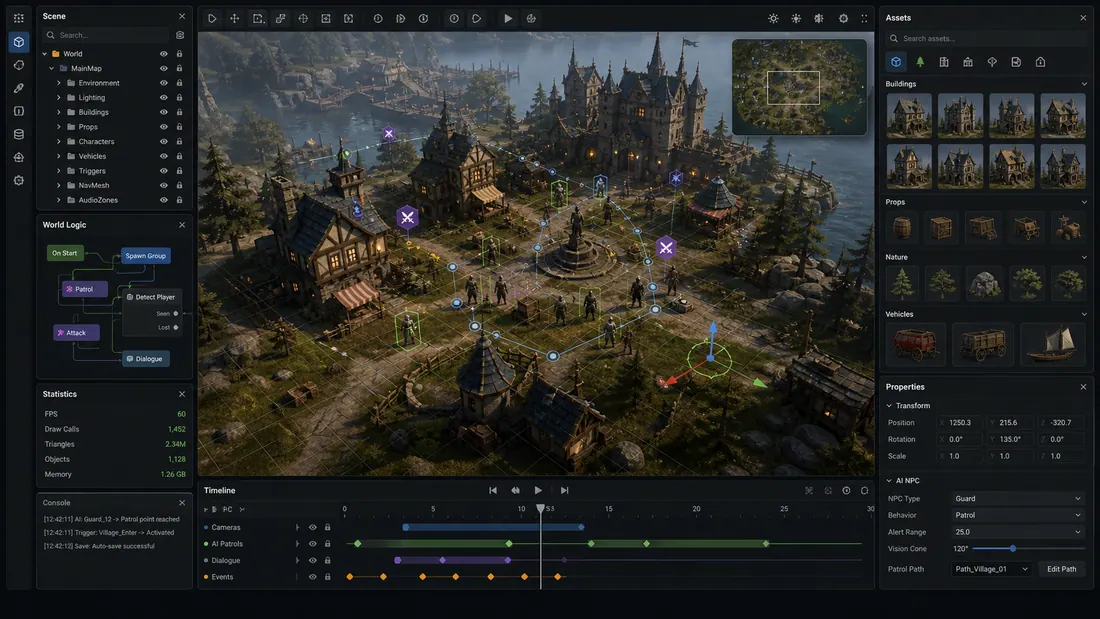
A world model learns patterns about environments, actions, and likely transitions from data. A game engine exposes explicit representations for scenes, entities, physics, scripting, animation, audio, input, networking, and builds.
These descriptions can overlap in an interactive demo, but they create different authoring and verification surfaces. Generated continuity is not the same as a queryable state machine.
What Google DeepMind Says About Genie 3
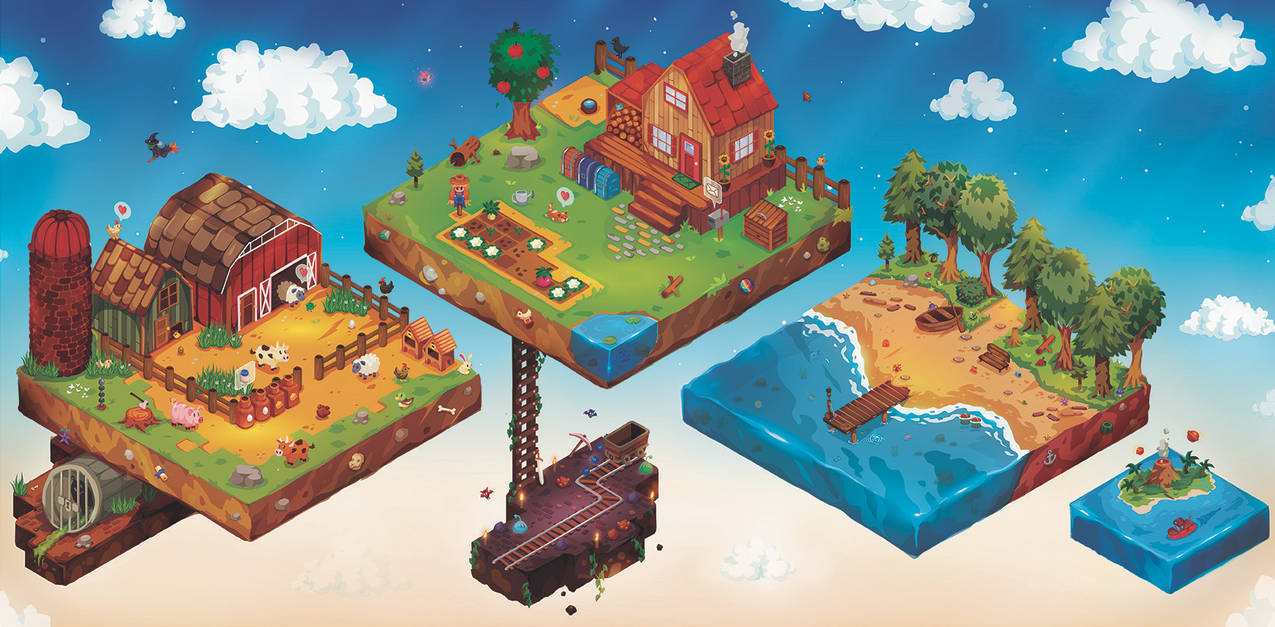
Google DeepMind describes Genie 3 as a general-purpose world model that can generate interactive environments from text and support real-time navigation for a limited duration. Project Genie provides an experimental way for eligible users to create and explore worlds.
Those capabilities are significant for simulation and ideation, but the public materials do not make Genie 3 a conventional engine with general build export, deterministic scripting, or a complete production editor.
What Microsoft Says About Muse
Microsoft Research introduced Muse as a generative model for gameplay ideation, trained on human gameplay data from Bleeding Edge. The announcement emphasizes consistency with game dynamics and responsive generated sequences.
The documented research goal is useful for ideation and understanding model behavior. It should not be expanded into unsupported claims about shipping arbitrary games or replacing the existing development toolchain.
Compare the Production Surface
| Question | World model | Game engine |
|---|---|---|
| Rules | Learned or prompted behavior | Explicit scripts, systems, and data |
| State | Often implicit in model context | Inspectable and persistent structures |
| Debugging | Probabilistic reproduction can be difficult | Logs, breakpoints, profilers, deterministic tests |
| Output | Interactive generated experience or predictions | Platform builds and runtime packages |
| Best current fit | Ideation, research, training, simulation drafts | Production authoring and delivery |
Design a Hybrid Workflow
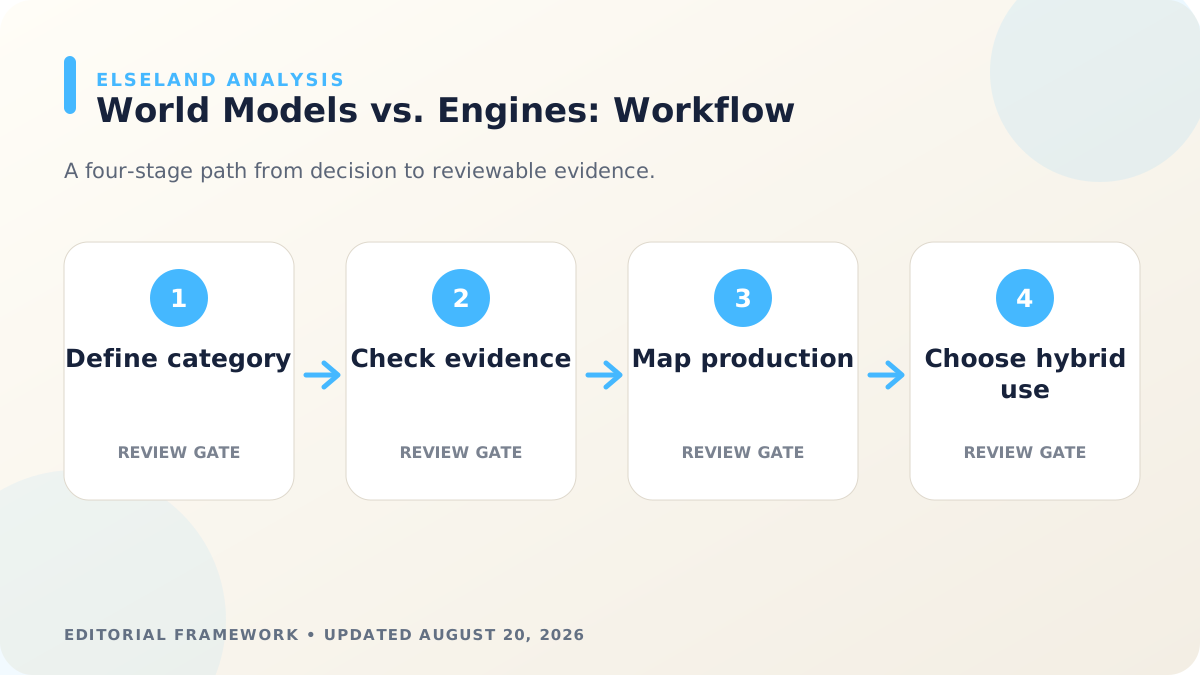
Use world models to explore spatial concepts, interaction possibilities, training scenarios, or early visual direction. Translate approved ideas into explicit assets, rules, state, tests, and builds when product control matters.
For practical browser examples, browse the playable game library; for deeper context on generated simulation, explore Elseland's living-world articles and simulation games.
Use a Capability Matrix, Not a Replacement Headline
Evaluate an interactive world demo and a conventional engine against the same production questions: rule control, state inspection, persistence, reproducibility, editing, asset ownership, debugging, integration, performance, build export, and platform compliance. A visually continuous experience may still provide few handles for deterministic product development.
Score only publicly documented capabilities and label inference. As of August 20, 2026, Google and Microsoft describe Genie 3 and Muse through research and experimental access; those materials do not establish general-purpose shipping workflows equivalent to mature engines.
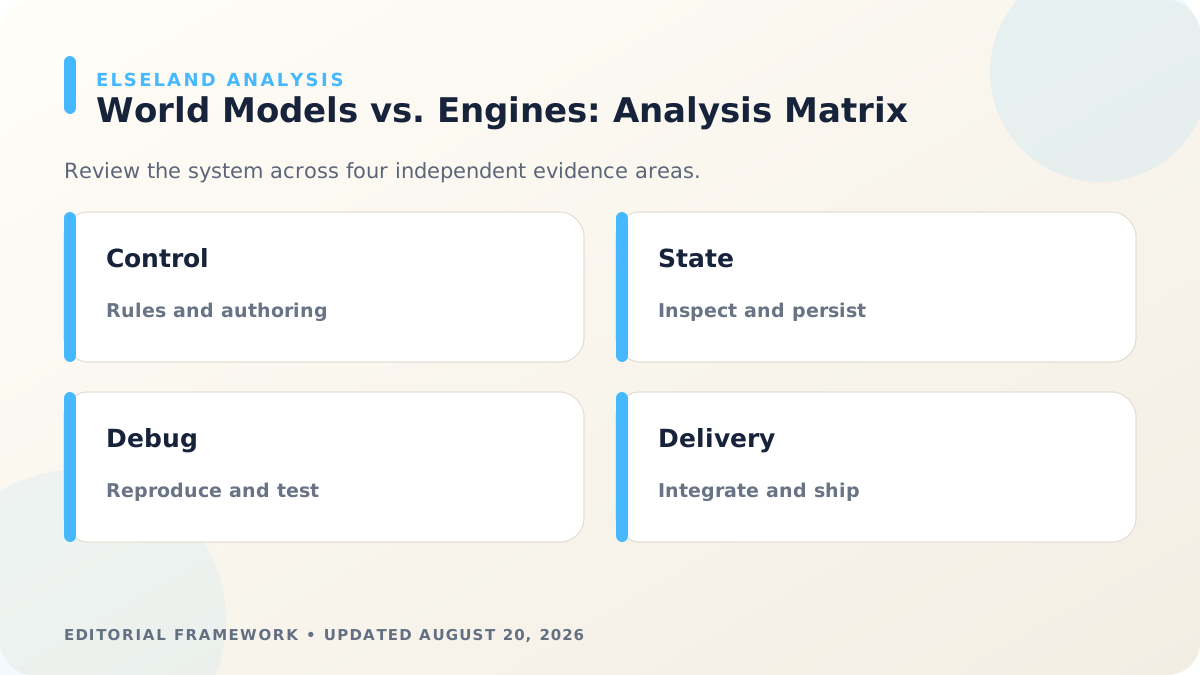
| Criterion | Evidence required | Why it matters |
|---|---|---|
| Control | Explicit rules or constrained actions | Design intent and fairness |
| State | Inspectable, persistent representation | Save, networking, analytics |
| Reproducibility | Seed, trace, or deterministic replay | Testing and bug fixing |
| Authoring | Editable objects, scripts, assets, and tools | Iteration and collaboration |
| Delivery | Supported builds, performance, compliance | Actual release |
Separate Confirmed, Inferred, and Unknown
Confirmed statements come directly from current first-party materials. Inferred statements explain plausible workflow implications and must be labeled. Unknowns include access, export, persistence, exact control surfaces, pricing, data policy, and reliability when the vendor has not documented them.
This evidence ladder prevents a research demonstration from being evaluated as a finished commercial engine. It also prevents the opposite mistake: dismissing world models because they do not yet expose every conventional tool.
- Confirmed: vendor-documented capability and access context
- Inferred: practical implication derived from the documented behavior
- Unknown: production requirement without public evidence
- Test needed: a reproducible experiment that could change the conclusion
- Decision horizon: useful now, watch, or not suitable for the current project
Avoid Category Errors in World-Model Analysis
Video quality is not the same as simulation accuracy, generated continuity is not the same as persistent state, and text prompting is not the same as editable game logic. Use precise terms for what the system produces and what the developer can control.
Google DeepMind's Genie page and Microsoft Research's Muse announcement provide the strongest starting evidence. Secondary headlines may add context, but they should not expand access or production claims beyond those primary sources.
| Symptom | Likely cause | Next check |
|---|---|---|
| Calls model an engine | Interactive output looks game-like | Check state, rules, tools, debug, export |
| Claims physical simulation | Visual motion appears plausible | Test consistency and hidden state |
| Assumes persistence | Scene remains coherent briefly | Verify save, revisit, and long-horizon state |
| Assumes replacement | One demo bypasses asset authoring | Map full production surface |
| Dismisses all value | Not ready for shipping | Evaluate ideation, training, and simulation uses |
World Model Evaluation Checklist
Design a small controlled task with known rules, repeated starting conditions, measurable state, and failure cases. Record what can be prompted, inspected, edited, replayed, exported, and integrated.
Revisit the evaluation when access or documentation changes. Emerging-model articles should carry a visible update date and preserve the evidence scope used for the current conclusion.
- Primary-source capability and access statements are date-scoped.
- Rules, state, persistence, and reproducibility are tested separately from visuals.
- Developer editing, debugging, collaboration, and integration surfaces are documented.
- Latency, duration, safety, data, and platform constraints are included.
- Confirmed facts, editorial inference, and unknowns use distinct language.
- The conclusion names suitable current uses without declaring an unsupported replacement.
What the Primary Sources Establish About World Models vs. Game Engines
Our evidence baseline starts with the Google DeepMind: Genie 3, accessed August 20, 2026. We use it to establish documented behavior, terminology, or constraints—not to claim that the source endorses Elseland's workflow or conclusions. The practical artifact under review is an evidence matrix separating demonstrated world-model capabilities from production-engine requirements.
That distinction is central to E-E-A-T. A first-party page can establish what a format, tool, platform, model, or game team publicly documents. It cannot prove that a particular asset is fast, accessible, legally cleared, fun, or production-ready. Those conclusions require separate observation, measurement, specialist review, or player evidence tied to the actual project.
For this topic, the decision is where a world model can support ideation or simulation without being mistaken for a controllable shipping runtime. The following observations turn the official reference into a reviewable production record rather than a decorative citation:
| Evidence layer | What it can support | What it cannot support alone |
|---|---|---|
| Official source | Documented feature, rule, format, or published design context | Project-specific quality or universal performance |
| Project measurement | Observed behavior in a named build, scene, device, or sample | Unmeasured platforms or future versions |
| Human review | Usability, visual, editorial, and production judgment | Legal certainty or population-level player behavior |
| Release record | Who approved what, when, with which evidence | Permanent compliance after inputs or rules change |
- 1. quote demonstrated capabilities from first-party research pages. Store the result with the asset or build identifier so another reviewer can reproduce the conclusion.
- 2. separate generated visual interaction from authored persistent state. Store the result with the asset or build identifier so another reviewer can reproduce the conclusion.
- 3. evaluate control, reproducibility, inspectability, integration, and deployment. Store the result with the asset or build identifier so another reviewer can reproduce the conclusion.
- 4. label forward-looking production uses as hypotheses rather than shipped facts. Store the result with the asset or build identifier so another reviewer can reproduce the conclusion.

A Field Review Protocol for World Models vs. Game Engines
Use this protocol after the first plausible output exists and before scaling the workflow. Keep one untouched baseline, one candidate revision, and one deliberately stressed case. The stressed case should expose the topic's likely failure mode—crowded scenes, extreme poses, small-screen play, unusual inputs, or a release-rule change—rather than merely repeat the easiest success case.
Run the review in the real delivery context whenever possible. Capture the tool or model version, source files, settings, target device or engine, date, and reviewer. If the work depends on a changing external service, record the response or exported artifact instead of assuming the same output can be recreated later.
A useful review ends with a decision and a next action. “Looks good” is not a gate. State whether the candidate passes, passes with a bounded exception, needs revision, or should be rejected; identify the evidence behind that status and the owner of the next check.
| Review status | Meaning | Required next action |
|---|---|---|
| Pass | All defined visual, technical, and release gates are supported by evidence | Freeze the reviewed artifact and link it to the build |
| Conditional pass | A known limitation is bounded and does not invalidate the intended use | Document the exception, owner, and trigger for re-review |
| Revise | The direction is viable but one or more gates remain unsupported | Change one controlled variable and repeat the affected checks |
| Reject | The candidate conflicts with the intended use, evidence, rights, safety, or budget | Preserve the record and choose a different approach |
- record model version, access context, demonstration conditions, and date. Record the expected result before the check, then attach the observed result and any exception after it.
- identify which outputs are pixels, actions, state, code, or editable assets. Record the expected result before the check, then attach the observed result and any exception after it.
- test whether the same setup can be reproduced and debugged. Record the expected result before the check, then attach the observed result and any exception after it.
- map missing engine services such as persistence, networking, UI, and tooling. Record the expected result before the check, then attach the observed result and any exception after it.
- choose bounded research or ideation tasks with human review. Record the expected result before the check, then attach the observed result and any exception after it.
- revisit the matrix when the provider publishes new technical evidence. Record the expected result before the check, then attach the observed result and any exception after it.
Expert Interpretation and Limits of This AI Worlds & Characters Guide
The strongest conclusion this guide can support is a conditional production recommendation: use the workflow when its documented assumptions match the project, and keep the evidence needed to revisit the decision. We do not infer universal model quality, player preference, legal clearance, or performance from an official screenshot, a provider example, or a single successful asset.
Experience matters here because world models vs. game engines crosses creative judgment and implementation detail. The practical review should include the people who will edit the source, integrate the result, test it in play, maintain it after release, and answer rights or policy questions. A narrow expert handoff often misses problems that appear only when those responsibilities meet.
Before publishing or shipping, repeat time-sensitive checks against the current source and exact build. Preserve dated evidence, disclose the evaluation method, and distinguish measured results from editorial inference. That record is more valuable than a confident conclusion that future reviewers cannot reproduce.
| Claim type | Editorial treatment |
|---|---|
| Documented fact | Link to Google DeepMind: Genie 3 and include the access date |
| Observed project result | Name the build, environment, sample, and method |
| Expert judgment | State the criteria, reviewer role, and tradeoff |
| Inference or forecast | Label it explicitly and describe what evidence could change it |
- A curated demonstration does not establish general production reliability.
- Interactive video generation is not equivalent to an inspectable entity-component world.
- Access, latency, cost, and export behavior may change as research systems evolve.
- This comparison is documentation-based and does not claim private model access.
Frequently asked questions
Is Genie 3 a game engine?
Google DeepMind describes it as a general-purpose world model. It can generate interactive environments, but its public capabilities and access model differ from a conventional production game engine.
What is Microsoft Muse for?
Microsoft Research presents Muse as a generative model designed for gameplay ideation and research, based on learned gameplay dynamics.
Will world models replace game engines?
Current public evidence does not support a simple replacement claim. Hybrid workflows are more plausible in the near term because production still needs explicit control, debugging, persistence, tools, and delivery.
How can indie developers use world-model ideas now?
Use them as inspiration for rapid world ideation, simulation, agent training, and prototype exploration, then move approved concepts into an engine or browser runtime with explicit rules and tests.
What would make a world model production-ready for games?
Projects need sufficient control, inspectable state, persistence, reproducibility, editing, debugging, integration, performance, safety, and release rights for the intended product. Different games can accept different levels of uncertainty.
Can a world model be used with a traditional engine?
Potentially. Hybrid uses could include ideation, synthetic training environments, visual drafts, agent evaluation, or generated content that is converted into explicit assets and rules. The integration surface must be documented and tested.
Why is persistence important?
Games often need saved progress, revisitable spaces, consistent inventories, quests, relationships, networking, and analytics. Short-term visual coherence does not by itself prove those state requirements.
How often should an emerging-model comparison be updated?
Review it when vendors change access, publish technical details, release APIs or exports, or provide evidence about control and persistence. Keep an absolute update date and avoid silently rewriting earlier claims.
Sources and further reading
- Google DeepMind: Genie 3
First-party model page for Genie 3 and its interactive world-generation capabilities.
- Google: Project Genie
Official announcement of the experimental interface and access context.
- Microsoft Research: Muse
First-party description of Muse's research design and gameplay-ideation focus.
Next step