
In many games, failure pauses the interesting part. Hades turns the return to the House of Hades into part of the interesting part: characters respond, resources can be spent, relationships change, and the player leaves with a new plan.
The transferable design question is not how to copy Hades. It is how your own action or RPG loop can make a failed run produce information, story, or choice before the next attempt.
Quick read
Key takeaways
- Return failure to a hub where relationships, dialogue, and goals can advance.
- Separate player learning from carefully bounded forms of permanent progression.
- Keep the restart path short and the next strategic choice visible.
- Offer difficulty support that preserves agency instead of hiding the challenge model.
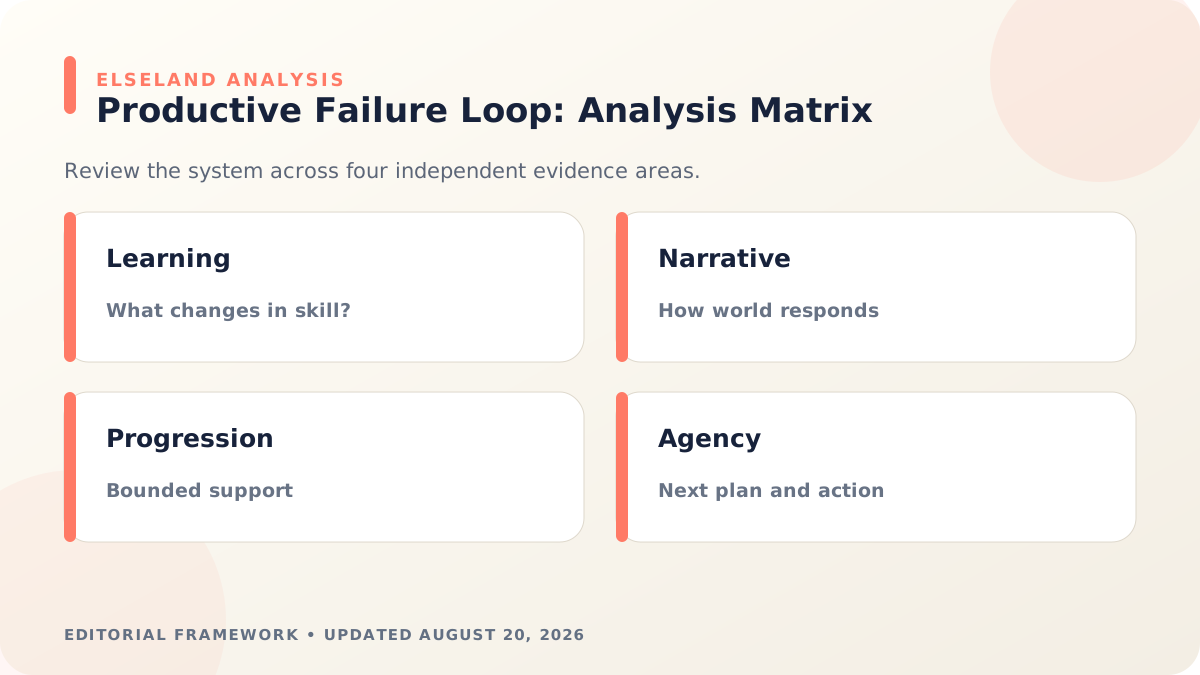
Failure Changes the State of the World
Death returns Zagreus to a social hub rather than an inert retry screen. Conversations, reactions, and ongoing relationships acknowledge what happened, so the run becomes part of the narrative record.
For another game, even a small contextual change—a new line, unlocked observation, updated rival behavior, or revised objective—can make failure feel witnessed rather than erased.
Permanent Progression Supports Learning
The player gains execution skill and knowledge across runs, while selected systems also provide persistent resources and options. These layers can reduce frustration without making every outcome automatic.
Avoid compensating for failure with so much power that decisions stop mattering. Progression should expand strategy, clarify goals, or soften a barrier while preserving the value of mastery.
The Next Attempt Starts With a New Plan
Changing rewards, weapon aspects, boons, encounters, and narrative goals create reasons to reconsider the route. A player can attribute the next run to an experiment rather than to repeating the exact same exam.
Show the next choice quickly. Long menus, repeated exposition, or slow traversal between death and agency can drain the motivation that failure generated.
Difficulty Support Can Preserve Agency
Supergiant's official FAQ describes permanent progression and a range of difficulty modifiers, including God Mode as an option for players focused on story. The important pattern is transparent support that the player can choose.
A good assist system explains what changes, remains reversible where possible, and avoids shaming the player. It helps different audiences reach the part of the game they value.
Design a Productive Failure Loop
Write down what the player learns, what the world acknowledges, what changes permanently, what new choice appears, and how long it takes to regain control. If none of those move forward, the loop may feel like lost time.
Prototype the smallest version of that loop with one encounter, one failure state, one persistent choice, and a fast restart before building a larger RPG progression system.
Worked Example: Redesign a Punishing Boss Retry
Assume defeat currently returns the player to a menu, removes all collected resources, and requires a three-minute route back to the boss. Preserve the boss's difficulty, but return the player to a small hub where one character reacts, the last run can be reviewed, one bounded upgrade or loadout choice is available, and the next attempt begins quickly.
The redesign creates four forms of progress without guaranteeing victory: mechanical knowledge, narrative acknowledgment, strategic variation, and optional persistent support. Measure time back to agency, whether the player can explain the failure, and whether the next attempt begins with a new plan.
| Failure output | Player value | Design risk |
|---|---|---|
| Run analysis | Explains damage, pattern, or missed choice | Overwhelming statistics |
| Narrative response | Makes the attempt part of the world | Repetitive or judgmental dialogue |
| Loadout choice | Creates a new hypothesis | False choice or dominant option |
| Persistent support | Adjusts long-term difficulty | Power growth erases mastery |
| Fast restart | Protects motivation | No time to reflect |
Design Failure Across Five Clocks
Track time to understand the failure, time to receive acknowledgment, time to make a new decision, time to regain control, and time to reach the next meaningful challenge. A loop can feel slow even when loading is fast if menus and repeated dialogue delay agency.
Hades combines these clocks through its return hub, relationships, progression, and renewed choices. Other genres can use different structures: a puzzle might reveal a board analysis, a strategy game may preserve intelligence, and a simulation can let the world respond to the failed intervention.
- Explanation clock: how quickly cause becomes legible
- Acknowledgment clock: when the world or narrative responds
- Decision clock: when a new plan can be formed
- Control clock: when the player can act again
- Challenge clock: when the next meaningful test begins
Avoid Fake Progress and Repetitive Recovery
A consolation currency does not automatically make failure meaningful. If it buys mandatory power on a fixed schedule, the player may feel the game is charging time instead of teaching. If dialogue repeats or the hub becomes chores, narrative acknowledgment turns into delay.
Supergiant's Hades FAQ describes permanent progression and optional difficulty modifiers alongside narrative and character interaction. The transferable principle is choice and context, not a requirement that every game add a metaprogression tree.
| Symptom | Likely cause | Next check |
|---|---|---|
| Failure feels erased | World and systems reset without acknowledgment | Preserve information, reaction, or choice |
| Retry feels slow | Long travel, menus, repeated dialogue | Shorten path and surface next decision |
| Progress feels compulsory | Only stats change | Add strategic options and learning support |
| Assist feels stigmatized | Opaque or judgmental presentation | Explain, allow choice, preserve reversibility |
| Runs feel identical | No meaningful variation | Change goals, tools, route, or narrative context |
Productive Failure Loop Checklist
Map the emotional and mechanical state before failure, during the recovery space, and at the start of the next attempt. Make sure the loop does not accidentally remove the player's strongest reason to return.
Playtest repeated failures, not only the first one. Recovery dialogue, menus, and reward animations that feel welcome once can become friction by the fifth attempt.
- The cause of failure is understandable without a developer explanation.
- The world, narrative, or analysis acknowledges the attempt meaningfully.
- The player gains knowledge, choice, story, or bounded progression.
- Optional difficulty support is transparent and non-judgmental.
- Time back to control and the next challenge protects motivation.
- Repeated recovery paths vary or compress instead of becoming chores.
What the Primary Sources Establish About Hades and Rewarding Failure
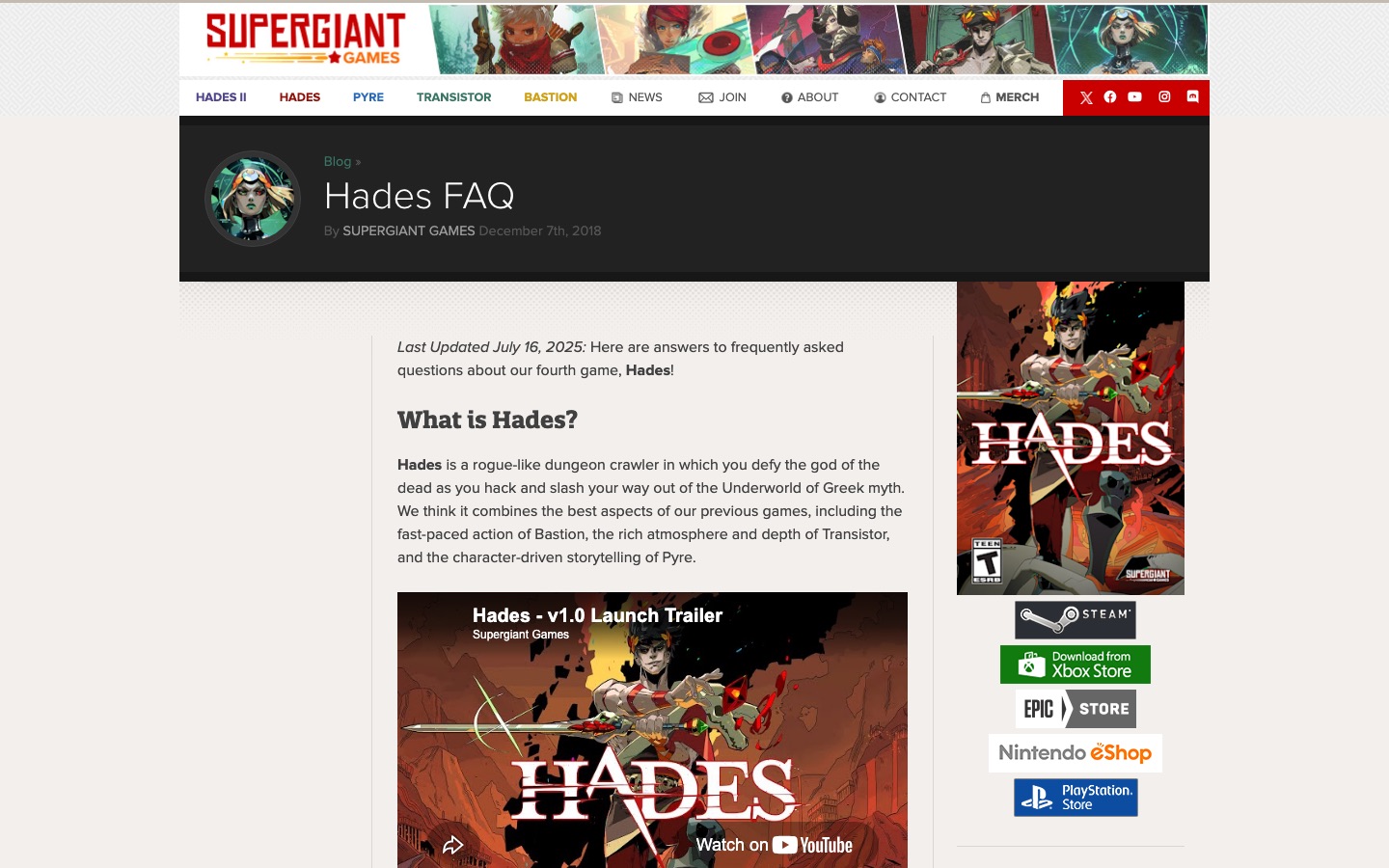
Our evidence baseline starts with the Supergiant Games: Hades FAQ, accessed August 20, 2026. We use it to establish documented behavior, terminology, or constraints—not to claim that the source endorses Elseland's workflow or conclusions. The practical artifact under review is a failure-to-restart journey map covering explanation, acknowledgement, new choices, permanent support, and renewed agency.
That distinction is central to E-E-A-T. A first-party page can establish what a format, tool, platform, model, or game team publicly documents. It cannot prove that a particular asset is fast, accessible, legally cleared, fun, or production-ready. Those conclusions require separate observation, measurement, specialist review, or player evidence tied to the actual project.
For this topic, the decision is whether defeat creates information and motivation instead of only delay. The following observations turn the official reference into a reviewable production record rather than a decorative citation:
| Evidence layer | What it can support | What it cannot support alone |
|---|---|---|
| Official source | Documented feature, rule, format, or published design context | Project-specific quality or universal performance |
| Project measurement | Observed behavior in a named build, scene, device, or sample | Unmeasured platforms or future versions |
| Human review | Usability, visual, editorial, and production judgment | Legal certainty or population-level player behavior |
| Release record | Who approved what, when, with which evidence | Permanent compliance after inputs or rules change |
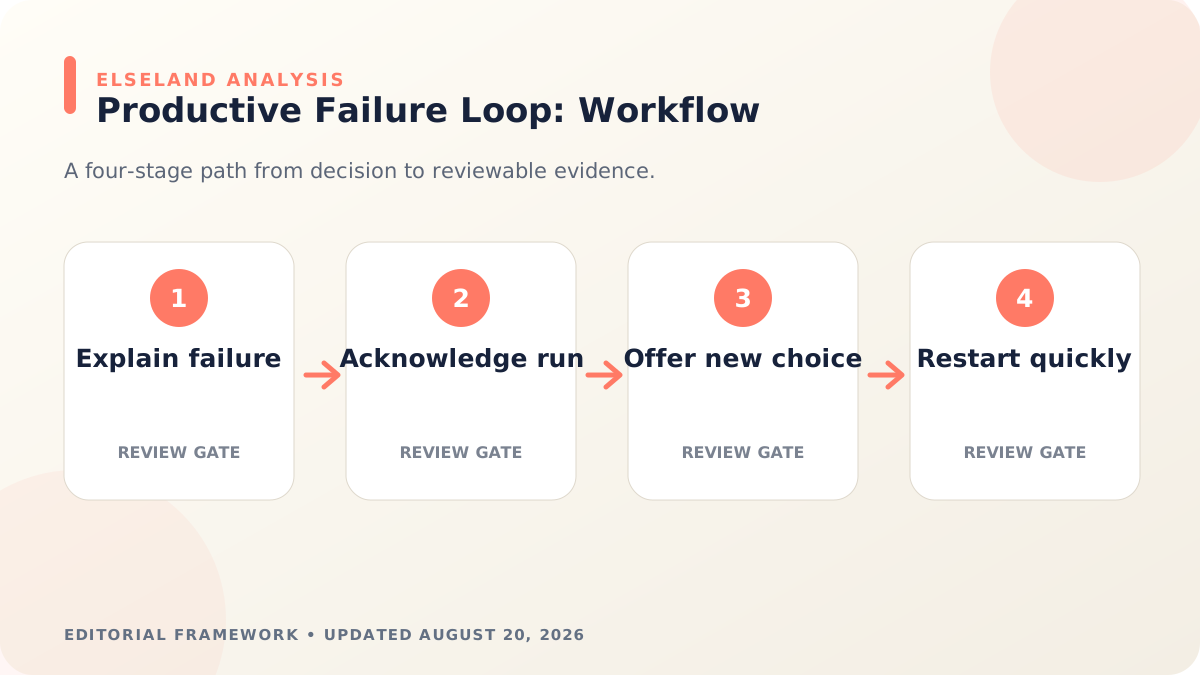
- 1. show the immediate reason for failure while the event is still legible. Store the result with the asset or build identifier so another reviewer can reproduce the conclusion.
- 2. acknowledge the run through world or character response. Store the result with the asset or build identifier so another reviewer can reproduce the conclusion.
- 3. offer bounded progression without erasing skill development. Store the result with the asset or build identifier so another reviewer can reproduce the conclusion.
- 4. minimize downtime between a new plan and meaningful action. Store the result with the asset or build identifier so another reviewer can reproduce the conclusion.
A Field Review Protocol for Hades and Rewarding Failure
Use this protocol after the first plausible output exists and before scaling the workflow. Keep one untouched baseline, one candidate revision, and one deliberately stressed case. The stressed case should expose the topic's likely failure mode—crowded scenes, extreme poses, small-screen play, unusual inputs, or a release-rule change—rather than merely repeat the easiest success case.
Run the review in the real delivery context whenever possible. Capture the tool or model version, source files, settings, target device or engine, date, and reviewer. If the work depends on a changing external service, record the response or exported artifact instead of assuming the same output can be recreated later.
A useful review ends with a decision and a next action. “Looks good” is not a gate. State whether the candidate passes, passes with a bounded exception, needs revision, or should be rejected; identify the evidence behind that status and the owner of the next check.
| Review status | Meaning | Required next action |
|---|---|---|
| Pass | All defined visual, technical, and release gates are supported by evidence | Freeze the reviewed artifact and link it to the build |
| Conditional pass | A known limitation is bounded and does not invalidate the intended use | Document the exception, owner, and trigger for re-review |
| Revise | The direction is viable but one or more gates remain unsupported | Change one controlled variable and repeat the affected checks |
| Reject | The candidate conflicts with the intended use, evidence, rights, safety, or budget | Preserve the record and choose a different approach |
- catalog what players can learn from each failure state. Record the expected result before the check, then attach the observed result and any exception after it.
- measure time from defeat to the next meaningful choice. Record the expected result before the check, then attach the observed result and any exception after it.
- separate narrative response, unlocks, currency, and player knowledge. Record the expected result before the check, then attach the observed result and any exception after it.
- avoid upgrades that make earlier decisions irrelevant. Record the expected result before the check, then attach the observed result and any exception after it.
- surface a small set of understandable next experiments. Record the expected result before the check, then attach the observed result and any exception after it.
- test whether repeated failure changes strategy rather than only statistics. Record the expected result before the check, then attach the observed result and any exception after it.
Expert Interpretation and Limits of This Game Guides Guide
The strongest conclusion this guide can support is a conditional production recommendation: use the workflow when its documented assumptions match the project, and keep the evidence needed to revisit the decision. We do not infer universal model quality, player preference, legal clearance, or performance from an official screenshot, a provider example, or a single successful asset.
Experience matters here because hades and rewarding failure crosses creative judgment and implementation detail. The practical review should include the people who will edit the source, integrate the result, test it in play, maintain it after release, and answer rights or policy questions. A narrow expert handoff often misses problems that appear only when those responsibilities meet.
Before publishing or shipping, repeat time-sensitive checks against the current source and exact build. Preserve dated evidence, disclose the evaluation method, and distinguish measured results from editorial inference. That record is more valuable than a confident conclusion that future reviewers cannot reproduce.
| Claim type | Editorial treatment |
|---|---|
| Documented fact | Link to Supergiant Games: Hades FAQ and include the access date |
| Observed project result | Name the build, environment, sample, and method |
| Expert judgment | State the criteria, reviewer role, and tradeoff |
| Inference or forecast | Label it explicitly and describe what evidence could change it |
- Hades is a public design case, not evidence of private retention metrics.
- Narrative response requires substantial authored content and cannot be copied mechanically.
- Permanent progression can conceal unclear combat feedback rather than fix it.
- Different audiences tolerate repetition, randomness, and punishment differently.
Frequently asked questions
Why does dying in Hades feel different from a normal game over?
Death returns the player to a hub where story, relationships, upgrades, and strategic choices can advance, so the failed run still affects what happens next.
Does permanent progression make failure rewarding?
It can help, but rewards also come from learning, narrative response, new choices, and a short restart. Power growth alone may weaken mastery if overused.
What is a productive failure loop?
It is a loop in which failure produces useful information, acknowledged consequences, an adjusted plan, or bounded progression before the next attempt.
Can this pattern work outside roguelikes?
Yes. Puzzle, strategy, simulation, and narrative games can preserve discoveries, update characters, reveal analysis, or offer new options after failure.
Does every failure need a material reward?
No. Clear information, narrative acknowledgment, a revealed strategy, changed world state, or a faster next decision can be valuable. Material rewards should support the loop rather than become payment for tolerating frustration.
How fast should a game restart after failure?
Fast enough to protect intent, but not so fast that the player misses the cause or the next choice. Measure the whole path back to meaningful agency, including menus, dialogue, loading, and repeated traversal.
Can a story game use rewarding failure without becoming a roguelike?
Yes. It can remember discoveries, alter dialogue, unlock investigation notes, preserve relationships, or change available approaches. The structure can stay linear while the failed attempt still matters.
How do assist modes fit a failure loop?
They give players control over the challenge relationship. Explain what changes, make the option easy to find, avoid shaming language, and preserve reversibility where the design permits.
Sources and further reading
- Supergiant Games: Hades FAQ
First-party discussion of difficulty options, permanent progression, narrative, and Early Access design.
- Supergiant Games: Hades
Official overview of Hades and its escape-from-the-underworld structure.
- Steam: Hades
Official store description and feature context for the released game.
Next step