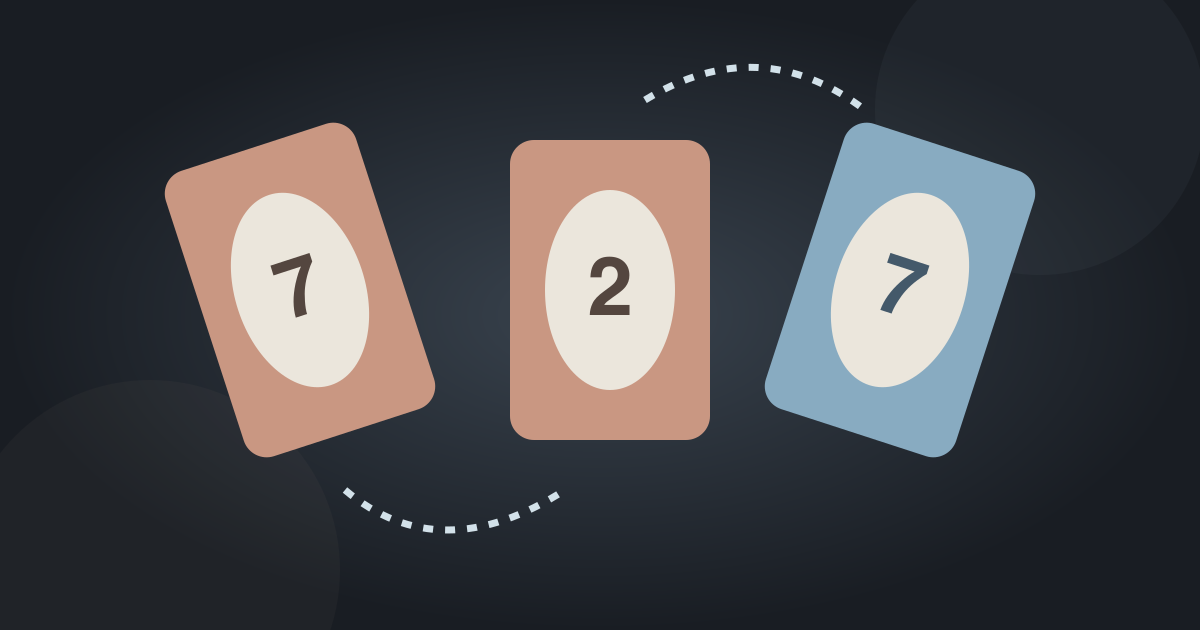

A useful ZAP card game strategy starts with a question beyond “Can I play this card?”: what options will remain after I do? Compare legal number cards, avoid leaving yourself dependent on one narrow situation, and make pressing “1” automatic. None of these habits guarantees a win; hidden cards and future draws still matter.
Build a ZAP card game strategy from verified rules
The ZAP distributor guide documents color-or-number matching, drawing when blocked, and the one-card declaration. Those rules support planning around flexibility. They do not establish an optimal policy, exact odds, or a scoring-based reason to discard particular card values.
Count legal ordinary-card options before deciding. If you have only one, the decision is simpler. If several are available, compare the hand you would keep—not just the card you could remove.
An illustrative hand: preserve more than one route
Suppose the top card is red 7 and your ordinary number cards are red 2, blue 7, blue 4, and yellow 2. Both red 2 and blue 7 match. Playing red 2 leaves a number-2 route for yellow 2; playing blue 7 leaves blue 4 aligned by color.
This is a decision example, not a solved position: another player can change the top card before your next turn. The useful habit is identifying what remains connected. Choose according to your actual hand and any verified in-game effects, not a rule that “always change color” or “always keep the same color” is best.
| Candidate | Connection kept in hand | Uncertainty |
|---|---|---|
| Red 2 | Yellow 2 shares its number | Opponents may change the top card |
| Blue 7 | Blue 4 shares its color | The next turn is not guaranteed to stay blue |
A second hand: compare the routes you leave behind
Suppose red 7 is on top and you hold red 2, red 9, blue 2, blue 4, and yellow 9. Both red cards are legal. Playing red 2 leaves blue 2 as a number connection, with blue 4 connected to blue 2 by color. Playing red 9 leaves yellow 9 as a number connection. You are comparing possible routes through the remaining hand, not claiming you can play the route uninterrupted.
This example favors examining the blue pair, but it does not prove red 2 is optimal. Unknown opponent cards and future changes matter. The transferable skill is naming what each candidate preserves instead of mechanically discarding the first legal card.
Flexibility is not the same as having more blue cards
Several cards of one color can help while that color stays active, but they also depend on the board returning to it. Repeated numbers across colors create another type of connection. Neither pattern is universally better without a complete ruleset and the hidden position. Do not turn the preceding example into “always keep pairs” or “always clear red first.”
When comparing candidates, ask which remaining cards share color, which share number, and which become isolated from the others. This describes your visible hand only. It does not calculate draw probabilities or reveal an opponent’s future action, so retain the uncertainty when explaining your choice.
Use opponent behavior as a clue, not certainty
A player drawing when blocked may lack an ordinary match for that moment. It does not reveal their whole hand or prove that a color remains weak later. A new draw or intervening play changes the evidence.
Observe current hand sizes to recognize urgency, but do not invent a card-counting system without knowing the deck. If an opponent is nearly out, a familiar attack-card tactic is only appropriate when ZAP’s current rules actually support it. This guide does not assume undocumented stacking or challenge behavior.
An opponent draw is temporary evidence
Imagine another player draws while the top card is yellow 5. That observation concerns one position at one moment. The player may gain a yellow card from the draw, use a matching number, or face a different top card later. The conclusion “they can never play yellow” is much stronger than the evidence.
Use the observation to ask a cautious question, not to invent certainty. Also distinguish urgency from knowledge: a small opposing hand makes their next legal opportunity important, but does not reveal the final card’s color. Without verified deck contents and special effects, a precise card-counting or guaranteed blocking plan would be misleading.
Plan the last two cards before declaring
When the hand is small, compare the card you would leave behind. A legal second-to-last play still may leave a final card that needs a different top card. You cannot force every intermediate opponent play, but you can avoid ignoring the endgame entirely.
Before committing, locate “1.” After the hand reaches one, press immediately. Preventing a known two-card penalty is a concrete process improvement, unlike a speculative promise that a particular color order wins most rounds.
An endgame rehearsal: inspect the final card before committing
With two ordinary cards left, consider both the candidate you can play now and the one you would retain. If red 2 and blue 7 face red 7, either is legal, but each leaves a different color and number requirement. Another player can change the board before you act again, so the rehearsal is about awareness rather than forcing a finish.
Locate “1” before choosing, then press immediately once the hand reaches one. After a two-card penalty, abandon the old two-card plan and inspect the expanded hand. A reliable declaration routine is a controllable habit; predicting the final board is not.
Review one decision, then change one habit
After a round, ask whether the decisive problem was no legal match, an overlooked number match, an unsupported rule assumption, or a missed declaration. Those are different failures and need different practice.
For the next round, choose one correction: scan both matching properties, compare the remaining hand, or pair the second-to-last play with “1.” Record a small example if useful. Do not judge the entire strategy from one lucky draw or one loss; outcome and decision quality are not identical.
Keep a decision log instead of chasing a lucky streak
Record one position: the top card, your visible ordinary cards, legal candidates, the choice, and the connection you intended to keep. Afterward, note what changed and whether a declaration was missed. A short record is enough; you do not need private opponent data or invented statistics.
If a sound comparison loses after an unexpected board change, that outcome alone does not make it careless. If an overlooked number match wins through a lucky draw, the result does not validate the oversight. Review what was knowable when choosing. For the next session, change one habit so you can tell whether the decision process—not merely the result—became clearer.
Next step