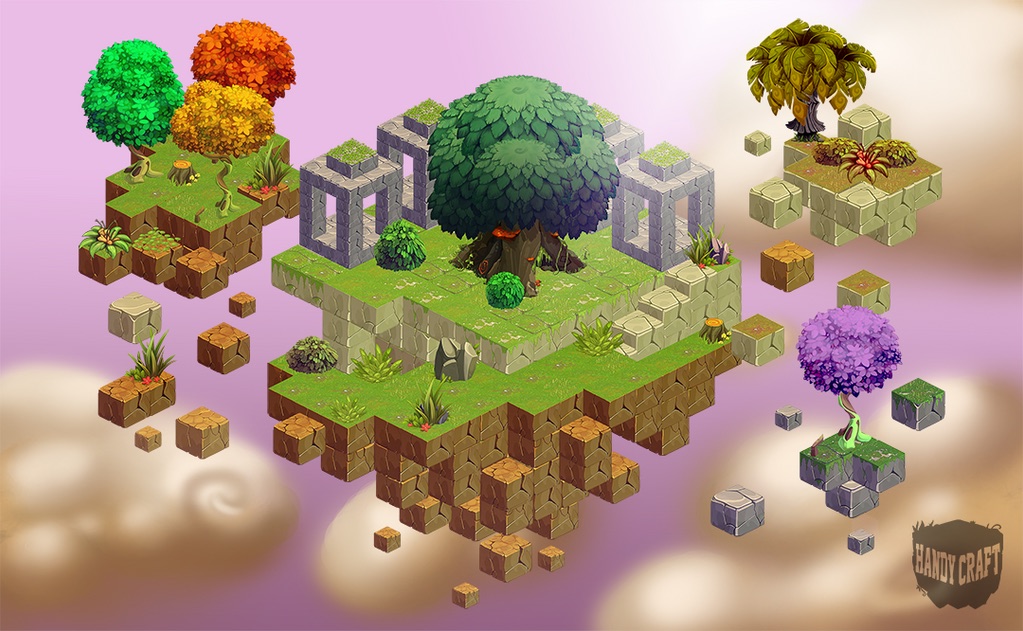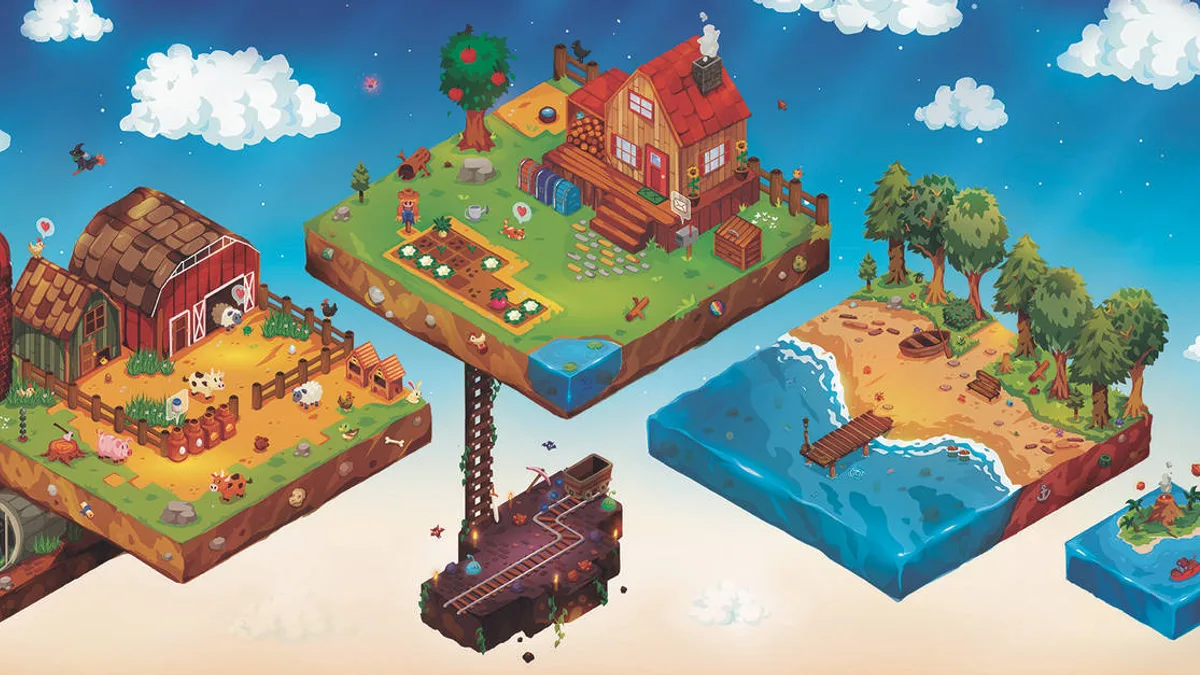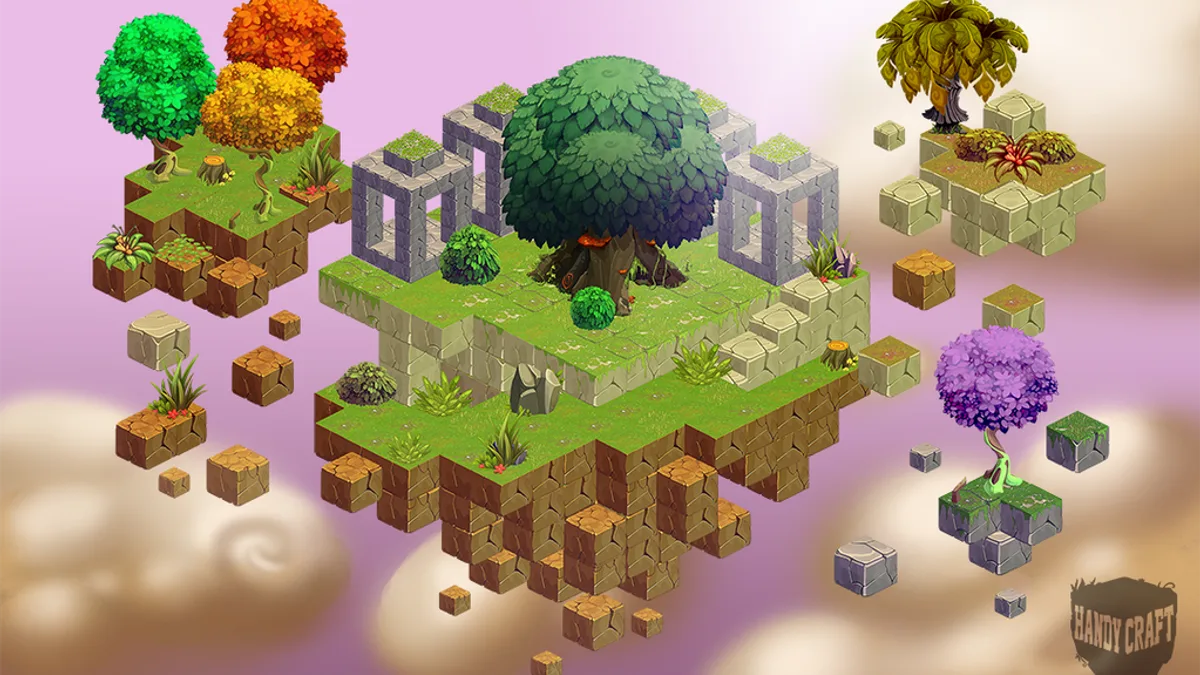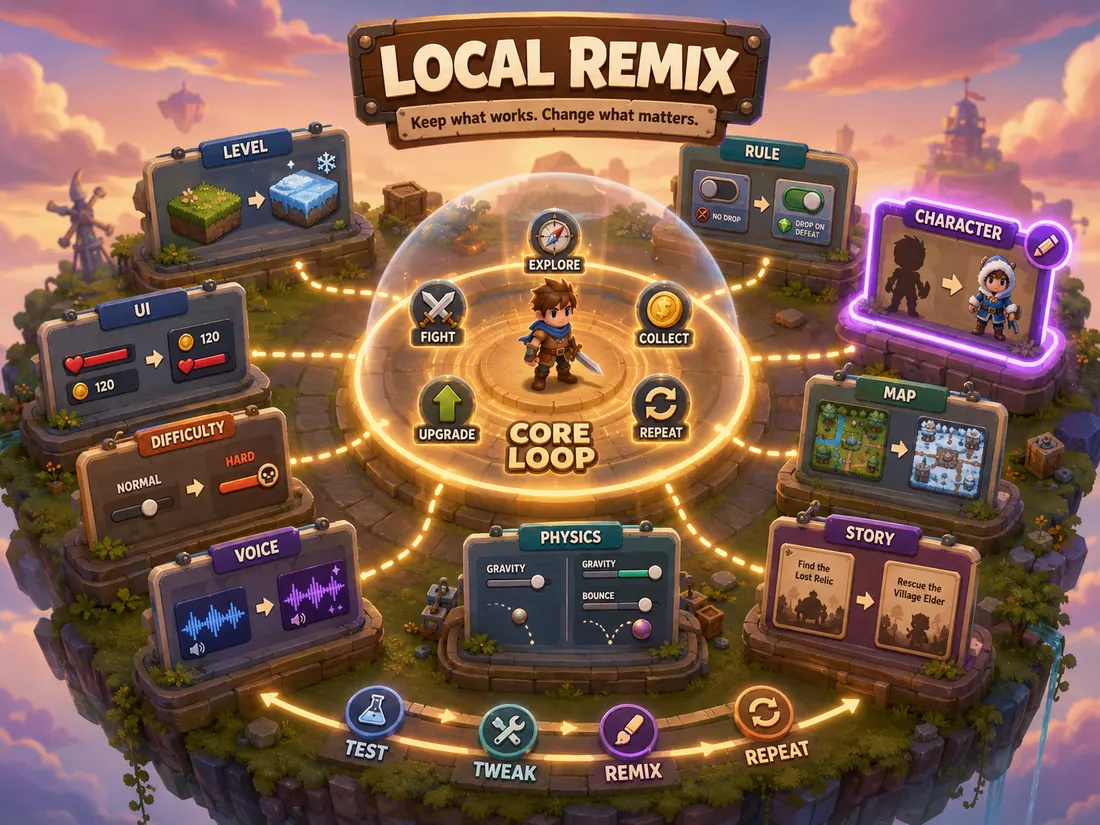
Minecraft starts with a world, a hand, and nearby blocks. The player can break, collect, place, combine, and observe. Those verbs produce visible evidence, creating a learning loop before a long sequence of modal instructions is required.
This approach is especially relevant to simulation and sandbox games, where the possible actions exceed what a single tutorial can explain. Browse simulation games to compare different levels of guidance.
Quick read
Key takeaways
- Teach the core verb through direct, reversible interaction.
- Let visible resources and world changes suggest the next question.
- Use pressure to create purpose, but offer several valid solutions.
- Layer contextual hints and recipe support behind exploration instead of front-loading every rule.
Make the First Verb Discoverable
The nearby environment is made of recognizable, repeated blocks that respond to input. Breaking a block changes the world and produces an item; placing it changes the world again. The system teaches through a short cause-and-effect chain.
For an original game, make the first action safe to try, easy to reverse, and visibly connected to the goal. A tooltip can confirm the input without replacing the interaction.
Let Resources Create Questions
Wood suggests crafting; darkness suggests shelter and light; damage and hunger suggest safety and food. Each system makes the next need legible through world state and feedback.
The player does not need the whole technology tree at once. Surface information when an item, station, threat, or failure makes it relevant.
Use the First Night as a Soft Curriculum
Official Minecraft guides frame the first day around gathering resources and preparing for hostile mobs after dark. Time pressure gives early actions a purpose, while solutions remain flexible: build, dig, light an area, fight, flee, or sleep when possible.
This is stronger than a single correct tutorial route because it demonstrates the sandbox promise. The system teaches a problem and allows player-authored answers.
Layer Optional Support Around Discovery
Minecraft now offers recipe books, beginner pages, videos, tooltips, settings, and community knowledge. Environmental learning and explicit help are complementary. Different players need different levels of structure.
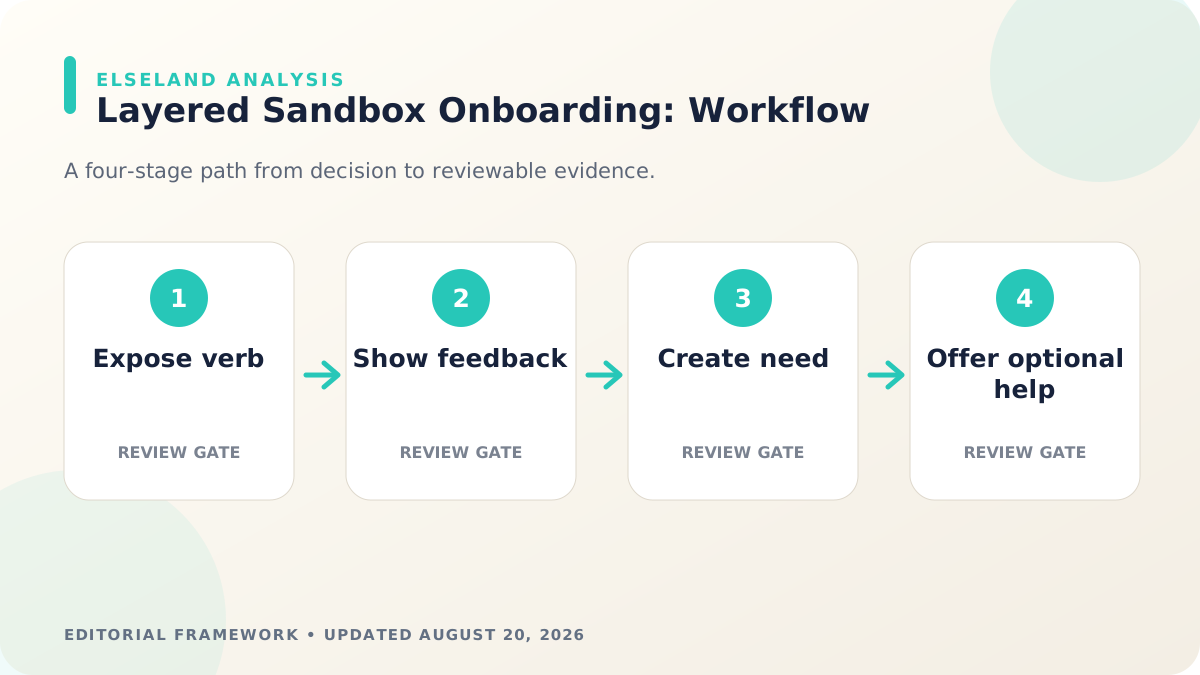
Design onboarding as layers: immediate affordance, contextual feedback, optional hint, searchable guide, and deeper reference. Preserve discovery without making confusion a requirement.
Apply the Pattern to an Original Sandbox
Choose one core verb, one visible resource, one changing need, and three valid responses. Test whether a new player forms the intended question and finds at least one answer without coaching.
Use a simulation prototype to test that learning loop, or study AI-generated living worlds where onboarding must explain dynamic systems without overwhelming the player.
Worked Example: Teach a Crafting Survival Loop
Spawn the player near a harvestable resource, a visible safe area, and a distant threat cue. The first interaction changes the world and adds an item to inventory. The item reveals a contextual recipe, and the approaching threat creates a reason to build or craft rather than presenting crafting as an abstract menu lesson.
Observe whether players form the intended questions in order: What can I interact with? What did I collect? What can it become? Why would I need it? What changes when I use it? Add explicit help only where repeated confusion prevents the next experiment.
| Learning layer | Design signal | Fallback |
|---|---|---|
| Affordance | Repeated object and responsive cursor or animation | One-line input hint |
| Feedback | World changes and item enters inventory | Short state label |
| Purpose | Visible need, threat, or opportunity | Contextual objective |
| Combination | Recipe or compatible slot appears | Optional recipe book |
| Mastery | Several valid solutions | Searchable guide or example |
Build an Onboarding Assistance Ladder
Start with world affordance and immediate feedback. Add contextual UI only after the relevant object, need, or failure exists. Offer optional hints and searchable reference for players who want structure. Reserve mandatory interruption for safety, account, or controls that cannot be discovered reliably.
The ladder supports different players without treating confusion as a virtue. A sandbox can preserve discovery while still explaining controls, accessibility options, recipes, and recovery paths.
- Layer 1: discoverable object, space, or verb
- Layer 2: immediate audiovisual and state feedback
- Layer 3: contextual hint tied to the current need
- Layer 4: optional recipe, journal, or objective support
- Layer 5: searchable guide, accessibility help, and recovery path
Diagnose Onboarding Failure Through Observation
Do not ask only whether the player finished. Record the first intentional action, first incorrect hypothesis, time spent without a new clue, use of optional help, failure recovery, and the explanation they give afterward.
Official Minecraft beginner material shows that explicit guidance and environmental learning coexist. If players repeatedly miss crafting, shelter, or light, the answer may be stronger world signals, a better contextual hint, or clearer recipe support—not a choice between a giant tutorial and no help.
| Symptom | Likely cause | Next check |
|---|---|---|
| Player does nothing | First affordance or input is unclear | Strengthen nearby response and minimal hint |
| Collects but cannot progress | Inventory or recipe relationship hidden | Reveal contextual combination |
| Threat feels arbitrary | No advance signal or preparation time | Telegraph need earlier |
| Only one solution is found | Environment over-signals a single route | Expose alternative resources or spaces |
| Help is ignored | Wrong timing or presentation | Move hint to the moment of need |
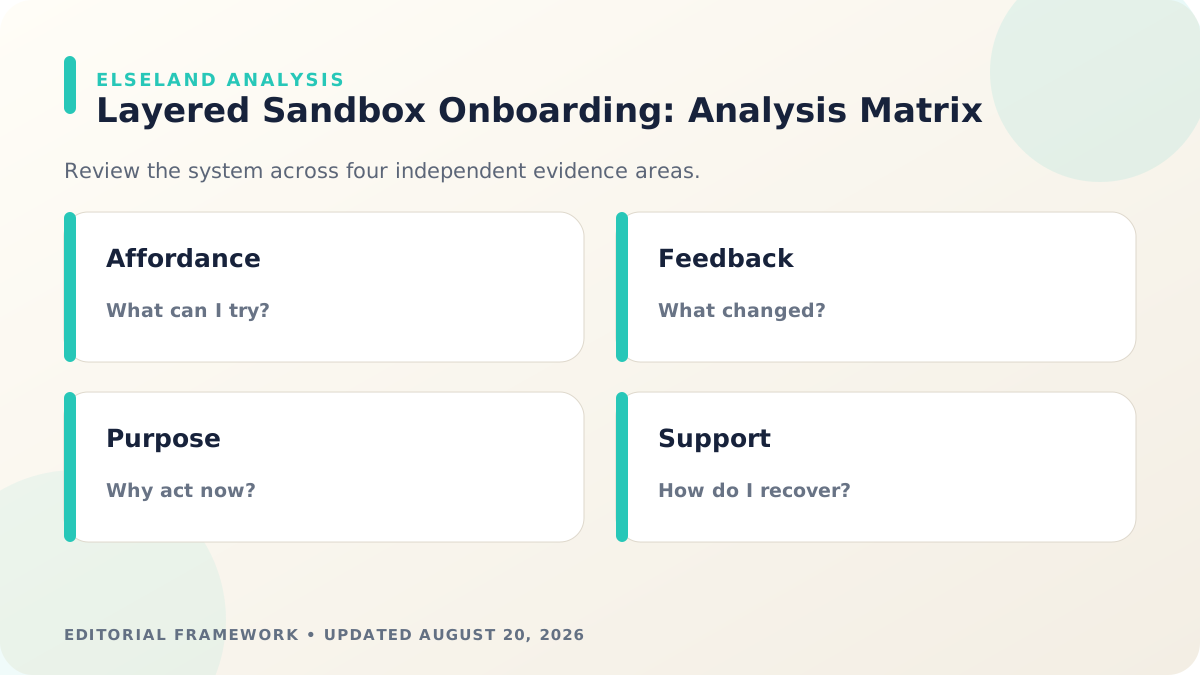
Sandbox Onboarding Playtest Sheet
Run sessions without explaining the design goal. Ask players to think aloud only if that does not change the behavior you want to observe, then conduct a short retrospective to separate what they inferred during play from what they rationalized afterward.
Test returning and accessibility-needs players as well as genre experts. Layered onboarding exists because one route cannot match every player's prior knowledge, motor needs, reading preference, or appetite for discovery.
- The first useful verb is visible, safe to try, and produces immediate evidence.
- Resources, needs, and world changes create a legible chain of questions.
- Pressure is telegraphed and allows more than one valid response.
- Contextual hints appear after need, not as an upfront rule dump.
- Optional guides, settings, and recovery paths remain easy to find.
- Playtests record hypotheses, confusion, recovery, and retained understanding.
What the Primary Sources Establish About Minecraft Tutorial Design
Our evidence baseline starts with the Minecraft: How to Minecraft, accessed August 20, 2026. We use it to establish documented behavior, terminology, or constraints—not to claim that the source endorses Elseland's workflow or conclusions. The practical artifact under review is a layered onboarding path combining world affordances, immediate feedback, contextual need, and optional reference.
That distinction is central to E-E-A-T. A first-party page can establish what a format, tool, platform, model, or game team publicly documents. It cannot prove that a particular asset is fast, accessible, legally cleared, fun, or production-ready. Those conclusions require separate observation, measurement, specialist review, or player evidence tied to the actual project.
For this topic, the decision is whether a new player can form and recover a useful plan without compulsory exposition. The following observations turn the official reference into a reviewable production record rather than a decorative citation:
| Evidence layer | What it can support | What it cannot support alone |
|---|---|---|
| Official source | Documented feature, rule, format, or published design context | Project-specific quality or universal performance |
| Project measurement | Observed behavior in a named build, scene, device, or sample | Unmeasured platforms or future versions |
| Human review | Usability, visual, editorial, and production judgment | Legal certainty or population-level player behavior |
| Release record | Who approved what, when, with which evidence | Permanent compliance after inputs or rules change |
- 1. introduce verbs through safe opportunities before demanding mastery. Store the result with the asset or build identifier so another reviewer can reproduce the conclusion.
- 2. pair every action with visible, audible, or systemic feedback. Store the result with the asset or build identifier so another reviewer can reproduce the conclusion.
- 3. let survival and construction goals create reasons to learn. Store the result with the asset or build identifier so another reviewer can reproduce the conclusion.
- 4. keep official help available for players who want explicit instruction. Store the result with the asset or build identifier so another reviewer can reproduce the conclusion.

A Field Review Protocol for Minecraft Tutorial Design
Use this protocol after the first plausible output exists and before scaling the workflow. Keep one untouched baseline, one candidate revision, and one deliberately stressed case. The stressed case should expose the topic's likely failure mode—crowded scenes, extreme poses, small-screen play, unusual inputs, or a release-rule change—rather than merely repeat the easiest success case.
Run the review in the real delivery context whenever possible. Capture the tool or model version, source files, settings, target device or engine, date, and reviewer. If the work depends on a changing external service, record the response or exported artifact instead of assuming the same output can be recreated later.
A useful review ends with a decision and a next action. “Looks good” is not a gate. State whether the candidate passes, passes with a bounded exception, needs revision, or should be rejected; identify the evidence behind that status and the owner of the next check.
| Review status | Meaning | Required next action |
|---|---|---|
| Pass | All defined visual, technical, and release gates are supported by evidence | Freeze the reviewed artifact and link it to the build |
| Conditional pass | A known limitation is bounded and does not invalidate the intended use | Document the exception, owner, and trigger for re-review |
| Revise | The direction is viable but one or more gates remain unsupported | Change one controlled variable and repeat the affected checks |
| Reject | The candidate conflicts with the intended use, evidence, rights, safety, or budget | Preserve the record and choose a different approach |
- list the minimum verbs needed for the first meaningful goal. Record the expected result before the check, then attach the observed result and any exception after it.
- make interactable materials and consequences visually legible. Record the expected result before the check, then attach the observed result and any exception after it.
- design a low-cost first experiment and clear recovery path. Record the expected result before the check, then attach the observed result and any exception after it.
- delay secondary systems until the player has a reason to use them. Record the expected result before the check, then attach the observed result and any exception after it.
- offer layered hints without blocking self-directed discovery. Record the expected result before the check, then attach the observed result and any exception after it.
- observe first-session behavior without explaining the intended solution. Record the expected result before the check, then attach the observed result and any exception after it.
Expert Interpretation and Limits of This Game Guides Guide
The strongest conclusion this guide can support is a conditional production recommendation: use the workflow when its documented assumptions match the project, and keep the evidence needed to revisit the decision. We do not infer universal model quality, player preference, legal clearance, or performance from an official screenshot, a provider example, or a single successful asset.
Experience matters here because minecraft tutorial design crosses creative judgment and implementation detail. The practical review should include the people who will edit the source, integrate the result, test it in play, maintain it after release, and answer rights or policy questions. A narrow expert handoff often misses problems that appear only when those responsibilities meet.
Before publishing or shipping, repeat time-sensitive checks against the current source and exact build. Preserve dated evidence, disclose the evaluation method, and distinguish measured results from editorial inference. That record is more valuable than a confident conclusion that future reviewers cannot reproduce.
| Claim type | Editorial treatment |
|---|---|
| Documented fact | Link to Minecraft: How to Minecraft and include the access date |
| Observed project result | Name the build, environment, sample, and method |
| Expert judgment | State the criteria, reviewer role, and tradeoff |
| Inference or forecast | Label it explicitly and describe what evidence could change it |
- Minecraft's familiarity and cultural reach reduce onboarding friction for many players.
- Open-world discovery can become confusion when feedback or recovery is weak.
- Optional guidance must still be accessible and searchable.
- A tutorial pattern should be tested against the actual audience, controls, and genre.
Frequently asked questions
Does Minecraft have a tutorial?
Minecraft provides official guides, videos, recipe support, interface prompts, and edition-specific help. The design lesson is that many core ideas are also learned through interaction with the world.
What is environmental tutorial design?
It uses world layout, affordances, feedback, resources, hazards, and consequences to teach actions in context rather than relying only on separate instruction screens.
Should a sandbox avoid explicit instructions?
No. Layer optional and contextual help so players can recover from confusion while preserving room for experimentation and self-directed learning.
How do I test tutorial-free onboarding?
Observe new players silently, record their first intentional action, questions, failures, and recovery path, then add the smallest hint that resolves repeated confusion.
Is tutorial-free design suitable for every game?
No. Complex controls, competitive rules, accessibility needs, safety information, and irreversible choices may require explicit instruction. The useful pattern is layered teaching that uses interaction where possible and clear help where necessary.
How long should a sandbox onboarding sequence last?
Measure the time to a meaningful self-directed loop rather than a fixed tutorial duration. The player should understand enough to choose a goal, act, read the result, recover, and form the next question.
What is the difference between discovery and confusion?
Discovery gives the player evidence and several plausible experiments. Confusion provides too little feedback to update a hypothesis. Observe whether each action narrows the player's understanding.
How can a game teach several valid solutions?
Present a shared need, expose resources with different tradeoffs, and make outcomes readable. Avoid rewards or camera framing that silently label one route as the only correct answer unless that constraint is intentional.
Sources and further reading
- Minecraft: How to Minecraft
Official overview of starting, survival, crafting, building, exploration, and combat.
- Minecraft: Survive your first day
Official step-by-step first-day survival guidance.
- Minecraft beginner hub
First-party collection of layered beginner videos and articles.
Next step