GPT-6 Astra media capabilities are easy to overstate. OpenAI describes a model with strong visual judgment, coding, computer use, and tool orchestration. The current API reference, however, documents text and image input with text output. That makes Astra a capable director and inspector inside a media pipeline—not a single endpoint that directly renders every image, video, voice, or soundtrack.
The distinction matters in game production. Browse playable games on Elseland and notice how art, motion, sound, interaction, and performance must agree. A convincing still is only one input to that system.
Quick read
Key takeaways
- GPT-6 Astra can reason over text and image inputs, but its model endpoint returns text rather than image, video, or audio files.
- Media understanding, media generation, and tool orchestration are separate capabilities and should be tested separately.
- Astra can plan shots, inspect frames, write prompts, and call approved tools; specialist media models still perform rendering or synthesis.
- Game teams need provenance, continuity, export, performance, and human-review gates around every generated asset.
Three layers of GPT-6 Astra media capability
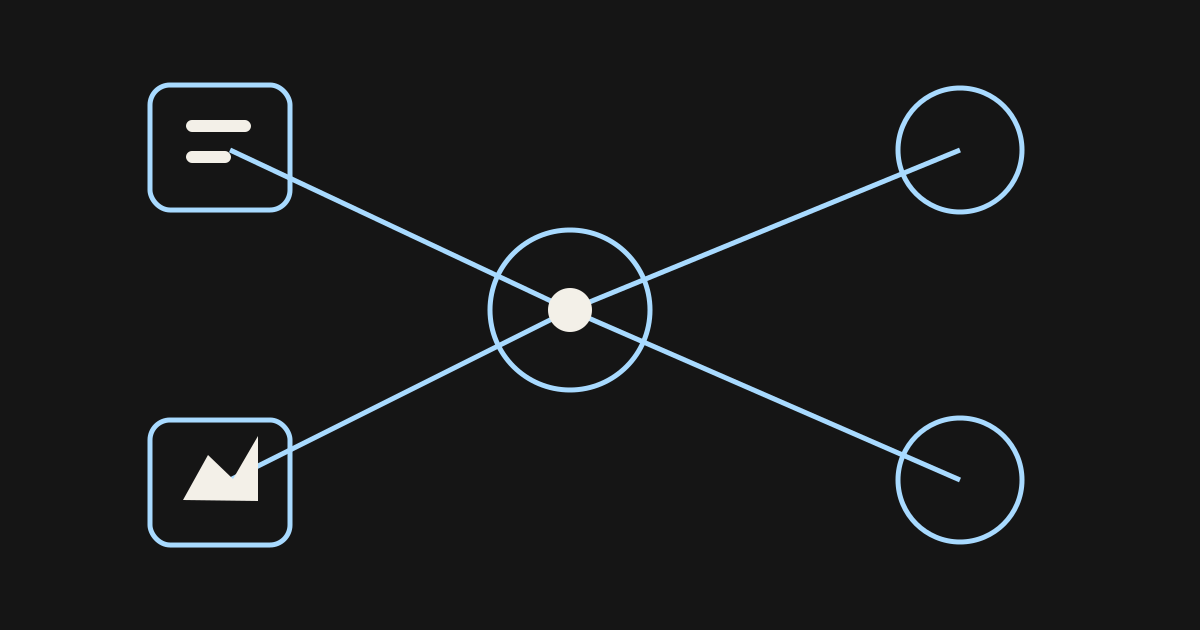
A useful capability map separates perception, reasoning, and generation. Perception means extracting evidence from an input image. Reasoning means connecting that evidence to a brief, a codebase, or a quality rule. Generation means producing a media file. Astra covers the first two directly and can coordinate the third through external tools.
Tool orchestration does not transfer the specialist model's capabilities into Astra. Record which model produced each artifact, which settings were used, and which human approved it.
| Layer | Astra's role | Output to verify |
|---|---|---|
| Understand | Inspect text and images | Grounded observations tied to regions or files |
| Plan | Create briefs, prompts, shot lists, manifests, and checks | Structured artifact that follows the schema |
| Orchestrate | Call an approved image, video, audio, or engine tool | Auditable arguments and bounded permissions |
| Generate | Delegated to a specialist tool or model | Media file plus provenance and settings |
Images: visual input is not image generation
Astra can inspect concept art, screenshots, UI states, texture references, and render errors supplied as images. It can compare them with a written art bible, identify inconsistencies, and propose a correction plan.
Direct image generation requires a compatible image-generation tool. Keep the handoff explicit: Astra writes or revises the brief, the image model renders, and a reviewer checks composition, anatomy, text artifacts, rights, and fit with the game.
- Reference the exact image and region behind each observation.
- Keep character identity and palette rules in a versioned art bible.
- Reject an asset that cannot meet crop, resolution, alpha, or licensing requirements.
- Test the asset at its real in-game size, not only full screen.
Video: plan and inspect before claiming generation
Astra can help turn a quest beat into a shot list, reason about continuity across supplied frames, or operate an approved editing interface through computer use. Those are planning, analysis, and control tasks.
The documented Astra endpoint does not return video. A video model or editing system performs generation and export. For a game cutscene, also test temporal consistency, safe areas for subtitles, frame rate, codec, looping, localization, and how the clip transitions back into interactive play.
Audio: scripts and analysis need specialist synthesis
Astra can draft dialogue, pronunciation notes, cue sheets, music direction, and implementation code. It can also reason about an audio workflow when relevant evidence has been converted into supported inputs or exposed through tools.
Do not treat that as native speech, music, or sound-effect output. Use an appropriate audio system, preserve performer and license metadata, normalize levels, check clipping and loudness, and listen in the game mix rather than in isolation.
Tool control needs production boundaries
OpenAI's model guide documents computer use, tool calling, structured outputs, and long-running workflow features. These capabilities can connect planning to execution, but they also expand the failure surface.
Give the model the smallest toolset needed for the stage. Start read-only, require a structured plan, isolate writes, cap spend and retries, and keep publishing, deletion, credentials, and rights decisions behind human approval.
| Gate | Question | Pass condition |
|---|---|---|
| Scope | Is the task bounded? | Named inputs, outputs, and exclusions |
| Permission | Can the tool cause irreversible change? | Read-only or isolated writes by default |
| Budget | Can retries create uncontrolled cost? | Hard limits and stop conditions |
| Evidence | Can the result be reproduced? | Model IDs, prompts, settings, and logs retained |
| Approval | Who accepts the asset? | Named human owner before release |
A practical AI game art workflow
Begin with one delivery target: a card cover, character turnaround, ten-second transition, ambient loop, or UI sound set. Define dimensions, duration, style, rights, and engine constraints before selecting tools.
Let Astra organize the brief and inspect evidence. Let specialist tools generate variants. Then validate continuity, technical specifications, provenance, accessibility, and in-engine performance. The useful metric is accepted assets per hour and per dollar—not raw generations.
| Stage | Deliverable | Failure condition |
|---|---|---|
| Brief | Versioned creative and technical constraints | Ambiguous ownership or output format |
| Generate | Variants with model and settings recorded | Missing provenance |
| Review | Visual or audio checklist | Selection based only on novelty |
| Integrate | Imported asset in a test scene | Wrong scale, codec, crop, or budget |
| Playtest | Observed player-facing result | Asset distracts or breaks comprehension |
Limits that a polished demo can hide
A successful example can conceal retries, editing, cherry-picking, tool-specific behavior, or manual repair. It cannot establish a general success rate. Media pipelines also fail at consistency across shots, editable layers, file naming, deterministic re-creation, and rights documentation.
The safest conclusion is specific: Astra can make media production more coherent when it acts as a reasoning and control layer. It does not collapse every specialist model, engine, editor, and reviewer into one model call.
When GPT-6 Astra belongs in the pipeline
Use Astra when the bottleneck is interpreting references, coordinating steps, maintaining a structured brief, reviewing outputs against rules, or connecting creative work to code and QA. Use a smaller or specialist model when the task is narrow, high-volume, latency-sensitive, or directly generative.
To design a grounded test, start from an existing game loop on Elseland AI, define one media deliverable, and judge whether the complete pipeline improves the playable result.
Frequently asked questions
Can GPT-6 Astra generate images directly?
The documented GPT-6 Astra model endpoint returns text. It can inspect image inputs and call a separate image-generation tool, but the image file is produced by that specialist tool.
Can GPT-6 Astra generate video?
Not through the documented Astra endpoint. It can plan shots, inspect supplied visual evidence, write prompts, and orchestrate compatible video tools.
Can GPT-6 Astra create voices or music?
It can write scripts, cue sheets, and implementation plans, but audio synthesis requires an audio-capable model or tool. Licensing, consent, loudness, and in-game mixing still need review.
What image inputs can a game team use?
Useful inputs include screenshots, concept sheets, UI states, render failures, and style references that the team is authorized to use. Ask the model to tie observations to visible evidence rather than making broad aesthetic claims.
Does computer use mean Astra can operate creative software?
It may operate supported interfaces through a computer-use harness. Reliability depends on the harness and environment, so isolate the workspace and require confirmation for consequential actions.
How should generated assets be tracked?
Retain the producing model, version, prompt, settings, source references, license status, reviewer, and final file hash. This makes revisions and rights review possible.
What is the best first media test?
Choose one bounded asset with objective specifications and a clear in-game use. Compare accepted output, retries, review time, and integration effort with the current workflow.
What is Astra's strongest media role?
Its strongest documented role is the reasoning layer: reading visual evidence, maintaining constraints, coordinating tools, and checking whether outputs meet a defined brief.
Sources and further reading
- OpenAI: GPT-6 Astra launch
Official launch, capability claims, evaluations, availability, and limitations.
- OpenAI API: GPT-6 Astra model
Official modalities, context, output, pricing, and feature support.
- OpenAI API: model guidance
Official tool, reasoning, and workflow guidance.
Next step