
Start GPT-6 Astra reasoning levels with the least effort that can meet a defined acceptance test, then escalate only when a failure calls for deeper analysis. A missing file, an ambiguous brief or a denied tool permission is not a reason to increase effort. This guide helps you distinguish those cases before changing your default.
This guide is based on official documentation, not paid API testing. It does not claim that any particular account has access to the model or that a higher effort setting produces a fixed improvement.
Quick read
Key takeaways
- Choose effort around acceptance checks, not answer length.
- Measure retries and review time alongside API usage.
- Keep permission to act separate from reasoning effort.
Choose a reasoning level by task and failure type
The following table is an editorial starting point for an evaluation, not an official task-to-setting guarantee.
Avoid creating a policy where the model is always escalated after any imperfect answer. Some failures come from missing data, incompatible instructions, unavailable tools or a broken environment. Those need a different intervention.
| Task shape | Starting point to test | Evidence to look for |
|---|---|---|
| A small, well-specified transformation | Low | Every required field survives unchanged |
| A task with several related constraints | Medium | The result satisfies all constraints together |
| A difficult diagnosis with competing explanations | High | The conclusion follows from evidence and rules out alternatives |
| A demanding task that still fails at high | Xhigh or max | The added effort changes an important failed outcome |
| A simple task that already passes | Keep the passing setting | No meaningful benefit from escalating |
The available Astra reasoning levels
As checked on September 14, 2026, the GPT-6 Astra model documentation lists low, medium, high, xhigh and max. These are settings for the same model, not separate model families. The model page lists reasoning support alongside its other capabilities; availability in a product interface must still be checked independently.
An effort setting is not a substitute for an output specification. Asking for more reasoning will not tell the model which repository branch to use, what counts as a correct calculation, or whether it is allowed to change files. Put those requirements in the task first.
The distinction matters in practice. “Improve this game” leaves success undefined. “Inspect the restart flow and identify why the score persists after a new session; do not edit files” gives the model a testable objective and an explicit boundary. Changing effort before fixing the first prompt confuses task ambiguity with model capability.
A puzzle reset bug versus a one-line label
In a game workflow, writing a short label and investigating an intermittent save bug are different jobs. A label can be checked against a character limit and tone brief. A save bug may require tracing state across restart, reload and session changes. Evaluate those task families separately.
A useful source of observable test cases is puzzle games: note what a restart clears, whether a hint persists and how a completed level is recorded. Convert your own observations into acceptance criteria for a prototype you control. The linked games are not evidence of Astra use.
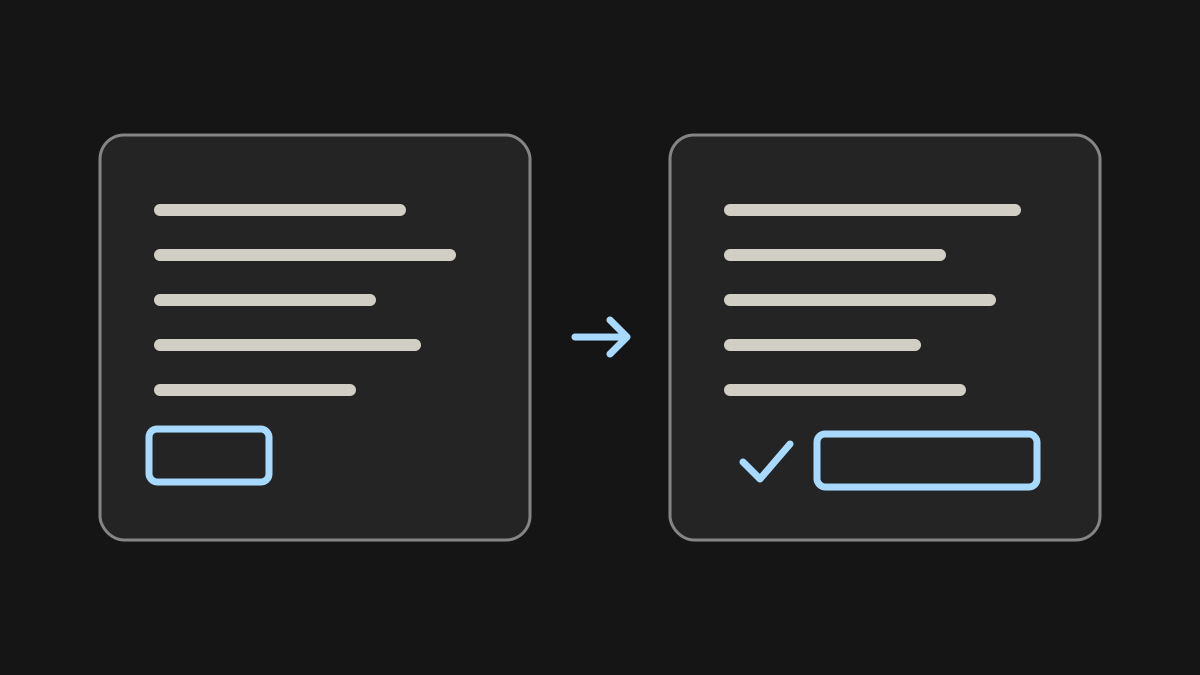
A suggested test brief might ask a coding assistant to inspect a local prototype, describe its restart behavior and propose tests without modifying the code. Only after that review should a separate instruction authorize changes. This keeps reasoning effort separate from permission to act.
For the label task, a failing character limit usually calls for a clearer constraint or a validator. For the reset bug, ask whether the assistant found the relevant state transition and a reproducible failure. Escalation is worth evaluating when the evidence is available but the diagnosis still misses that relationship—not when the source code was never supplied.
Build an effort evaluation you can repeat
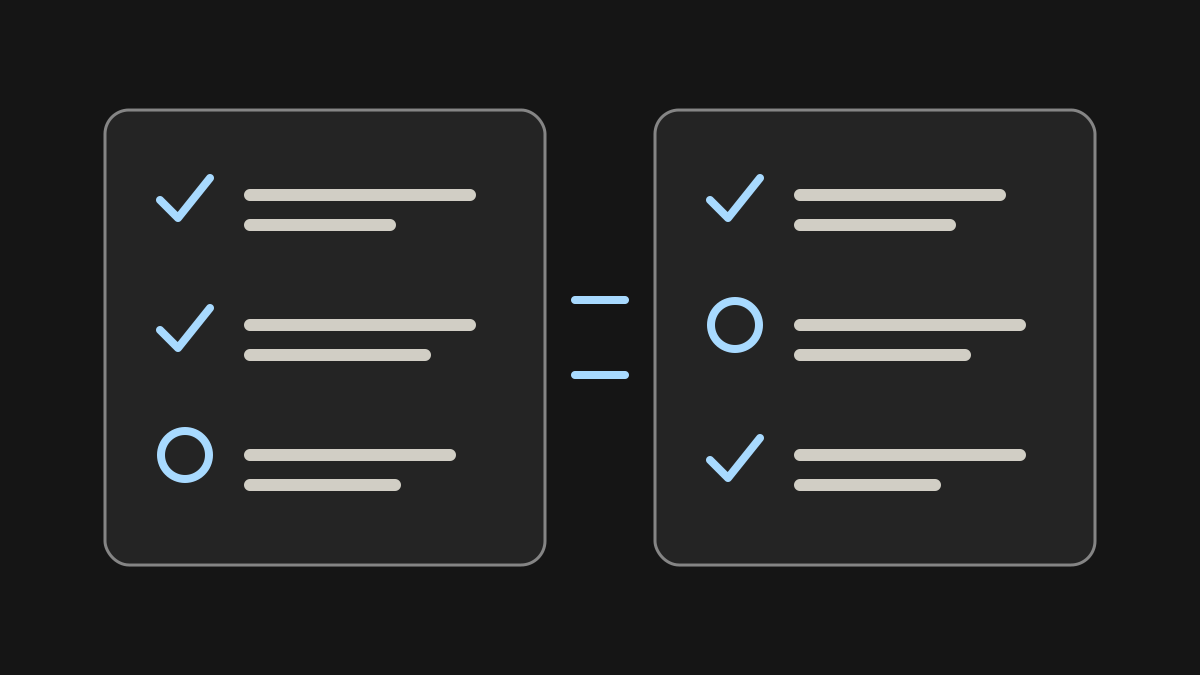
Prepare a small set of representative tasks before changing production defaults. Include easy cases, difficult cases and at least a few tasks where the correct response is to report missing information. Keep the input materials, allowed tools and expected output the same across effort settings.
Score the results without looking at the effort label where practical. A longer explanation can appear more convincing even when it introduces unsupported assumptions. Separate factual correctness, instruction compliance and formatting so that a polished answer cannot hide a critical failure.
Record total elapsed time, retries and review effort. A response that arrives quickly but needs repeated correction may be less useful than a slower response that is acceptable immediately. Conversely, extra waiting has no value when it does not change whether the task passes.
Do not convert this into a public performance claim until the evaluation has actually been run and its limitations recorded.
For a concrete evaluation, prepare ten representative tasks and run the same acceptance checks at low and high effort. Treat ten as a manageable pilot, not a statistically reliable benchmark. Count accepted results, record total latency and include correction time. If both settings pass the same tasks, the faster or less costly workflow is the stronger default for that sample; if high resolves a critical failure, reserve escalation for that task family. We have not run this example.
- Task ID and input version.
- Model ID and effort setting.
- Required checks and pass/fail results.
- Total time, retries and tool failures.
- Usage reported by the API.
- Reviewer corrections and final acceptance.
Configure effort without confusing it with verbosity
The official model guidance distinguishes supported effort settings from other request parameters. Check the request format for the endpoint and SDK you actually use rather than copying a parameter from a different interface.
A useful operational split is to specify the required final answer separately from the work needed to produce it. For example, request a short diagnosis containing the affected component, supporting evidence and next action. That allows a difficult investigation to end in a concise answer.
Do not ask for hidden internal reasoning as a debugging technique. Ask for an evidence summary, assumptions, test results and unresolved questions. Those are artifacts a reviewer can check.
Change effort when the task changes
A conversation can begin with a difficult diagnosis and continue with routine formatting. It does not follow that every later turn needs the same effort as the first.
The reasoning guide documents a configuration-update mechanism for changing effort between responses while preserving the original prompt prefix. Its stated support is GPT-6 Astra in standard single-agent mode. Treat those conditions as part of the feature, not as optional details.
Before adopting such a policy, decide what triggers escalation and who can authorize expensive work. “The task is long” is usually too vague. “The current attempt failed the same correctness check and the necessary evidence is present” is a more useful signal to test.
Choose a policy you can explain
The best default is the one your own task evidence supports. Revisit it when inputs, tools or acceptance criteria change. Keep failure examples rather than only successful demonstrations, because those show when escalation or human review is actually needed.
If you need another player-facing reference for your test brief, compare games you can play in your browser and write down one observable requirement at a time. Keep that exercise separate from the controlled model evaluation: a smooth player experience is a design target, not a benchmark score.
Sources and further reading
- GPT-6 Astra model documentation
Model-specific effort options checked September 14, 2026; product-interface availability is a separate question.
- official model guidance
Request configuration guidance; not a benchmark or a guarantee of improvement at higher effort.
- reasoning guide
Configuration updates and their support conditions. No account-level experiment was performed.
Next step