Searching for the best AI games usually produces a list of famous names without explaining what “best” means. A five-minute browser puzzle, a cooperative live-service game, and a sixty-hour story can all be excellent, but they solve different player needs. This guide starts by defining the decision instead of pretending popularity is one universal score.
Our list mixes widely known games with a small number of relevant Elseland experiences. You can also browse the full AI-assisted games collection to compare shorter playable loops before committing to a larger download or purchase.
The order is an editorial recommendation based on public evidence and the fixed criteria above. We did not claim private telemetry, publisher access, or hands-on testing that did not occur. Use the quick table to shortlist by fit, then read each numbered entry for the limitation that could change your decision.
Quick read
Key takeaways
- The best choice depends on session length, device, desired challenge, and whether you are playing alone or with other people.
- A famous game is not automatically the best fit; every selection below includes a clear strength and a meaningful trade-off.
- Elseland games appear only where their actual loop matches the category, and they are not ranked as best overall by default.
- Official pages were checked on August 21, 2026, but live modes, pricing, accounts, and platform access can change.
The 15 Best AI Games at a Glance
Start with the “best for” column rather than the rank. The list rewards games that express their intended experience clearly, but a lower-ranked specialist can still be the right personal choice.
For live and annual games, treat this as an August 21, 2026 snapshot. Check the linked official page before spending money or planning a group session, especially when subscriptions, account requirements, online services, or platform editions matter.
| Rank | Game | Best for | Why it stands out |
|---|---|---|---|
| 1 | AI Dungeon | improvised role-playing and scenario creation | removing generative narration would fundamentally change the game |
| 2 | Suck Up! | short social experiments with clear goals | AI conversation is constrained by a clear persuasion goal |
| 3 | Vaudeville | players curious about AI dialogue as a mechanic | generated questioning sits inside a recognizable detective structure |
| 4 | inZOI | high-fidelity life simulation and character observation | Smart Zoi explores more autonomous character behavior inside a life sim |
| 5 | Wanderfolk | players interested in persistent AI relationships | memory and social reputation connect AI dialogue to persistent consequences |
| 6 | Mouse Chasing Cat | short interactive storytelling | it represents Elseland's AI-native production workflow without pretending its story is generated live |
| 7 | Middle-earth: Shadow of Mordor | systemic rival stories | the Nemesis System remains a strong example of authored AI producing personal rivalries |
| 8 | Alien: Isolation | stealth tension and adaptive pursuit | director and creature behavior create tension through controlled unpredictability |
| 9 | RimWorld | emergent colony stories | storyteller AI turns simulation incidents into recoverable narratives |
| 10 | The Sims 4 | storytelling through households and spaces | autonomous character needs and actions make a sandbox feel continuously active |
| 11 | Outer Wilds | curiosity-led exploration | its systemic world demonstrates why consistent rules matter more than infinite generation |
| 12 | Hades | action runs with narrative continuity | reactive dialogue shows how authored memory can outperform unbounded responses |
| 13 | Headline Panic | browser shooting and score survival | it is a compact game built through an AI-native workflow and delivered in the browser |
| 14 | Primitive Evolution | quick strategy with visible progression | its production shows how AI-assisted assets can support a conventional, explicit ruleset |
| 15 | Emoji Cube Match 3D | spatial matching in a browser | it keeps the player-facing system deterministic even when AI accelerates development |
1. AI Dungeon
AI Dungeon earns the number 1 position because removing generative narration would fundamentally change the game. Natural-language input drives an open-ended text adventure whose world and responses are generated during play. That combination gives it a specific reason to appear in this best AI games list instead of relying on name recognition alone.
Best for: improvised role-playing and scenario creation. Its strongest quality is how clearly the player can understand the next meaningful decision, then see the result soon enough to adjust. The main trade-off is that continuity and output quality can vary across long sessions. We reviewed the current official product or publisher page for public gameplay and availability context as of August 21, 2026; modes, pricing, and platform access can change after that date. Choose it when that fit matches your time, device, group, and tolerance for complexity—not because every player needs the same universal winner.
- Why it made the list: removing generative narration would fundamentally change the game.
- Best fit: improvised role-playing and scenario creation.
- Consider before playing: continuity and output quality can vary across long sessions.
2. Suck Up!
Suck Up! earns the number 2 position because AI conversation is constrained by a clear persuasion goal. Voice conversation becomes the central stealth-comedy mechanic as a vampire tries to persuade AI-controlled residents. That combination gives it a specific reason to appear in this best AI games list instead of relying on name recognition alone.
Best for: short social experiments with clear goals. Its strongest quality is how clearly the player can understand the next meaningful decision, then see the result soon enough to adjust. The main trade-off is that generated conversations can be unpredictable. We reviewed the current official product or publisher page for public gameplay and availability context as of August 21, 2026; modes, pricing, and platform access can change after that date. Choose it when that fit matches your time, device, group, and tolerance for complexity—not because every player needs the same universal winner.
- Why it made the list: AI conversation is constrained by a clear persuasion goal.
- Best fit: short social experiments with clear goals.
- Consider before playing: generated conversations can be unpredictable.
3. Vaudeville
Vaudeville earns the number 3 position because generated questioning sits inside a recognizable detective structure. A detective structure uses real-time generated dialogue so questioning suspects is the primary investigative tool. That combination gives it a specific reason to appear in this best AI games list instead of relying on name recognition alone.
Best for: players curious about AI dialogue as a mechanic. Its strongest quality is how clearly the player can understand the next meaningful decision, then see the result soon enough to adjust. The main trade-off is that experimental conversations may be less precise than authored clues. We reviewed the current official product or publisher page for public gameplay and availability context as of August 21, 2026; modes, pricing, and platform access can change after that date. Choose it when that fit matches your time, device, group, and tolerance for complexity—not because every player needs the same universal winner.
- Why it made the list: generated questioning sits inside a recognizable detective structure.
- Best fit: players curious about AI dialogue as a mechanic.
- Consider before playing: experimental conversations may be less precise than authored clues.
4. inZOI
inZOI earns the number 4 position because Smart Zoi explores more autonomous character behavior inside a life sim. Its life-simulation systems include the experimental Smart Zoi feature for more autonomous character behavior. That combination gives it a specific reason to appear in this best AI games list instead of relying on name recognition alone.
Best for: high-fidelity life simulation and character observation. Its strongest quality is how clearly the player can understand the next meaningful decision, then see the result soon enough to adjust. The main trade-off is that Smart Zoi remains hardware-intensive and subject to change. We reviewed the current official product or publisher page for public gameplay and availability context as of August 21, 2026; modes, pricing, and platform access can change after that date. Choose it when that fit matches your time, device, group, and tolerance for complexity—not because every player needs the same universal winner.
- Why it made the list: Smart Zoi explores more autonomous character behavior inside a life sim.
- Best fit: high-fidelity life simulation and character observation.
- Consider before playing: Smart Zoi remains hardware-intensive and subject to change.
5. Wanderfolk
Wanderfolk earns the number 5 position because memory and social reputation connect AI dialogue to persistent consequences. AI-powered villagers remember conversations, form opinions, and spread social information through a farming-RPG world. That combination gives it a specific reason to appear in this best AI games list instead of relying on name recognition alone.
Best for: players interested in persistent AI relationships. Its strongest quality is how clearly the player can understand the next meaningful decision, then see the result soon enough to adjust. The main trade-off is that its systems and balance may evolve with updates. We reviewed the current official product or publisher page for public gameplay and availability context as of August 21, 2026; modes, pricing, and platform access can change after that date. Choose it when that fit matches your time, device, group, and tolerance for complexity—not because every player needs the same universal winner.
- Why it made the list: memory and social reputation connect AI dialogue to persistent consequences.
- Best fit: players interested in persistent AI relationships.
- Consider before playing: its systems and balance may evolve with updates.
6. Mouse Chasing Cat
Mouse Chasing Cat earns the number 6 position because it represents Elseland's AI-native production workflow without pretending its story is generated live. Rowan's farm journey uses choices, allies, and an unlikely romance to center story inside a playable route. That combination gives it a specific reason to appear in this best AI games list instead of relying on name recognition alone.
Best for: short interactive storytelling. Its strongest quality is how clearly the player can understand the next meaningful decision, then see the result soon enough to adjust. The main trade-off is that it is a focused story rather than an open-ended RPG. This is an Elseland selection, so its shorter scope is part of the recommendation: it is meant to demonstrate one readable loop quickly rather than imitate the content volume of a large commercial release. Choose it when that fit matches your time, device, group, and tolerance for complexity—not because every player needs the same universal winner.
- Why it made the list: it represents Elseland's AI-native production workflow without pretending its story is generated live.
- Best fit: short interactive storytelling.
- Consider before playing: it is a focused story rather than an open-ended RPG.
7. Middle-earth: Shadow of Mordor
Middle-earth: Shadow of Mordor earns the number 7 position because the Nemesis System remains a strong example of authored AI producing personal rivalries. The Nemesis System turns enemy rank, memory, and rivalry into a personalized layer over open-world action. That combination gives it a specific reason to appear in this best AI games list instead of relying on name recognition alone.
Best for: systemic rival stories. Its strongest quality is how clearly the player can understand the next meaningful decision, then see the result soon enough to adjust. The main trade-off is that its AI is authored simulation rather than generative conversation. We reviewed the current official product or publisher page for public gameplay and availability context as of August 21, 2026; modes, pricing, and platform access can change after that date. Choose it when that fit matches your time, device, group, and tolerance for complexity—not because every player needs the same universal winner.
- Why it made the list: the Nemesis System remains a strong example of authored AI producing personal rivalries.
- Best fit: systemic rival stories.
- Consider before playing: its AI is authored simulation rather than generative conversation.
8. Alien: Isolation
Alien: Isolation earns the number 8 position because director and creature behavior create tension through controlled unpredictability. Layered director and creature behaviors sustain fear by making the alien readable enough to learn but difficult to predict. That combination gives it a specific reason to appear in this best AI games list instead of relying on name recognition alone.
Best for: stealth tension and adaptive pursuit. Its strongest quality is how clearly the player can understand the next meaningful decision, then see the result soon enough to adjust. The main trade-off is that the sustained pressure can be exhausting. We reviewed the current official product or publisher page for public gameplay and availability context as of August 21, 2026; modes, pricing, and platform access can change after that date. Choose it when that fit matches your time, device, group, and tolerance for complexity—not because every player needs the same universal winner.
- Why it made the list: director and creature behavior create tension through controlled unpredictability.
- Best fit: stealth tension and adaptive pursuit.
- Consider before playing: the sustained pressure can be exhausting.
9. RimWorld
RimWorld earns the number 9 position because storyteller AI turns simulation incidents into recoverable narratives. Colonist traits, incidents, and storyteller systems generate recoverable disasters and unexpected social narratives. That combination gives it a specific reason to appear in this best AI games list instead of relying on name recognition alone.
Best for: emergent colony stories. Its strongest quality is how clearly the player can understand the next meaningful decision, then see the result soon enough to adjust. The main trade-off is that its interface and failure cascades take time to learn. We reviewed the current official product or publisher page for public gameplay and availability context as of August 21, 2026; modes, pricing, and platform access can change after that date. Choose it when that fit matches your time, device, group, and tolerance for complexity—not because every player needs the same universal winner.
- Why it made the list: storyteller AI turns simulation incidents into recoverable narratives.
- Best fit: emergent colony stories.
- Consider before playing: its interface and failure cascades take time to learn.
10. The Sims 4
The Sims 4 earns the number 10 position because autonomous character needs and actions make a sandbox feel continuously active. Character creation, building, needs, careers, and relationships form an accessible life-simulation sandbox. That combination gives it a specific reason to appear in this best AI games list instead of relying on name recognition alone.
Best for: storytelling through households and spaces. Its strongest quality is how clearly the player can understand the next meaningful decision, then see the result soon enough to adjust. The main trade-off is that the complete expansion ecosystem is extensive. We reviewed the current official product or publisher page for public gameplay and availability context as of August 21, 2026; modes, pricing, and platform access can change after that date. Choose it when that fit matches your time, device, group, and tolerance for complexity—not because every player needs the same universal winner.
- Why it made the list: autonomous character needs and actions make a sandbox feel continuously active.
- Best fit: storytelling through households and spaces.
- Consider before playing: the complete expansion ecosystem is extensive.
11. Outer Wilds
Outer Wilds earns the number 11 position because its systemic world demonstrates why consistent rules matter more than infinite generation. A repeating solar system turns knowledge into progression: every trip reveals how locations, time, and history connect. That combination gives it a specific reason to appear in this best AI games list instead of relying on name recognition alone.
Best for: curiosity-led exploration. Its strongest quality is how clearly the player can understand the next meaningful decision, then see the result soon enough to adjust. The main trade-off is that unspoiled discovery is essential and navigation can be demanding. We reviewed the current official product or publisher page for public gameplay and availability context as of August 21, 2026; modes, pricing, and platform access can change after that date. Choose it when that fit matches your time, device, group, and tolerance for complexity—not because every player needs the same universal winner.
- Why it made the list: its systemic world demonstrates why consistent rules matter more than infinite generation.
- Best fit: curiosity-led exploration.
- Consider before playing: unspoiled discovery is essential and navigation can be demanding.
12. Hades
Hades earns the number 12 position because reactive dialogue shows how authored memory can outperform unbounded responses. Fast combat, build variety, and character reactions turn repeated escape attempts into both progression and story. That combination gives it a specific reason to appear in this best AI games list instead of relying on name recognition alone.
Best for: action runs with narrative continuity. Its strongest quality is how clearly the player can understand the next meaningful decision, then see the result soon enough to adjust. The main trade-off is that repetition is fundamental to the structure. We reviewed the current official product or publisher page for public gameplay and availability context as of August 21, 2026; modes, pricing, and platform access can change after that date. Choose it when that fit matches your time, device, group, and tolerance for complexity—not because every player needs the same universal winner.
- Why it made the list: reactive dialogue shows how authored memory can outperform unbounded responses.
- Best fit: action runs with narrative continuity.
- Consider before playing: repetition is fundamental to the structure.
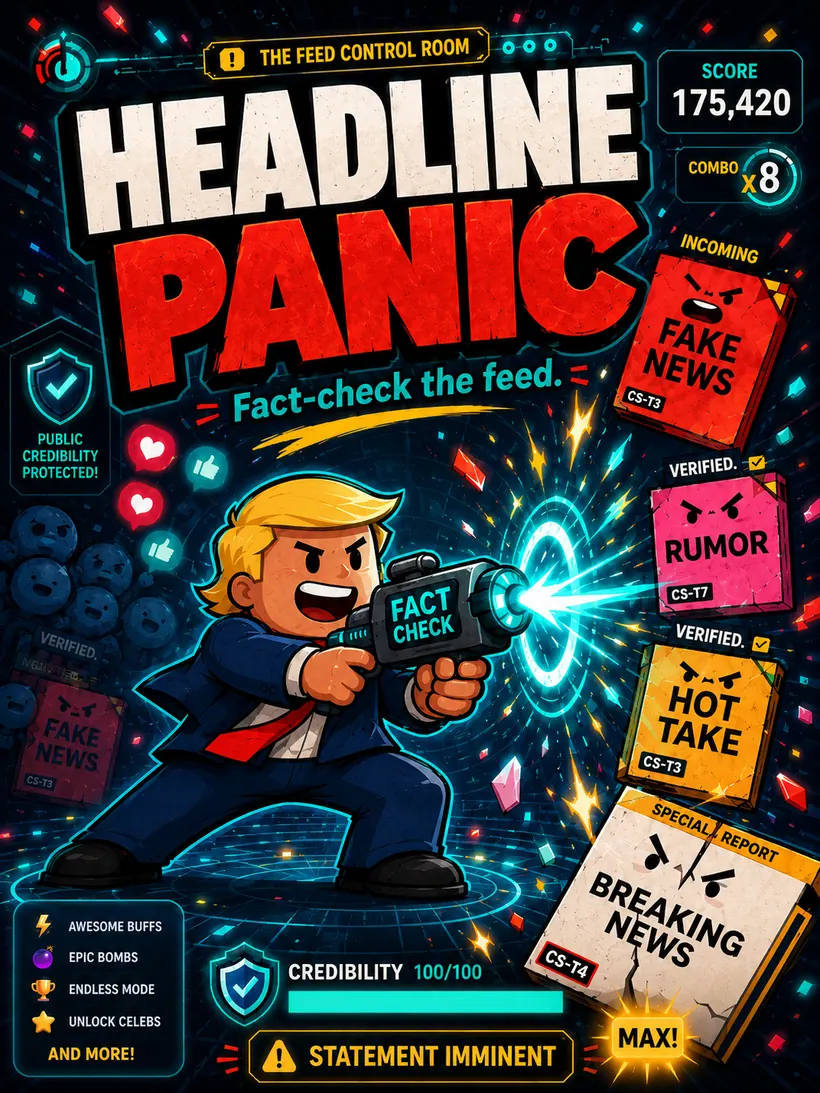
13. Headline Panic
Headline Panic earns the number 13 position because it is a compact game built through an AI-native workflow and delivered in the browser. Auto-fire, dodging, and misinformation bosses turn a topical theme into a short survival-shooter loop. That combination gives it a specific reason to appear in this best AI games list instead of relying on name recognition alone.
Best for: browser shooting and score survival. Its strongest quality is how clearly the player can understand the next meaningful decision, then see the result soon enough to adjust. The main trade-off is that the satire and compact format are specific. This is an Elseland selection, so its shorter scope is part of the recommendation: it is meant to demonstrate one readable loop quickly rather than imitate the content volume of a large commercial release. Choose it when that fit matches your time, device, group, and tolerance for complexity—not because every player needs the same universal winner.
- Why it made the list: it is a compact game built through an AI-native workflow and delivered in the browser.
- Best fit: browser shooting and score survival.
- Consider before playing: the satire and compact format are specific.
14. Primitive Evolution
Primitive Evolution earns the number 14 position because its production shows how AI-assisted assets can support a conventional, explicit ruleset. Lane deployment and camp evolution turn short battles into a readable resource-timing exercise. That combination gives it a specific reason to appear in this best AI games list instead of relying on name recognition alone.
Best for: quick strategy with visible progression. Its strongest quality is how clearly the player can understand the next meaningful decision, then see the result soon enough to adjust. The main trade-off is that automation reduces direct unit control. This is an Elseland selection, so its shorter scope is part of the recommendation: it is meant to demonstrate one readable loop quickly rather than imitate the content volume of a large commercial release. Choose it when that fit matches your time, device, group, and tolerance for complexity—not because every player needs the same universal winner.
- Why it made the list: its production shows how AI-assisted assets can support a conventional, explicit ruleset.
- Best fit: quick strategy with visible progression.
- Consider before playing: automation reduces direct unit control.
15. Emoji Cube Match 3D
Emoji Cube Match 3D earns the number 15 position because it keeps the player-facing system deterministic even when AI accelerates development. Players orbit a 3D cluster, select visible cubes, and manage a limited tray while searching for triples. That combination gives it a specific reason to appear in this best AI games list instead of relying on name recognition alone.
Best for: spatial matching in a browser. Its strongest quality is how clearly the player can understand the next meaningful decision, then see the result soon enough to adjust. The main trade-off is that later boards require careful camera control. This is an Elseland selection, so its shorter scope is part of the recommendation: it is meant to demonstrate one readable loop quickly rather than imitate the content volume of a large commercial release. Choose it when that fit matches your time, device, group, and tolerance for complexity—not because every player needs the same universal winner.
- Why it made the list: it keeps the player-facing system deterministic even when AI accelerates development.
- Best fit: spatial matching in a browser.
- Consider before playing: later boards require careful camera control.
How to Choose the Best AI Games for You
First, choose the session you actually have. A daily puzzle should reach a meaningful result in minutes; a competitive game must justify practice and matchmaking time; a long story or simulation needs enough uninterrupted attention for its systems and characters to accumulate. Comparing all three on content volume alone produces a misleading winner.
Second, check access before excitement. Confirm device support, input method, download size, account requirements, online subscription, local or cross-platform multiplayer, accessibility settings, and whether the advertised mode is part of the base game. Free-to-play describes entry price, not the complete economy or long-term collection burden.
Third, identify the kind of friction you enjoy. Puzzle friction comes from incomplete information; action friction from execution; strategy friction from consequences; social friction from other people. The right game makes that friction understandable and recoverable. The wrong game can be critically acclaimed and still feel like work.
- Time: decide whether you want a five-minute round, a one-hour session, or a long campaign.
- Access: verify platform, account, network, input, and current price on the official page.
- People: distinguish solo, local co-op, asynchronous, and live competitive play.
- Difficulty: choose whether you want planning, execution, social reading, or relaxed progression.
- Safety and comfort: review age rating, content warnings, communication tools, privacy, and accessibility.
- Return value: look for mastery, varied stories, social play, or fresh systems—not only a long checklist.
What This AI Games Ranking Can and Cannot Tell You
A list can organize choices, but it cannot replace your device constraints, accessibility needs, regional store, preferred community, or tolerance for monetization. It also cannot freeze a live game in time. We therefore link first-party pages, date the review, separate Elseland's short playable experiences from full commercial releases, and avoid invented performance scores.
The ranking should be revisited when a game closes, changes its access model, launches a major edition, or materially alters the mode that justified its inclusion. Reader feedback is most useful when it identifies a factual change or a missing player need, not simply a different favorite.
| Evidence | Supports | Does not prove |
|---|---|---|
| Official game page | Current public positioning, platforms, and documented modes | Independent quality or universal fit |
| Public playable page | Observable controls, loop, and presentation | Long-term retention or private metrics |
| Editorial criteria | A consistent basis for comparison | A mathematical truth for every player |
| Dated review | A reproducible snapshot | Future availability, price, or balance |
Frequently asked questions
What is the best ai games game in 2026?
The first-ranked option is our broadest editorial recommendation, but the better answer depends on your device, session length, preferred difficulty, and whether you play solo or with a group. Use the “best for” field before treating rank as a universal score.
Are the best AI games free?
Some are free, some offer free entry with optional purchases, and others require a purchase or subscription. We avoid hard-coding unstable prices; check the linked official page for the current terms in your region.
Can I play these games in a browser?
Only some entries are browser games. Browser access is stated when it is central to the recommendation; other games may require a console, PC, mobile download, account, or online service.
Why are Elseland games included with famous commercial games?
They give readers a directly playable example of a category loop. Their smaller scope is disclosed, they use the same best-for and trade-off format, and they are included only when the actual mechanic fits the topic.
Did Elseland test every game on this list?
No. This draft is based on current public official pages and documented or publicly observable gameplay, not a claimed hands-on benchmark. The methodology states that limit explicitly.
How often should a best-games article be updated?
Review it whenever a listed game changes access, closes, receives a major new edition, or alters the mode behind its recommendation. At minimum, recheck official links and time-sensitive claims before republishing the annual title.
How should parents choose an age-appropriate game?
Check the current regional age rating, content descriptors, online communication, user-generated content, purchases, privacy controls, and whether play requires interaction with strangers. A broad “casual” or colorful presentation is not an age rating.
What should I play if I only have ten minutes?
Choose an entry built around a complete short loop, such as a daily puzzle, arcade run, match, or compact Elseland game. Avoid starting a long narrative or management session when stopping early would erase context or progress.
Sources and further reading
- AI Dungeon official page
First-party product or publisher reference used for public gameplay and availability context; checked August 21, 2026.
- Suck Up! official page
First-party product or publisher reference used for public gameplay and availability context; checked August 21, 2026.
- Vaudeville official page
First-party product or publisher reference used for public gameplay and availability context; checked August 21, 2026.
- inZOI official page
First-party product or publisher reference used for public gameplay and availability context; checked August 21, 2026.
- Wanderfolk official page
First-party product or publisher reference used for public gameplay and availability context; checked August 21, 2026.
- Middle-earth: Shadow of Mordor official page
First-party product or publisher reference used for public gameplay and availability context; checked August 21, 2026.
- Alien: Isolation official page
First-party product or publisher reference used for public gameplay and availability context; checked August 21, 2026.
- RimWorld official page
First-party product or publisher reference used for public gameplay and availability context; checked August 21, 2026.
- ESRB ratings guide
Authoritative reference for rating categories and content descriptors.
- Game Accessibility Guidelines
Practical accessibility guidance used when considering control, feedback, and readable game states.
Next step